• Produktbild: Economics and Ecology
  • Produktbild: Economics and Ecology

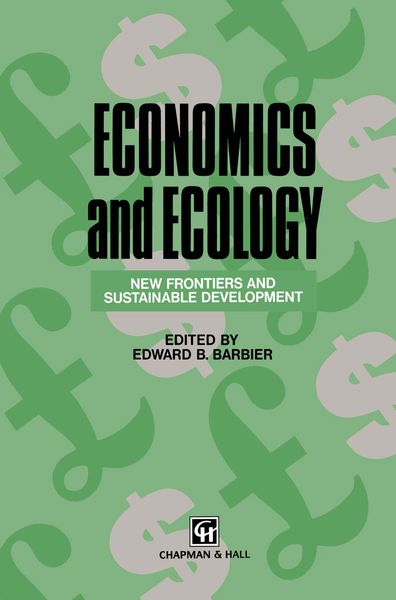
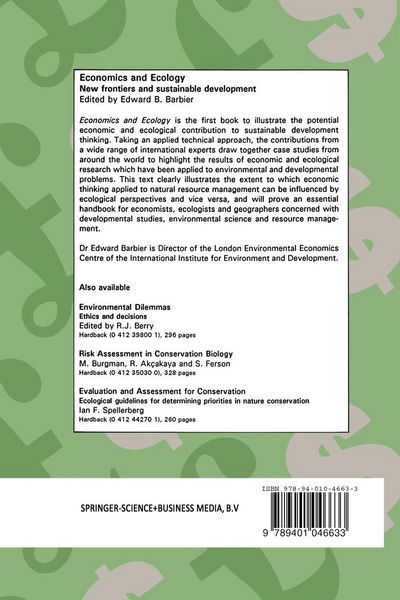
Economics and Ecology New frontiers and sustainable development

99,99 €

inkl. gesetzl. MwSt., Versandkostenfrei


Beschreibung

Produktdetails

Einband

Taschenbuch

Erscheinungsdatum

25.09.2012

Herausgeber

Edward B. Barbier

Verlag

Springer Netherland

Seitenzahl

205

Maße (L/B/H)

23,5/15,5/1,3 cm

Gewicht

347 g

Auflage

1. Auflage

Sprache

Englisch

ISBN

978-94-010-4663-3

Beschreibung

Rezension

Interesting and useful - Integrated Environmental Management

Portrait

Edward B. Barbier is the John S. Bugas Professor of Economics in the Department of Economics and Finance, University of Wyoming. He has over twenty-five years of experience as an environmental and resource economist, working mainly on the economics of environment and development issues. He is the author of many books on environmental policy.

Produktdetails

Einband

Taschenbuch

Erscheinungsdatum

25.09.2012

Herausgeber

Edward B. Barbier

Verlag

Springer Netherland

Seitenzahl

205

Maße (L/B/H)

23,5/15,5/1,3 cm

Gewicht

347 g

Auflage

1. Auflage

Sprache

Englisch

ISBN

978-94-010-4663-3

Herstelleradresse

Springer-Verlag KG
Sachsenplatz 4-6
1201 Wien
AT

Email: GPSR Kontakt

Noch keine Bewertungen vorhanden

Verfassen Sie die erste Bewertung zu diesem Artikel

Helfen Sie anderen Kundinnen und Kunden durch Ihre Meinung.

Kundinnen und Kunden meinen

Bewertungen (0)

  • Produktbild: Economics and Ecology
  • Produktbild: Economics and Ecology
  • 1 Introduction: economics and ecology – the next frontier.- 1.1 A short parable.- 1.2 Natural capital, economics and ecology in development.- 1.3 Outline of the book.- References.- 2 Environmentally sustainable development: Optimal economic conditions.- 2.1 Introduction.- 2.2 A model of environmentally sustainable economic activity.- 2.3 Optimal sustainable economic growth.- 2.4 Conclusions.- References.- 3 Ecological economic systems analysis: Order and chaos.- 3.1 What is systems analysis?.- 3.2 Scientific uncertainty: beyond risk, into the abyss.- 3.3 Conclusions.- Acknowledgements.- References.- 4 Sustainable agriculture: The trade-offs with productivity, stability and equitability.- 4.1 Introduction.- 4.2 Agroecosystems.- 4.3 The measurement of agroecosystem properties.- 4.4 Trade-offs.- 4.5 Conclusions.- References.- 5 Stress, shock and the sustainability of optimal resource utilization in a stochastic environment.- 5.1 Introduction.- 5.2 An ecological model.- 5.3 The management problem.- 5.4 A simulation.- 5.5 The economic environment and ecological stress.- 5.6 Stress, shock and the discount rate.- 5.7 Conclusions.- References.- 6 Economic and ecological carrying capacity: Applications to pastoral systems in Zimbabwe.- 6.1 Introduction.- 6.2 The productivity of CA cattle: What is the economic CC?.- 6.3 Ecological sustainability: Limits to livestock numbers in CAs.- 6.4 Investigating land degradation.- 6.5 The determinants of ecological CC: How do cattle survive in CAs?.- 6.6 Livestock management in variable environments: Some policy implications.- 6.7 Conclusions.- Acknowledgements.- Archival sources.- References.- 7 Tropical forests and biodiversity conservation: A new ecological imperative.- 7.1 What is biodiversity?.- 7.2 What do we know aboutbiodiversity?.- 7.3 The role of tropical forests as ‘sources’ of global biodiversity.- 7.4 Interpretations of biodiversity for planning.- 7.5 Issues concerning biodiversity and tropical forests.- 7.6 Empirical efforts to research and resolve these issues.- 7.7 Conclusion.- References.- 8 Optimal economic growth and the conservation of biological diversity.- 8.1 Introduction.- 8.2 The species-area relation.- 8.3 The model.- 8.4 Solution to the autonomous control problem.- 8.5 Solution to the nonautonomous control problem.- 8.6 Conclusions.- Acknowledgements.- References.- 9 The viewing value of elephants.- 9.1 Introduction.- 9.2 The viewing value of elephants.- 9.3 Contingent valuation method.- 9.4 Safari expenditures in Kenya.- References.- 10 Ecology and economics in small islands: Constructing a framework for sustainable development.- 10.1 Introduction.- 10.2 The vulnerabilities of island economies and island ecologies.- 10.3 Islands as opportunities for sustainable development.- 10.4 Frameworks for sustainable development.- References.- 11 Sustainable economic development: Economic and ethical principles.- 11.1 Introduction.- 11.2 Weak and strong sustainability paradigms.- 11.3 The valuation of environmental resources.- 11.4 Sustainability and ethics.- 11.5 Conclusions.- References.- 12 Postscript.- References.