KI-Beratung Beta

Gutscheinbedingungen

**Gültig bis 18.11.2026 auf englischsprachige Klassiker (klassiker-32728) online auf thalia.at und in der Thalia App. Einzelne Artikel können ausgeschlossen sein. Ausgenommen sind preisgebundene Artikel & eBooks. Pro Einkauf einmal einlösbar. Click & Collect nur bei Onlinevorabzahlung möglich. Keine Barauszahlung. Nicht kombinierbar mit anderen Aktionen und Gutscheinen. Gutschein wird auf max. 500€ Bestellwert angerechnet. Nicht gültig für Geschenkkarten, Versandkosten und Services.

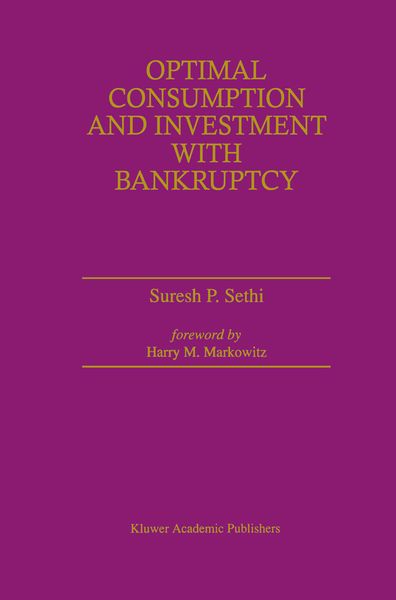
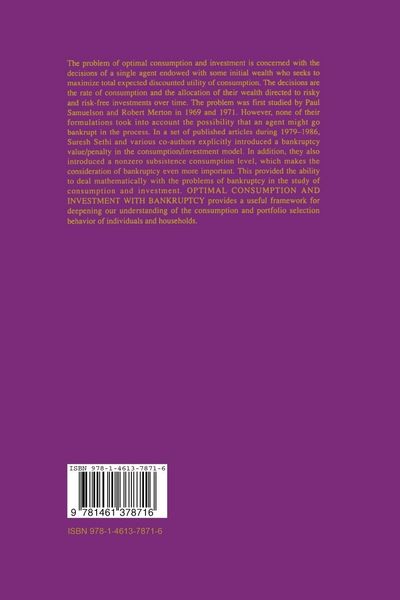
  • Produktbild: Optimal Consumption and Investment with Bankruptcy
  • Produktbild: Optimal Consumption and Investment with Bankruptcy
  • Produktbild: Optimal Consumption and Investment with Bankruptcy
- 12%

Optimal Consumption and Investment with Bankruptcy

12% sparen

144,99 € UVP 164,99 €

inkl. gesetzl. MwSt., Versandkostenfrei


Beschreibung

This book presents papers on continuous-time consumption investment models by Suresh Sethi and various co-authors. Sir Isaac Newton said that he saw so far because he stood on the shoulders of gi ants. Giants upon whose shoulders Professor Sethi and colleagues stand are Robert Merton, particularly Merton's...

Beschreibung

This book presents papers on continuous-time consumption investment models by Suresh Sethi and various co-authors. Sir Isaac Newton said that he saw so far because he stood on the shoulders of gi ants. Giants upon whose shoulders Professor Sethi and colleagues stand are Robert Merton, particularly Merton's (1969, 1971, 1973) seminal papers, and Paul Samuelson, particularly Samuelson (1969). Karatzas, Lehoczky, Sethi and Shreve (1986), henceforth KLSS, re produced here as Chapter 2, reexamine the model proposed by Mer ton. KLSS use methods of modern mathematical analysis, taking care to prove the existence of integrals, check the existence and (where appro priate) the uniqueness of solutions to equations, etc. KLSS find that un der some conditions Merton's solution is correct; under others, it is not. In particular, Merton's solution for aHARA utility-of-consumption is correct for some parameter values and not for others. The problem with Merton's solution is that it sometimes violates the constraints against negative wealth and negative consumption stated in Merton (1969) and presumably applicable in Merton (1971 and 1973). This not only affects the solution at the zero-wealth, zero-consumption boundaries, but else where as well. Problems with Merton's solution are analyzed in Sethi and Taksar (1992), reproduced here as Chapter 3.

Produktdetails

Einband

Taschenbuch

Erscheinungsdatum

10.10.2012

Abbildungen

XX, 428 p.

Verlag Springer Us

Produktdetails

Einband

Taschenbuch

Erscheinungsdatum

10.10.2012

Abbildungen

XX, 428 p.

Verlag Springer Us
Seitenzahl

428

Maße (L/B/H)

23,5/15,5/2,5 cm

Gewicht

680 g

Auflage

Softcover reprint of the original 1st ed. 1997

Sprache

Englisch

ISBN

978-1-4613-7871-6

Herstelleradresse

Springer-Verlag KG
Sachsenplatz 4-6
1201 Wien
AT

Email: ProductSafety@springernature.com

Noch keine Bewertungen vorhanden

Verfassen Sie die erste Bewertung zu diesem Artikel

Helfen Sie anderen Kundinnen und Kunden durch Ihre Meinung.

Kundinnen und Kunden meinen

Bewertungen (0)

  • Produktbild: Optimal Consumption and Investment with Bankruptcy
  • Produktbild: Optimal Consumption and Investment with Bankruptcy
  • Produktbild: Optimal Consumption and Investment with Bankruptcy
  • I. Introduction.- 1. Consumption/Investment Problems.- II. Models with Constant Market Parameters and Nonnegative Consumption.- 2. Explicit Solution of a General Consumption/Investment Problem.- 3. A Note on Merton’s “Optimum Consumption and Portfolio Rules in a Continuous-time Model”.- 4. Infinite-Horizon Investment Consumption Model with a Nonterminal Bankruptcy.- 5. Risk-Aversion Behavior in Consumption/Investment Problems.- III: Models with Constant Market Parameters and Positive Subsistence Consumption.- 6. Explicit Solution of a General Consumption/Portfolio Problem with Subsistence Consumption and Bankruptcy.- 7. Distribution of Bankruptcy Time in a Consumption/Portfolio Problem.- 8. Risk-Aversion Behavior in Consumption/Investment Problems with Subsistence Consumption.- 9. Consumption Behavior in Investment/Consumption Problems.- 10. Equivalence of Objective Functionals in Infinite Horizon and Random Horizon Problems.- 11. A Contribution to the Micro Foundation for Keynesian Macroeconomic Models.- IV: Models with More General Markets and Positive Subsistence Consumption.- 12. The Consumption-Investment Problem with Subsistence Consumption, Bankruptcy, and Random Market Coefficients.- V: Models with Constant Market Parameters, Positive Subsistence Consumption and Borrowing/Shortselling Constraints.- 13. Optimal Dynamic Consumption and Portfolio Planning in a Welfare State.- 14. Optimal Consumption and Investment Policies Allowing Consumption Constraints, Bankruptcy and Welfare.- 15. A Martingale Formulation for Optimal Consumption/Investment Decision Making.- VI: Conclusions.- 16. Concluding Remarks and Open Research Problems.- Author Index.- Copyright Permissions.