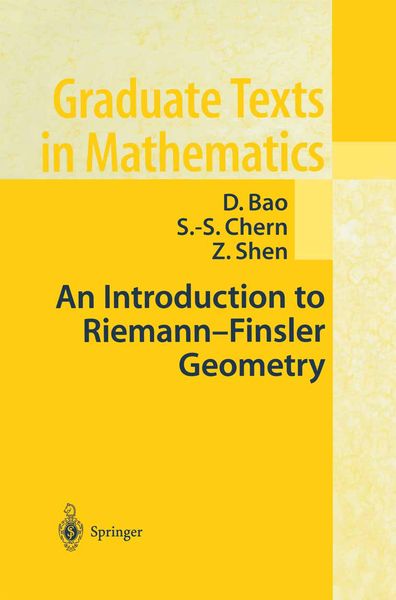
• Produktbild: An Introduction to Riemann-Finsler Geometry
  • Produktbild: An Introduction to Riemann-Finsler Geometry
Band 200 - 11%

An Introduction to Riemann-Finsler Geometry

11% sparen

62,99 € UVP 71,49 €

inkl. gesetzl. MwSt., Versandkostenfrei


Rezension

"This book offers the most modern treatment of the topic and will attract both graduate students and a broad community of mathematicians from various related fields."

EMS Newsletter, Issue 41, September 2001

Produktdetails

Einband

Taschenbuch

Erscheinungsdatum

03.10.2012

Verlag

Springer Us

Seitenzahl

435

Maße (L/B/H)

23,5/15,5/2,5 cm

Gewicht

692 g

Auflage

Softcover reprint of the original 1st ed. 2000

Sprache

Englisch

ISBN

978-1-4612-7070-6

Rezension

Produktdetails

Einband

Taschenbuch

Erscheinungsdatum

03.10.2012

Verlag

Springer Us

Seitenzahl

435

Maße (L/B/H)

23,5/15,5/2,5 cm

Gewicht

692 g

Auflage

Softcover reprint of the original 1st ed. 2000

Sprache

Englisch

ISBN

978-1-4612-7070-6

Herstelleradresse

Springer-Verlag KG
Sachsenplatz 4-6
1201 Wien
AT

Email: GPSR Kontakt

Noch keine Bewertungen vorhanden

Verfassen Sie die erste Bewertung zu diesem Artikel

Helfen Sie anderen Kundinnen und Kunden durch Ihre Meinung.

Kundinnen und Kunden meinen

Bewertungen (0)

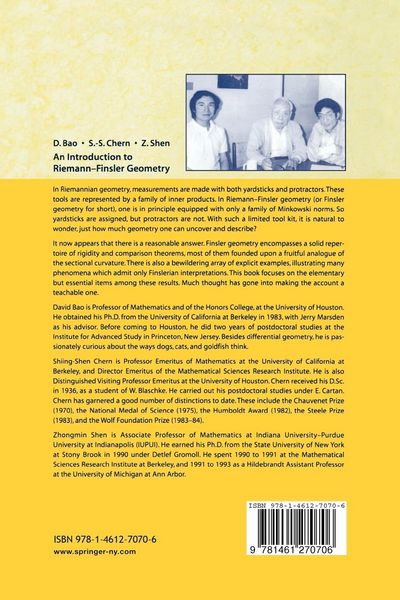
  • Produktbild: An Introduction to Riemann-Finsler Geometry
  • Produktbild: An Introduction to Riemann-Finsler Geometry
  • One Finsler Manifolds and Their Curvature.- 1 Finsler Manifolds and the Fundamentals of Minkowski Norms.- 1.0 Physical Motivations.- 1.1 Finsler Structures: Definitions and Conventions.- 1.2 Two Basic Properties of Minkowski Norms.- 1.2 A. Euler’s Theorem.- 1.2 B. A Fundamental Inequality.- 1.2 C. Interpretations of the Fundamental Inequality.- 1.3 Explicit Examples of Finsler Manifolds.- 1.3 A. Minkowski and Locally Minkowski Spaces.- 1.3 B. Riemannian Manifolds.- 1.3 C. Randers Spaces.- 1.3 D. Berwald Spaces.- 1.3 E. Finsler Spaces of Constant Flag Curvature.- 1.4 The Fundamental Tensor and the Cartan Tensor.- * References for Chapter 1.- 2 The Chern Connection.- 2.0 Prologue.- 2.1 The Vector Bundle ?*TM and Related Objects.- 2.2 Coordinate Bases Versus Special Orthonormal Bases.- 2.3 The Nonlinear Connection on the Manifold TM \0.- 2.4 The Chern Connection on ?*TM.- 2.5 Index Gymnastics.- 2.5 A. The Slash (…)s and the Semicolon (…);s.- 2.5 B. Covariant Derivatives of the Fundamental Tensor g.- 2.5 C. Covariant Derivatives of the Distinguished ?.- * References for Chapter 2.- 3 Curvature and Schur’s Lemma.- 3.1 Conventions and the hh-, hv-, vv-curvatures.- 3.2 First Bianchi Identities from Torsion Freeness.- 3.3 Formulas for R and P in Natural Coordinates.- 3.4 First Bianchi Identities from “Almost” g-compatibility.- 3.4 A. Consequences from the $$
    dx^k \wedge dx^l
    $$ Terms.- 3.4 B. Consequences from the $$
    dx^k \wedge \frac{1}
    {F}\delta y^l
    $$ Terms.- 3.4 C. Consequences from the $$
    \frac{1}
    {F}\delta y^k \wedge \frac{1}
    {F}\delta y^l
    $$ Terms.- 3.5 Second Bianchi Identities.- 3.6 Interchange Formulas or Ricci Identities.- 3.7 Lie Brackets among the $$
    \frac{\delta }
    {{\delta x}}
    $$ and the $$
    F\frac{\partial }
    {{\partial y}}
    $$.- 3.8 Derivatives of the Geodesic Spray Coefficients Gi.- 3.9 The Flag Curvature.- 3.9 A. Its Definition and Its Predecessor.- 3.9 B. An Interesting Family of Examples of Numata Type.- 3.10 Schur’s Lemma.- *References for Chapter 3.- 4 Finsler Surfaces and a Generalized Gauss—Bonnet Theorem.- 4.0 Prologue.- 4.1 Minkowski Planes and a Useful Basis.- 4.1 A. Rund’s Differential Equation and Its Consequence.- 4.1 B. A Criterion for Checking Strong Convexity.- 4.2 The Equivalence Problem for Minkowski Planes.- 4.3 The Berwald Frame and Our Geometrical Setup on SM.- 4.4 The Chern Connection and the Invariants I, J, K.- 4.5 The Riemannian Arc Length of the Indicatrix.- 4.6 A Gauss-Bonnet Theorem for Landsberg Surfaces.- *References for Chapter 4.- Two Calculus of Variations and Comparison Theorems.- 5 Variations of Arc Length, Jacobi Fields, the Effect of Curvature.- 5.1 The First Variation of Arc Length.- 5.2 The Second Variation of Arc Length.- 5.3 Geodesics and the Exponential Map.- 5.4 Jacobi Fields.- 5.5 How the Flag Curvature’s Sign Influences Geodesic Rays.- *References for Chapter 5.- 6 The Gauss Lemma and the Hopf-Rinow Theorem.- 6.1 The Gauss Lemma.- 6.1 A. The Gauss Lemma Proper.- 6.1 B. An Alternative Form of the Lemma.- 6.1 C. Is the Exponential Map Ever a Local Isometry?.- 6.2 Finsler Manifolds and Metric Spaces.- 6.2 A. A Useful Technical Lemma.- 6.2 B. Forward Metric Balls and Metric Spheres.- 6.2 C. The Manifold Topology Versus the Metric Topology.- 6.2 D. Forward Cauchy Sequences, Forward Completeness.- 6.3 Short Geodesics Are Minimizing.- 6.4 The Smoothness of Distance Functions.- 6.4 A. On Minkowski Spaces.- 6.4 B. On Finsler Manifolds.- 6.5 Long Minimizing Geodesies.- 6.6 The Hopf-Rinow Theorem.- *References for Chapter 6.- 7 The Index Form and the Bonnet-Myers Theorem.- 7.1 Conjugate Points.- 7.2 The Index Form.- 7.3 What Happens in the Absence of Conjugate Points?.- 7.3 A. Geodesies Are Shortest Among “Nearby” Curves.- 7.3 B. A Basic Index Lemma.- 7.4 What Happens If Conjugate Points Are Present?.- 7.5 The Cut Point Versus the First Conjugate Point.- 7.6 Ricci Curvatures.- 7.6 A. The Ricci Scalar Ric and the Ricci Tensor Ricij.- 7.6 B. The Interplay between Ric and RiCij.- 7.7 The Bonnet-Myers Theorem.- *References for Chapter 7.- 8 The Cut and Conjugate Loci, and Synge’s Theorem.- 8.1 Definitions.- 8.2 The Cut Point and the First Conjugate Point.- 8.3 Some Consequences of the Inverse Function Theorem.- 8.4 The Manner in Which cy and iy Depend on y.- 8.5 Generic Properties of the Cut Locus Cutx.- 8.6 Additional Properties of Cutx When M Is Compact.- 8.7 Shortest Geodesics within Homotopy Classes.- 8.8 Synge’s Theorem.- *References for Chapter 8.- 9 The Cartan-Hadamard Theorem and Rauch’s First Theorem.- 9.1 Estimating the Growth of Jacobi Fields.- 9.2 When Do Local Diffeomorphisms Become Covering Maps?.- 9.3 Some Consequences of the Covering Homotopy Theorem.- 9.4 The Cartan-Hadamard Theorem.- 9.5 Prelude to Rauch’s Theorem.- 9.5 A. Transplanting Vector Fields.- 9.5 B. A Second Basic Property of the Index Form.- 9.5 C. Flag Curvature Versus Conjugate Points.- 9.6 Rauch’s First Comparison Theorem.- 9.7 Jacobi Fields on Space Forms.- 9.8 Applications of Rauch’s Theorem.- *References for Chapter 9.- Three Special Finsler Spaces over the Reals.- 10 Berwald Spaces and Szabó’s Theorem for Berwald Surfaces.- 10.0 Prologue.- 10.1 Berwald Spaces.- 10.2 Various Characterizations of Berwald Spaces.- 10.3 Examples of Berwald Spaces.- 10.4 A Fact about Flat Linear Connections.- 10.5 Characterizing Locally Minkowski Spaces by Curvature.- 10.6 Szabó’s Rigidity Theorem for Berwald Surfaces.- 10.6 A. The Theorem and Its Proof.- 10.6 B. Distinguishing between y-local and y-global.- *References for Chapter 10.- 11 Randers Spaces and an Elegant Theorem.- 11.0 The Importance of Randers Spaces.- 11.1 Randers Spaces, Positivity, and Strong Convexity.- 11.2 A Matrix Result and Its Consequences.- 11.3 The Geodesic Spray Coefficients of a Randers Metric.- 11.4 The Nonlinear Connection for Randers Spaces.- 11.5 A Useful and Elegant Theorem.- 11.6 The Construction of y-global Berwald Spaces.- 11.6 A. The Algorithm.- 11.6 B. An Explicit Example in Three Dimensions.- *References for Chapter 11 309.- 12 Constant Flag Curvature Spaces and Akbar-Zadeh’s Theorem.- 12.0 Prologue.- 12.1 Characterizations of Constant Flag Curvature.- 12.2 Useful Interpretations of ? and Ë.- 12.3 Growth Rates of Solutions of Ë + ? E = 0.- 12.4 Akbar-Zadeh’s Rigidity Theorem.- 12.5 Formulas for Machine Computations of K.- 12.5 A. The Geodesic Spray Coefficients.- 12.5 B. The Predecessor of the Flag Curvature.- 12.5 C. Maple Codes for the Gaussian Curvature.- 12.6 A Poincaré Disc That Is Only Forward Complete.- 12.6 A. The Example and Its Yasuda-Shimada Pedigree.- 12.6 B. The Finsler Function and Its Gaussian Curvature.- 12.6 C. Geodesics; Forward and Backward Metric Discs.- 12.6 D. Consistency with Akbar-Zadeh’s Rigidity Theorem.- 12.7 Non-Riemannian Projectively Flat S2 with K = 1.- 12.7 A. Bryant’s 2-parameter Family of Finsler Structures.- 12.7 B. A Specific Finsler Metric from That Family.- *References for Chapter 12 350.- 13 Riemannian Manifolds and Two of Hopf’s Theorems.- 13.1 The Levi-Civita (Christoffel) Connection.- 13.2 Curvature.- 13.2 A. Symmetries, Bianchi Identities, the Ricci Identity.- 13.2 B. Sectional Curvature.- 13.2 C. Ricci Curvature and Einstein Metrics.- 13.3Warped Products and Riemannian Space Forms.- 13.3 A. One Special Class of Warped Products.- 13.3 B. Spheres and Spaces of Constant Curvature.- 13.3 C. Standard Models of Riemannian Space Forms.- 13.4 Hopf’s Classification of Riemannian Space Forms.- 13.5 The Divergence Lemma and Hopf’s Theorem.- 13.6 The Weitzenböck Formula and the Bochner Technique.- *References for Chapter 13.- 14 Minkowski Spaces, the Theorems of Deicke and Brickell.- 14.1 Generalities and Examples.- 14.2 The Riemannian Curvature of Each Minkowski Space.- 14.3 The Riemannian Laplacian in Spherical Coordinates.- 14.4 Deicke’s Theorem.- 14.5 The Extrinsic Curvature of the Level Spheres of F.- 14.6 The Gauss Equations.- 14.7 The Blaschke-Santaló Inequality.- 14.8 The Legendre Transformation.- 14.9 A Mixed-Volume Inequality, and Brickell’s Theorem.- * References for Chapter 14.