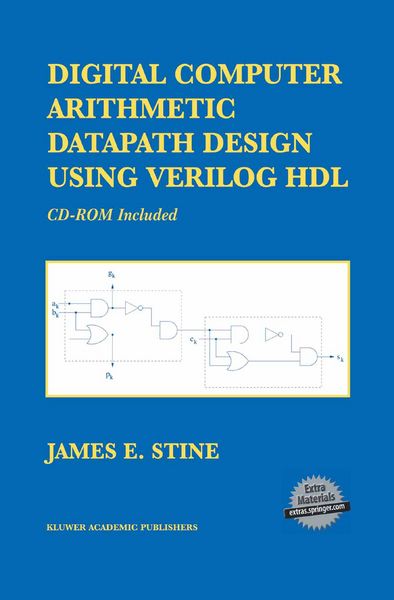
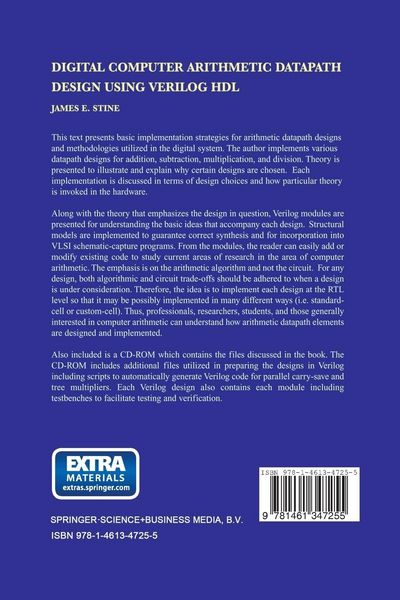
• Produktbild: Digital Computer Arithmetic Datapath Design Using Verilog HDL
  • Produktbild: Digital Computer Arithmetic Datapath Design Using Verilog HDL

Digital Computer Arithmetic Datapath Design Using Verilog HDL

99,99 €

inkl. gesetzl. MwSt., Versandkostenfrei


Beschreibung

Produktdetails

Einband

Taschenbuch

Erscheinungsdatum

04.10.2012

Abbildungen

XI, 181 p. With online files/update.

Verlag

Springer Us

Seitenzahl

181

Maße (L/B/H)

23,5/15,5/1,1 cm

Gewicht

306 g

Auflage

Softcover reprint of the original 1st edition 2004

Sprache

Englisch

ISBN

978-1-4613-4725-5

Beschreibung

Rezension

From the reviews:


"This book concentrates on basic implementation strategies for arithmetic datapath designs. It shows how to write efficient Verilog code to describe the arithmetic circuits. … The main objective of this small and nice book is to provide a good understanding of the arithmetic specifics of algorithms and points to their implementation strategies and methodologies used in the design of datapaths. … The book is well written and readers, using it, will enjoy … . All in all, I highly recommend this book." (Mile Stojcev, Microelectronics Reliability, Vol. 45, 2005)

Produktdetails

Einband

Taschenbuch

Erscheinungsdatum

04.10.2012

Abbildungen

XI, 181 p. With online files/update.

Verlag

Springer Us

Seitenzahl

181

Maße (L/B/H)

23,5/15,5/1,1 cm

Gewicht

306 g

Auflage

Softcover reprint of the original 1st edition 2004

Sprache

Englisch

ISBN

978-1-4613-4725-5

Herstelleradresse

Springer-Verlag GmbH
Tiergartenstr. 17
69121 Heidelberg
DE

Email: ProductSafety@springernature.com

Noch keine Bewertungen vorhanden

Verfassen Sie die erste Bewertung zu diesem Artikel

Helfen Sie anderen Kundinnen und Kunden durch Ihre Meinung.

Kundinnen und Kunden meinen

Bewertungen (0)

  • Produktbild: Digital Computer Arithmetic Datapath Design Using Verilog HDL
  • Produktbild: Digital Computer Arithmetic Datapath Design Using Verilog HDL
  • 1. Motivation.- 2. Verilog At The RTL Level.- 3. Addition.- 4. Multiplication.- 5. Division Using Recurrence.- 6. Elementary Functions.- 7. Division Using Multiplicative-Based Methods.- References.