
KI-Beratung Beta

  • Produktbild: Nonlinearities and Synchronization in Musical Acoustics and Music Psychology
  • Produktbild: Nonlinearities and Synchronization in Musical Acoustics and Music Psychology
Band 2 - 12%

Nonlinearities and Synchronization in Musical Acoustics and Music Psychology

12% sparen

144,99 € UVP 164,99 €

inkl. gesetzl. MwSt., Versandkostenfrei


Beschreibung

Nonlinearities are a crucial and founding principle in nearly all musical systems, may they be musical instruments, timbre or rhythm perception and production, or neural networks of music perception. This volume gives an overview about present and past research in these fields. In Musical Acoustics,...

Beschreibung

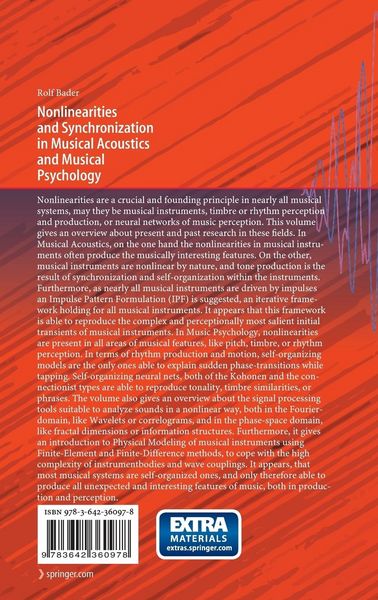
Nonlinearities are a crucial and founding principle in nearly all musical systems, may they be musical instruments, timbre or rhythm perception and production, or neural networks of music perception. This volume gives an overview about present and past research in these fields. In Musical Acoustics, on the one hand the nonlinearities in musical instruments often produce the musically interesting features. On the other, musical instruments are nonlinear by nature, and tone production is the result of synchronization and self-organization within the instruments. Furthermore, as nearly all musical instruments are driven by impulses an Impulse Pattern Formulation (IPF) is suggested, an iterative framework holding for all musical instruments. It appears that this framework is able to reproduce the complex and perceptionally most salient initial transients of musical instruments. In Music Psychology, nonlinearities are present in all areas of musical features, like pitch, timbre, or rhythm perception. In terms of rhythm production and motion, self-organizing models are the only ones able to explain sudden phase-transitions while tapping. Self-organizing neural nets, both of the Kohonen and the connectionist types are able to reproduce tonality, timbre similarities, or phrases. The volume also gives an overview about the signal processing tools suitable to analyze sounds in a nonlinear way, both in the Fourier-domain, like Wavelets or correlograms, and in the phase-space domain, like fractal dimensions or information structures. Furthermore, it gives an introduction to Physical Modeling of musical instruments using Finite-Element and Finite-Difference methods, to cope with the high complexity of instrument bodies and wave couplings. It appears, that most musical systems are self-organized ones, and only therefore able to produce all unexpected and interesting features of music, both in production and perception.

Produktdetails

Einband

Gebundene Ausgabe

Erscheinungsdatum

02.02.2013

Abbildungen

XXXI, 458 p. 202 illus., 28 illus. in color.

Verlag Springer Berlin

Produktdetails

Einband

Gebundene Ausgabe

Erscheinungsdatum

02.02.2013

Abbildungen

XXXI, 458 p. 202 illus., 28 illus. in color.

Verlag Springer Berlin
Seitenzahl

458

Maße (L/B/H)

24,1/16/3,1 cm

Gewicht

847 g

Auflage

2013

Sprache

Englisch

ISBN

978-3-642-36097-8

Herstelleradresse

Spektrum-Akademischer Vlg
Slevogtstraße 3-5
69126 Heidelberg
DE

Email: ProductSafety@springernature.com

Noch keine Bewertungen vorhanden

Verfassen Sie die erste Bewertung zu diesem Artikel

Helfen Sie anderen Kundinnen und Kunden durch Ihre Meinung.

Kundinnen und Kunden meinen

Bewertungen (0)

  • Produktbild: Nonlinearities and Synchronization in Musical Acoustics and Music Psychology
  • Produktbild: Nonlinearities and Synchronization in Musical Acoustics and Music Psychology
  • Introduction.- Signal Processing.- Frequency Representations.- Embedding Representations.- Physical Modelling.- Musical Acoustics.- Musical Instruments.- Impulse Pattern Formulation.- Examples of Impulse Pattern Formulation.- Music Psychology.- Psychoacoustic.- Timbre.- Rhythm.- Pitch, Melody, Tonality.- CD Tracks.