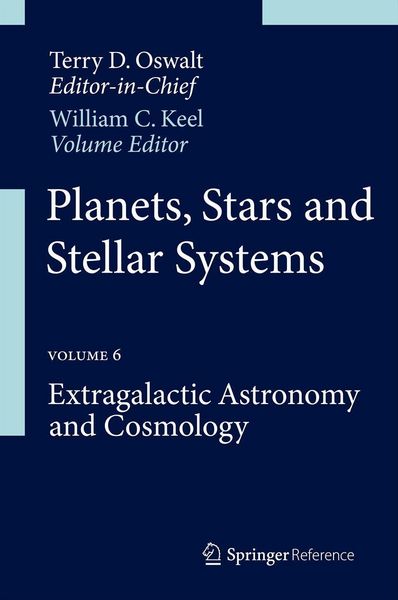
Planets, Stars and Stellar Systems: Volume 6: Extragalactic Astronomy and Cosmology
-
- Englisch ausgewählt
-
Auflage:2013
- 2013 928,99 €
- 2013 928,99 €
- 2013 928,99 € ausgewählt
- 2013 986,99 €
928,99 €
inkl. gesetzl. MwSt.,
Portrait
Dr. Terry D. Oswalt, an astronomer, is Head of the Department of Physics and Space Sciences and Associate Provost for Research at Florida Institute of Technology. He has also served the U.S. National Science Foundation as program officer for Stellar Astronomy and Astrophysics. He earned his Ph.D. in Astronomy at The Ohio State University specializing in photoelectric and spectroscopic studies of binary star systems, late stages of stellar evolution, minor planets, and comets.
Since coming to Florida Tech in 1982, Dr. Oswalt has taught astronomy and physics, while continuing his primary research interest in studies of collapsed stars called white dwarfs. Because such objects are very faint, this work often takes him to Kitt Peak National Observatory in Arizona, Cerro Tololo Inter-American Observatory in Chile, and Mauna Kea Observatory in Hawaii, where telescopes as large as 10-meters are available on a competitive basis to scientists.
Oswalt is the founding Chairman of the Southeast Association for Research in Astronomy, a consortium of 10 universities which operates an automated 1-meter telescope at Kitt Peak National Observatory near Tucson, Arizona. In 2007 SARA will assume operations of a similar telescope at Cerro Tololo Interamerican Observatory in Chile. Oswalt also has been director of the SARA summer internship program, which brings undergraduate students from around the U.S. to the SARA facility at Kitt Peak each summer to do research in astronomy. Dr. Oswalt has written over 100 scientific articles and edits the I.A.P.P.P. Communications, an international journal for advanced amateurs, students, teachers and professionals who collaborate on research and educational projects in astronomy. He is also the editor for a three-volume set of Springer books, "The Future of Small Telescopes in the New Millennium".
William C. Keel is Professor of Astronomy at the University of Alabama in Tuscaloosa. His astronomical interests began as a youngster using a secondhand reflector in the back yard, and he remains active as an amateur as well as professional astronomer. His undergraduate work was at Vanderbilt University, followed by a Ph.D. from the University of California, Santa Cruz. Dr. Keel had postdoctoral positions at Kitt Peak National Observatory and at Leiden, before taking up a faculty position in Alabama.His research interests span the galaxies - active galactic nuclei, galaxy interactions and evolution, dust in galaxies. Observationally oriented, his work has used spectral bands from the radio to the X-ray regimes, with the strongest emphasis in the optical and ultraviolet.These results have been reported in 150 refereed papers. In recent years, much of his work has been tied to the enormously successful Galaxy Zoo citizen-science project. He continues to have scheduling responsibilities for the two telescopes of the SARA consortium, and has served on numerous NASA review panels including two Senior Reviews. Dr. Keel has been active in outreach beyond the formal classroom, through magazine articles, an online presence in several discussion forums, and webcomics explaining ongoing Hubble Space Telescope programs. He has written a technical monograph, The Road to Galaxy Formation, and the nontechnical volumeThe Sky at Einstein’s Feet tracing the impact of relativity throughout astronomy.
Produktdetails
Einband
Gebundene Ausgabe
Erscheinungsdatum
27.03.2013
Herausgeber
William C. KeelVerlag
Springer NetherlandSeitenzahl
690
Auflage
2013
Sprache
Englisch
ISBN
978-94-007-5610-6
Dr. Terry D. Oswalt, an astronomer, is Head of the Department of Physics and Space Sciences and Associate Provost for Research at Florida Institute of Technology. He has also served the U.S. National Science Foundation as program officer for Stellar Astronomy and Astrophysics. He earned his Ph.D. in Astronomy at The Ohio State University specializing in photoelectric and spectroscopic studies of binary star systems, late stages of stellar evolution, minor planets, and comets.
Since coming to Florida Tech in 1982, Dr. Oswalt has taught astronomy and physics, while continuing his primary research interest in studies of collapsed stars called white dwarfs. Because such objects are very faint, this work often takes him to Kitt Peak National Observatory in Arizona, Cerro Tololo Inter-American Observatory in Chile, and Mauna Kea Observatory in Hawaii, where telescopes as large as 10-meters are available on a competitive basis to scientists.
Oswalt is the founding Chairman of the Southeast Association for Research in Astronomy, a consortium of 10 universities which operates an automated 1-meter telescope at Kitt Peak National Observatory near Tucson, Arizona. In 2007 SARA will assume operations of a similar telescope at Cerro Tololo Interamerican Observatory in Chile. Oswalt also has been director of the SARA summer internship program, which brings undergraduate students from around the U.S. to the SARA facility at Kitt Peak each summer to do research in astronomy. Dr. Oswalt has written over 100 scientific articles and edits the I.A.P.P.P. Communications, an international journal for advanced amateurs, students, teachers and professionals who collaborate on research and educational projects in astronomy. He is also the editor for a three-volume set of Springer books, "The Future of Small Telescopes in the New Millennium".
William C. Keel is Professor of Astronomy at the University of Alabama in Tuscaloosa. His astronomical interests began as a youngster using a secondhand reflector in the back yard, and he remains active as an amateur as well as professional astronomer. His undergraduate work was at Vanderbilt University, followed by a Ph.D. from the University of California, Santa Cruz. Dr. Keel had postdoctoral positions at Kitt Peak National Observatory and at Leiden, before taking up a faculty position in Alabama.His research interests span the galaxies - active galactic nuclei, galaxy interactions and evolution, dust in galaxies. Observationally oriented, his work has used spectral bands from the radio to the X-ray regimes, with the strongest emphasis in the optical and ultraviolet.These results have been reported in 150 refereed papers. In recent years, much of his work has been tied to the enormously successful Galaxy Zoo citizen-science project. He continues to have scheduling responsibilities for the two telescopes of the SARA consortium, and has served on numerous NASA review panels including two Senior Reviews. Dr. Keel has been active in outreach beyond the formal classroom, through magazine articles, an online presence in several discussion forums, and webcomics explaining ongoing Hubble Space Telescope programs. He has written a technical monograph, The Road to Galaxy Formation, and the nontechnical volumeThe Sky at Einstein’s Feet tracing the impact of relativity throughout astronomy.
Noch keine Bewertungen vorhanden
Verfassen Sie die erste Bewertung zu diesem Artikel
Helfen Sie anderen Kundinnen und Kunden durch Ihre Meinung.
Kurze Frage zu unserer Seite
Vielen Dank für Ihr Feedback
Wir nutzen Ihr Feedback, um unsere Produktseiten zu verbessern. Bitte haben Sie Verständnis, dass wir Ihnen keine Rückmeldung geben können. Falls Sie Kontakt mit uns aufnehmen möchten, können Sie sich aber gerne an unseren Kund*innenservice wenden.
zum Kundenservice