• Produktbild: Bioinspired Computation in Combinatorial Optimization
  • Produktbild: Bioinspired Computation in Combinatorial Optimization

Bioinspired Computation in Combinatorial Optimization Algorithms and Their Computational Complexity

Aus der Reihe Natural Computing Series

49,99 €

inkl. gesetzl. MwSt., Versandkostenfrei


Beschreibung

Produktdetails

Einband

Taschenbuch

Erscheinungsdatum

02.01.2013

Verlag

Springer Berlin

Seitenzahl

216

Maße (L/B/H)

23,5/15,5/1,3 cm

Gewicht

353 g

Auflage

2010

Sprache

Englisch

ISBN

978-3-642-26584-6

Beschreibung

Rezension

“A very nice and, with respect to the topics treated, a useful contribution to the literature. The book gives a very appealing introduction into the area of bio-inspired algorithms with solid results on the theoretical side, gathering many recent results which so far only have been available in research papers. … recommendable resource both for researchers who want to learn more on the topic and for preparing a course on bio-inspired algorithms. … Altogether this is a very recommendable textbook.” (Klaus Meer, Mathematical Reviews, February, 2015)

"This timely book will be useful to many researchers and advanced undergraduate and graduate students. The key strength of the book is the complexity analysis of the algorithms for a variety of combinatorial optimization problems on graphs. Furthermore, it provides a comprehensive treatment of evolutionary algorithms and ant colony optimization. The book is recommended to anyone working in the areas of computational complexity, combinatorial optimization, and engineering." (Manish Gupta, Computing Reviews, May, 2011)

“This book treats bio-inspired computing methods as stochastic algorithms and presents rigorous results on their runtime behavior. The book is meant to give researchers a state-of-the-art presentation of theoretical results on bio-inspired computing methods in the context of combinatorial optimization. It can be used as basic material for courses on bio-inspired computing that are meant for graduate students and advanced undergraduates.” (I. N. Katz, Zentralblatt MATH, Vol. 1223, 2011)

Zitat

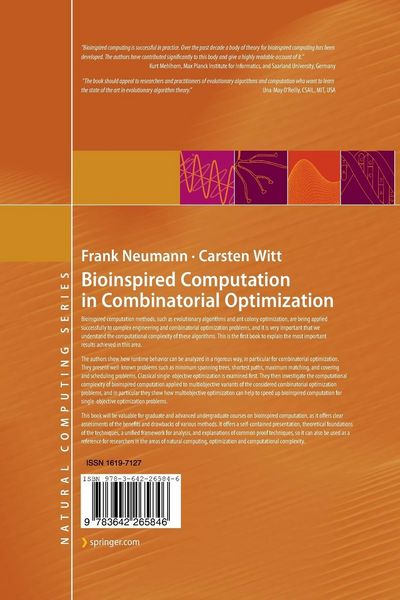
From the reviews: "Bioinspired computing is successful in practice. Over the past decade a body of theory for bioinspired computing has been developed. The authors have contributed significantly to this body and give a highly readable account of it." Kurt Mehlhorn, Max Planck Institute for Informatics, and Saarland University, Germany "Bioinspired algorithms belong to the most powerful methods used to tackle real world optimization problems. This book gives such algorithms a solid foundation. It presents some of the most exciting results that have been obtained in bioinspired computing in the last decade." Zbigniew Michalewicz, University of Adelaide, Australia "This book presents a most welcome theoretical computer science approach and perspective to the design and analysis of discrete evolutionary algorithms. It describes the design and derivation of evolutionary algorithms which have precise computation complexity bounds for combinatorial optimization. The book should appeal to researchers and practitioners of evolutionary algorithms and computation who want to learn the state of the art in evolutionary algorithm theory." Una-May O'Reilly, CSAIL, MIT, USA "The evolutionary computation community has been in need of rigorous results concerning the computational complexity of their approaches for decades. This is the first textbook covering such a fundamental topic. It provides an excellent overview of the state of the art in this research area, in terms of both the results obtained and the analytical methods. It is an indispensable book for everyone who is interested in the foundations of evolutionary computation." Xin Yao, University of Birmingham, UK "This timely book will be useful to many researchers and advanced undergraduate and graduate students. The key strength of the book is the complexity analysis of the algorithms for a variety of combinatorial optimization problems on graphs. Furthermore, it provides a comprehensive treatment of evolutionary algorithms and ant colony optimization. The book is recommended to anyone working in the areas of computational complexity, combinatorial optimization, and engineering." ACM Computing Reviews, Manish Gupta, May 2011 "This book treats bio-inspired computing methods as stochastic algorithms and presents rigorous results on their runtime behavior. The book is meant to give researchers a state-of-the-art presentation of theoretical results on bio-inspired computing methods in the context of combinatorial optimization. It can be used as basic material for courses on bio-inspired computing that are meant for graduate students and advanced undergraduates." (I. N. Katz, Zentralblatt MATH, Vol. 1223, 2011)

Produktdetails

Einband

Taschenbuch

Erscheinungsdatum

02.01.2013

Verlag

Springer Berlin

Seitenzahl

216

Maße (L/B/H)

23,5/15,5/1,3 cm

Gewicht

353 g

Auflage

2010

Sprache

Englisch

ISBN

978-3-642-26584-6

Herstelleradresse

Springer-Verlag GmbH
Tiergartenstr. 17
69121 Heidelberg
DE

Email: ProductSafety@springernature.com

Kundinnen und Kunden meinen

0 Bewertungen

Informationen zu Bewertungen

Zur Abgabe einer Bewertung ist eine Anmeldung im Konto notwendig. Die Authentizität der Bewertungen wird von uns nicht überprüft. Wir behalten uns vor, Bewertungstexte, die unseren Richtlinien widersprechen, entsprechend zu kürzen oder zu löschen.

Die Bewertungen sind nach Format, Anzahl Sterne und Datum sortiert.

Verfassen Sie die erste Bewertung zu diesem Artikel

Helfen Sie anderen Kund*innen durch Ihre Meinung

Kundinnen und Kunden meinen

0 Bewertungen filtern

  • Produktbild: Bioinspired Computation in Combinatorial Optimization
  • Produktbild: Bioinspired Computation in Combinatorial Optimization
  • Basics.- Combinatorial Optimization and Computational Complexity.- Stochastic Search Algorithms.- Analyzing Stochastic Search Algorithms.- Single-objective Optimization.- Minimum Spanning Trees.- Maximum Matchings.- Makespan Scheduling.- Shortest Paths.- Eulerian Cycles.- Multi-objective Optimization.- Multi-objective Minimum Spanning Trees.- Minimum Spanning Trees Made Easier.- Covering Problems.- Cutting Problems.