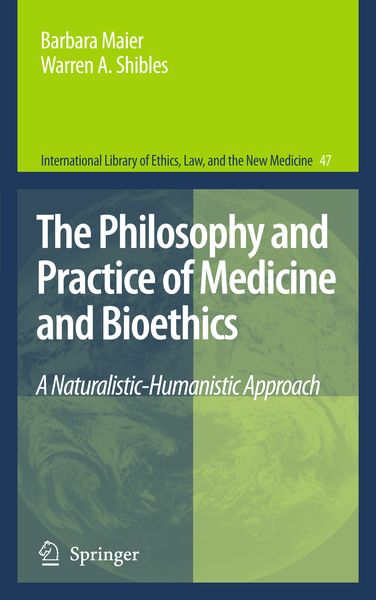
Produktbild: The Philosophy and Practice of Medicine and Bioethics
Band 47 - 12%

The Philosophy and Practice of Medicine and Bioethics A Naturalistic-Humanistic Approach

12% sparen

192,99 € UVP 219,99 €

inkl. gesetzl. MwSt., Versandkostenfrei


Beschreibung

Produktdetails

Einband

Taschenbuch

Erscheinungsdatum

02.01.2013

Verlag

Springer Netherland

Seitenzahl

543

Maße (L/B/H)

23,5/15,5/3,1 cm

Gewicht

855 g

Auflage

1. Auflage

Sprache

Englisch

ISBN

978-94-007-3408-1

Beschreibung

Rezension

From the reviews:

“The Philosophy and Practice of Medicine and Bioethics, it provides an overview of the crucial issues being faced in medical practice, replete with interesting case studies and patient-care narratives … . The authors repeatedly encourage good, open communication between patients and healthcare workers as well as between healthcare professionals and management staff. They also advocate constructive dialogue and human relationships based on trust, which are surely relevant aspects of what a philosophy of medicine must promote.” (Francesca Marin, Theoretical Medicine and Bioethics, Vol. 34, 2013)

“This book advocates a philosophy of medicine founded on humanism and naturalism. … a philosophical work providing an honest, detailed, analytical inquiry of prevailing concepts and methods used in medicine. … The book, a mixture of philosophical argument, opinions, case studies, and patient-care narratives from the authors’ experience, is best appreciated … . I found this book to be an informative read … . most understood and best appreciated by academics in moral philosophy and ethics … . the book is surely worth the effort.” (Andrew R. Barnosky, Journal of the American Medical Association, Vol. 306 (8), August, 2011)

“The purpose is to present a ‘naturalistic, practical, pragmatic, consequentialistic, and humanistic theory of ethics,’ to apply this to the philosophy of medicine, and to examine existing bioethical arguments in light of this theory. A systematic approach to this topic is quite welcome. … the book will be helpful to practitioners, and … healthcare workers (and everyone else) would benefit greatly from paying greater attention to philosophical ethics. … Readers sympathetic to naturalistic and humanistic philosophies are the most likely to find this work helpful.” (D. Robert MacDougall, Doody’s Review Service, February, 2011)

Zitat

From the reviews: "The purpose is to present a 'naturalistic, practical, pragmatic, consequentialistic, and humanistic theory of ethics,' to apply this to the philosophy of medicine, and to examine existing bioethical arguments in light of this theory. A systematic approach to this topic is quite welcome. ... the book will be helpful to practitioners, and ... healthcare workers (and everyone else) would benefit greatly from paying greater attention to philosophical ethics. ... Readers sympathetic to naturalistic and humanistic philosophies are the most likely to find this work helpful." (D. Robert MacDougall, Doody's Review Service, February, 2011) "This book advocates a philosophy of medicine founded on humanism and naturalism. ... a philosophical work providing an honest, detailed, analytical inquiry of prevailing concepts and methods used in medicine. ... The book, a mixture of philosophical argument, opinions, case studies, and patient-care narratives from the authors' experience, is best appreciated ... . I found this book to be an informative read ... . most understood and best appreciated by academics in moral philosophy and ethics ... . the book is surely worth the effort." (Andrew R. Barnosky, Journal of the American Medical Association, Vol. 306 (8), August, 2011)

Produktdetails

Einband

Taschenbuch

Erscheinungsdatum

02.01.2013

Verlag

Springer Netherland

Seitenzahl

543

Maße (L/B/H)

23,5/15,5/3,1 cm

Gewicht

855 g

Auflage

1. Auflage

Sprache

Englisch

ISBN

978-94-007-3408-1

Herstelleradresse

Springer-Verlag GmbH
Tiergartenstr. 17
69121 Heidelberg
DE

Email: ProductSafety@springernature.com

Kundinnen und Kunden meinen

0 Bewertungen

Informationen zu Bewertungen

Zur Abgabe einer Bewertung ist eine Anmeldung im Konto notwendig. Die Authentizität der Bewertungen wird von uns nicht überprüft. Wir behalten uns vor, Bewertungstexte, die unseren Richtlinien widersprechen, entsprechend zu kürzen oder zu löschen.

Die Bewertungen sind nach Format, Anzahl Sterne und Datum sortiert.

Verfassen Sie die erste Bewertung zu diesem Artikel

Helfen Sie anderen Kund*innen durch Ihre Meinung

Kundinnen und Kunden meinen

0 Bewertungen filtern

  • Produktbild: The Philosophy and Practice of Medicine and Bioethics
  • Rationale of the book
    About the Authors

    1. Metaphor in Medicine. The Metaphorical Method
    1.1 Introduction
    1.2 Types of metaphor
    1.2.1 Substitution
    1.2.2 Juxtaposition
    1.2.3 Analogy, Simile, or Comparison
    1.2.4 Symbolism
    1.2.5 Metonymy
    1.2.6 Synecdoche
    1.2.7 Synesthesia
    1.2.8 Reversal
    1.2.9 Personification
    1.2.10 Oxymora or combination of opposites
    1.2.11 Deviation
    1.2.12 Metaphor-to-myth fallacy
    1.3 Metaphorical methods should be considered for analysis of and writing research papers
    1.4. Clarification of medical language
    1.5 Case example: A healthcare worker (H) – patient (P) metaphoric: H/P modeling in medicine
    1.6 H/P models

    2. Definition
    2.1 Where does it come from that we think we need to define?
    2.2 Distinction between types of definition

    3. Decision Making: fallacies and other mistakes
    3.1 Conditions of decision-making
    3.2 Frequent causes of irrational medical thinking and decision-making
    3.3 Five levels of decision-making in medicine
    3.4 Fallacies in decision-making
    3.5 Mistakes
    3.5.1. What are mistakes?
    3.5.2. What are indications of errors?
    3.5.3. Indications that mistakes are often preventable ones
    3.5.4. What are the reasons for the mistakes?
    3.5.4.1 Questionable medical treatments
    3.5.4.2 Error is necessary
    3.5.4.3 Uncritical thinking (speaking)
    3.5.4.4 Medical knowledge is lacking
    3.5.4.5. System as a cause of error
    3.5.4.6 Some mistakes are not mistakes
    3.5.4.7 Guidelines are not followed
    3.5.4.8 Self-caused mistakes
    3.5.4.9. Patient errors
    3.5.4.10 Lack of sufficient attention
    3.5.4.11 Misdiagnosis
    3.5.4.12 Overwork
    3.5.4.13 Limitations of knowledge in medicine
    3.5.4.14 Unfair medical threats of malpractice suits threaten physicians
    3.5.4.15 Unfair blame
    3.5.4.16 Protocols of good management are violated
    3.5.4.17 Unfairness of the law
    3.5.4.18 Negative emotions
    3.5.5 Case example: Misleading diagnosis
    3.5.6 Personal experiences: mistakes

    4. Analysis of Causation in Medicine
    4.1 Decision-making and cause
    4.2 Synonyms of cause
    4.3 Antonyms for cause
    4.4 Metaphorical models for cause
    4.5 Substitutions for cause
    4.6 Temporal factors in causality
    4.7 Types of causality
    4.8. Summary

    5. Ethics and Non-Ethics
    5.1 Introduction
    5.2 A naturalistic theory of ethics
    5.3 What is ethics in actual usage?
    5.4 Ethics and morals: an unethical society
    5.5 Value contradictions
    5.6 Examples of contradictions
    5.7 On being non-ethical and anti-inquiry
    5.8 Brief conclusion
    5.9 An Ethics Text for British Medical Schools
    5.10 Case example: medicine and dysfunctional culture
    5.11 Case example: military medical service as contradictory to medical practice
    5.12. Insensitivity to killing: the failure to be embarrassed.
    5.13 Case example: on sensitivity
    5.14 Case example: Tsunami disaster and cultural irresponsibility
    5.15 Case example: culture and family as anti-medicine: female circumcision

    6. Medicotheology and Biotheology
    6.1 Introduction. How many people have religious beliefs?
    6.2 The influence of religion on bioethics and medicine
    6.3 Church opposition to medicine
    6.4 Should medicine be based on supernaturalism?
    6.5 Science and metaphysical causes?
    6.6 Case example: religion and autonomy
    6.7 Religion versus medicine: a common ground?
    6.8 Religion as ethics
    6.9 Ethics Committees
    6.10 Humanism versus religion
    6.11 Absolute religious ethics versus consequentialism
    6.12 Case example: deprogramming religion in medicine
    6.13 Case example: a real woman
    6.14 The person as a soul
    6.15 Sanctity-of-life (human)
    6.16 General observations regarding the Value of human life
    6.17 Contradictions regarding the Sanctity-of-Life doctrine
    6.18 Selected arguments from the philosophy of religion
    6.19 Prayer as medical treatment

    7. Emotion in Medicine
    7.1 Introduction
    7.2 Case example: non-mental associations provide complexity to cognitions
    7.3 Emotion is not an internal state
    7.4 Emotions can be changed
    7.5 The happy Stoics: passionate rational emotion
    7.6 Virtually all judgments involve emotion
    7.7 Emotion can change with bodily feeling
    7.8 Emotion is not passive
    7.9 Emotions are unique
    7.10 Rejection of the Release Theory of Emotions
    7.11 Case example: emotion requires assessment
    7.12 Negative emotions are philosophical language fallacies
    7.13 Some traditional examples of philosophy of language fallacies
    7.14 Pity
    7.15 Hope and humor
    7.16 Case example: patients' negative emotions
    7.17 Can emotions be reduced to physiology?
    7.18 How are diseases and emotions classified?
    7.19 Case example: legal recognition of emotional harm
    7.20 Brief summary of the Cognitive Theory of Emotion

    8. Enlightened Versus Normative Management. Ethics Versus Morals.
    8.1 Introduction
    8.2 Requirements for good management
    8.3 Special section on overwork: a failed metaphor of the medical system
    8.3.1 Introduction
    8.3.2 How many hours do physicians, nurses and healthcare workers work?
    8.3.3 Attempts to limit the number of work hours
    8.3.4 Do physicians and nurses also cause the problems of overwork?
    8.3.5 What is the effect of overwork?
    8.3.6 Overwork harms health of staff
    8.3.7 Overwork increases sick leave
    8.3.8 Overwork causes stress and burnout
    8.3.9 Overwork and suicide
    8.3.10 Overwork causes loss of quality of life
    8.3.11 Overwork is a cause of negative emotions
    8.3.12 Overwork causes loss of interest in medical practice
    8.3.13 What is the legal result of overwork?
    8.3.14 Denial that healthcare workers overwork and/or that it is harmful
    8.3.15 Is there evidence for the harm of overwork?

    9. Care: A Critique of the Ethics and Emotion of Care
    9.1 Introduction
    9.2 Care theories
    9.3 The word-field meanings of caring
    9.3.1 Introduction
    9.3.2 The synonyms and word-field of the term "caring"
    9.4 Irrational forms of Caring
    9.5 The Cognitive-Emotive Theory of Caring
    9.5.1 Feeling
    9.5.2 Caring is a value cognition causing feeling
    9.5.3 Caring is based on positive cognitions
    9.5.4 Emotions can be changed
    9.5.5 We cause our own emotions. Caring is caused by ourselves.
    9.5.6 The passionate stoics: rational emotion, rational caring
    9.5.7 Negative emotion changes with feeling
    9.5.8 Negative emotion is not passive
    9.5.9 Each emotion of caring is unique
    9.5.10 Rejection of the release theory of caring
    9.5.11 Judgments generally involve emotion
    9.5.12 Metaemotion
    9.6 Caring and negative emotions
    9.7 Mutuality of Caring
    9.8 The patient's Hippocratic Oath
    9.10 Empathy and caring
    9.11 Summary

    10. Egoism and Altruism in Medicine
    10.1 Introduction
    10.2 Common definition of altruism and egoism
    10.3 Definitions of altruism
    10.4 Definitions of egoism
    10.5 An analysis of the word-fields of altruism and egoism
    10.5.1 The word-field of altruism
    10.5.2 The word-field of egoism
    10.6 Altruism versus egoism
    10.7 The problem of the Self
    10.8 The ethical basis of altruism and egoism
    10.8.1 General remarks
    10.8.2 Utilitarian altruism
    10.8.3 Ayn Rand's Objectivist Egoism
    10.8.4 The Ordinary Language basis of altruism and egoism
    10.9 Altruism and egoism as emotions
    10.9.1 Altruistic and egoistic emotion are not mere bodily feelings
    10.9.2 Altruism and egoism are cognitions causing bodily feelings
    10.9.3 The emotions of altruism and egoism can be changed
    10.9.4 Altruism and egoism are based on value cognitions
    10.10 Sympathy
    10.11 Selfishness
    10.12 Rational altruism and egoism
    10.13 Summary

    11. Letting Die
    11.1 Introduction
    11.2 Misuse of ethical terms
    11.3 Criteria for preferential treatment: non-contradiction
    11.4 Case example: Oregon Healthcare prioritizing
    11.5 What about self-caused illness and how to determine?
    11.6 The Hippocratic Oath: pacifism in medicine?
    11.7. Should we kill X to save Y? The numbers game
    11.8 Allowing death = killing = murder
    11.9 Letting-die and the Samaritan
    11.10 Albert Schweitzer on Reverence for Life
    11.11 Negative emotions kill and let die
    11.12 Lack of organs as a form of letting die
    11.13 Suicide and euthanasia
    11.14 Conclusion

    12. A Critique of Autonomy and Patient Responsibility
    12.1 Introduction
    12.2 Criticisms of the principle of autonomy
    12.3 Patient responsibility and a patient code of ethics
    12.4 Patients duties and patient code of ethics
    12.5 Case report: patient and legal irresponsibility

    13. Philosophy and Ethics of the Body
    13.1 Introduction
    13.2 Definition of philosophy and body
    13.3 The scientific method: medicine as a science
    13.4 A Naturalistic Ethics of the body
    13.5 The value of life in terms of the body
    13.6 The mind
    13.7 The Self as a language construct
    13.8 The un-philosophical body
    13.9 Outward physical appearances: beauty
    13.10 The face
    13.11 The body as a whole and body parts: organs and Transplantation Medicine
    13.12 Reproduction of bodies?
    13.13 Leib: living to the full.
    13.14 The philosophical body: the body as an aesthetic whole
    13.15 Summary of the ethics of the body

    14. Organ Donation: Mandatory Organ Donation Declaration
    14.1 How many people need organs?
    14.2 Death requirement
    14.3 Opposition to organ donation
    14.4 Support of organ donation
    14.5 Presumed organ donation
    14.6 Family approval as an adverse policy
    14.7 Recommendations for obtaining organs for transplantation
    14.7.1 Lottery
    14.7.2 The economic incentive approach
    14.7.3 Irresponsible lifestyles and organ preference
    14.7.4 Mandatory Organ Donation Declaration

    15. Stem Cell Research: A Question of Beliefs?
    15.1 Introduction
    15.2 Definitions and clarifications of morals and ethics
    15.3 Facts and beliefs about stem cells
    15.3.1 What we already know about stem cells
    15.3.2 The promise of stem cell research in general
    15.4 The controversy about what an embryo is
    15.4.1 Definitions
    15.4.2 Embryonic development in its context
    15.4.3 The moral status ascribed to an embryo
    15.4.4. Life is not just life: when is a human a human?
    15.5 Ethical issues in stem cell research
    15.5.1 How to perform an ethical examination?
    15.5.2 Inquiry into language
    15.5.3 The abortion argument all over again?
    15.5.4 Adult stem cell research, an alternative to embryonic stem cell research? Other alternatives?
    15.5.5 IVF "left over" embryos versus "created for research" embryos
    15.5.6 Public funding?
    15.5.7 The ethical challenge of research
    15.6 Conclusions: humaine medicine – medicine for suffering people

    16. Philosophy of Prevention
    16.1 Introduction
    16.2 An analysis of prevention
    16.3 Unethical behavior and irresponsible lifestyles
    16.4 Lifestyle as philosophical and critical thinking
    16.5 Areas of prevention
    16.5.1 Education: the greatest preventative of disorder
    16.5.2 Cancer prevention
    16.5.3 AIDS
    16.5.4 Alzheimer`s disease (AD)
    16.5.5 Lack of exercise: the obvious escapes us
    16.5.6 Sexually transmitted disease (STD)
    16.5.7 Longevity
    16.5.8 Death and disease
    16.5.9 Hand-washing: the obvious escapes us again
    16.5.10 Drugs and toxins
    16.6 Hidden prevention possibilities
    16.7 Summary

    17. Ethics Counseling: Philosophy of Medicine Counseling Instead of Medical Ethics Counseling
    17.1 Introduction
    17.2 What is Ethics Counseling?
    17.2.1 Task Force on standards of Bioethics Consultation (USA)
    17.2.2 Basic ethical principles in European Bioethics and Biolaw
    17.2.2.1 Autonomy
    17.2.2.2 Dignity
    17.2.2.3 Integrity and narrative analysis
    19.2.2.4 Vulnerability
    17.2.2.5 Solidarity and social responsibility
    17.3 Criticism of Bioethical Principlism
    17.4 Case Method of Clinical Ethics
    17.5 Holistic philosophy of medicine
    17.6 Brief description of Dewey's Pragmatism and Naturalistic Ethics
    17.7 Humanism contains many of the elements of contemporary definitions of philosophical practice
    17.8 The present definitions and methods of Philosophical Counseling are too restrictive
    17.9 Philosophical Counseling or Philosophical Practice
    17.10 A proposal to change the title of Philosophical Practice to Philosophy Education
    17.11 The philosophy practitioner and emotion
    17.12 Summary

    18. Medical Language: The Ordinary Language Approach
    18.1 Introduction
    18.2 Formal logic as a pseudo-logical failure
    18.3 Formal logic is irrelevant to thought, reason and emotion
    18.4 Formal logic as irrelevant to ethics or bioethics
    18.5 Formal logic as formal fallacy
    18.6 Formal logic as a fallacy of abstractionism
    18.7 The arrogance of logicians
    18.8 Formal logic reduces language to mathematics
    18.9 Formal logic as a faulty view of meaning
    18.10 “Propositions”: a pseudo-logical term
    18.11 Formal logic as dogmatism and misuse of symbols
    18.12 Formal logic misuses the term “truth”
    18.13 The useless syllogism
    18.14 Formal logic is not philosophy
    18.15 The primacy of ordinary language and Pragmatism
    18.16 Formal logic excludes metaphor and creative language

    19. A Critique of Evidence-Based Medicine. Evidence Based Medicine and Philosophy Based Medicine
    19.1 Does EBM really meet the challenge of modern medicine?
    19.2 What is the view of evidence in EBM –is it left undefined?
    19.3 EBM as statistics
    19.4 EBM often investigates the obvious and trivial
    19.5 EBM bears the risk of overgeneralization
    19.6 EBM is often unintelligibly complex
    19.7 EBM is often too abstractionistic
    19.8 EBM as appeal to authority fallacy
    19.9 EBM and the individual case and context
    19.10 Uncritical use of EBM and clinical experience
    19.11 EBM often excludes relevant causes and variables
    19.12 EBM has limited self-criticism
    19.13 EBM and psychiatry
    19.14 EBM and human emotions
    19.15 EBM and ethics
    19.16 EBM depersonalizes
    19.17 EBM text reviews
    19.17.1 Evidence-based spirituality
    19.17.2 EBM and practical medicine
    19.17.3 Evidence-based nursing
    19.17.4 EBM and logic
    19.17.5 EBM and Gender Medicine
    19.18 EBM and rational medicine
    19.19 EBM, psychosomatics and philosophy
    19.20 EBM and the problem of the placebo
    19.21 "Philosophy of Medicine"– based medicine instead of only "Evidence"– based medicine

    20. Lying in Medicine
    20.1. Introduction
    20.2 Definitions of lying
    20.3 A new theory of lying
    20.4 Self lie
    20.5 Consequences of lying
    20.6 Logic of flattery. Beneficial lying
    20.7 Hypocrisy

    21. Rhetoric of Death and Dying
    21.1 Definitions of death
    21.1.1 General definitions
    21.1.2 Medical-psychological definitions of death
    21.1.3 Death and abortion
    21.2 Death: the literature
    21.2.1 The poet's view
    21.2.2 Wittgenstein on death
    21.2.2.1 Death as a language-game
    21.2.2.2 The question: what is death?
    21.2.2.3 Death is not a thought or concept
    21.2.2.4 The epistemological primacy of language
    21.2.2.5 The death of mentalistic meaning
    21.2.2.6 There is no non-linguistic knowledge of death
    21.2.2.7 Language-games again and again
    21.2.2.8 What death is not
    21.2.2.9 Imagery and sensation
    21.2.2.10 Can we imagine death?
    21.2.2.11 Illustrations
    21.3 Dying
    21.3.1 The Cognitive-Emotive Theory
    21.3.2 The Cognitive-Emotive Theory of grief and bereavement
    21.4 Philosophy of religion
    21.4.1 Views in theology
    21.4.2 Old Testament
    21.4.3 New Testament
    21.5 Humanism
    21.6 The rhetoric of death using the Metaphorical Method
    21.6.1 Introduction to the metaphorical method
    21.6.2 Rhetorical techniques for the exploration of the concept
    21.6.2.1 Abstraction
    21.6.2.2 All-statements or none-statements
    21.6.2.3 Allegory
    21.6.2.4 Ambiguity
    21.6.2.5 Analogy and simile
    21.6.2.6 Behavioral metaphor
    21.6.2.7 Category-mistakes
    21.6.2.8 Grammatical term metaphors
    21.6.2.9 Circularity
    21.6.2.10 Connotation
    21.6.2.11 Context deviation
    21.6.2.12 Contradiction humor
    21.6.2.13 Defense mechanisms
    21.6.2.14 Deviation
    21.6.2.15 Euphemism
    21.6.2.16 Free association
    21.6.2.17 Hopelessness
    21.6.2.18 Irony
    21.6.2.19 Juxtaposition
    21.6.2.20 Metaphor and metaphorization
    21.6.2.21 Metonymy
    21.6.2.22 Personification
    21.6.2.23 Poetic metaphor
    21.6.2.24 Probability
    21.6.2.25 (Faulty) Questions and riddles
    21.6.2.26 Reduction to absurdity
    21.6.2.27 Rejuvenate metaphors
    21.6.2.28 Reversal humor
    21.6.2.29 Substitution
    21.6.2.30 Tension metaphors
    21.6.2.31 Uselessness
    21.6.2.32 Therapeutic metaphor
    21.7 Death and medical profession
    21.8 Final personal remarks
    Index