Gutscheinbedingungen

**Gültig bis 14.09.2026 auf Spielzeug, Schreibwaren, Filme, Geschenke & Trends, Musik, tolino eReader & Zubehör, Hörbücher, nicht preisgebundene Bücher und Kalender in der Thalia App. Einzelne Artikel können ausgeschlossen sein. Aufgrund der Buchpreisbindung sind deutschsprachige Bücher und eBooks ausgenommen. Zusätzlich ausgenommen sind Abos & Flatrates, Games, Geschenkkarten/-boxen, Shelfies, Software, Zeitschriften sowie einzelne Artikel von tonies®. Pro Einkauf einmal einlösbar. Nur gültig mit im Onlineshop hinterlegter Bonuscard. Click & Collect nur bei Onlinevorabzahlung möglich. Keine Barauszahlung. Nicht kombinierbar mit anderen Aktionen und Gutscheinen. Gutschein wird auf max. 500€ Bestellwert angerechnet. Nicht gültig für Versandkosten und Services.

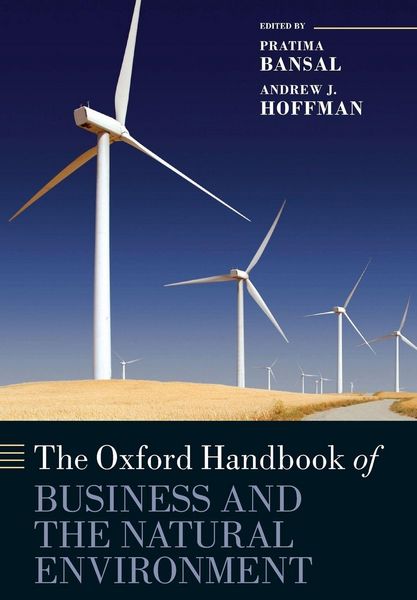
  • Produktbild: The Oxford Handbook of Business and the Natural Environment
  • Produktbild: The Oxford Handbook of Business and the Natural Environment

The Oxford Handbook of Business and the Natural Environment

85,99 €

inkl. gesetzl. MwSt., Versandkostenfrei


Beschreibung

Produktdetails

Einband

Taschenbuch

Erscheinungsdatum

04.07.2013

Herausgeber

Pratima Bansal + weitere

Verlag

Oxford University Press

Seitenzahl

718

Maße (L/B/H)

24,4/17/3,8 cm

Gewicht

1217 g

Sprache

Englisch

ISBN

978-0-19-967743-6

Beschreibung

Produktdetails

Einband

Taschenbuch

Erscheinungsdatum

04.07.2013

Herausgeber

Verlag

Oxford University Press

Seitenzahl

718

Maße (L/B/H)

24,4/17/3,8 cm

Gewicht

1217 g

Sprache

Englisch

ISBN

978-0-19-967743-6

Herstelleradresse

Libri GmbH
Europaallee 1
36244 Bad Hersfeld
DE

Email: gpsr@libri.de

Noch keine Bewertungen vorhanden

Verfassen Sie die erste Bewertung zu diesem Artikel

Helfen Sie anderen Kundinnen und Kunden durch Ihre Meinung.

Kundinnen und Kunden meinen

Bewertungen (0)

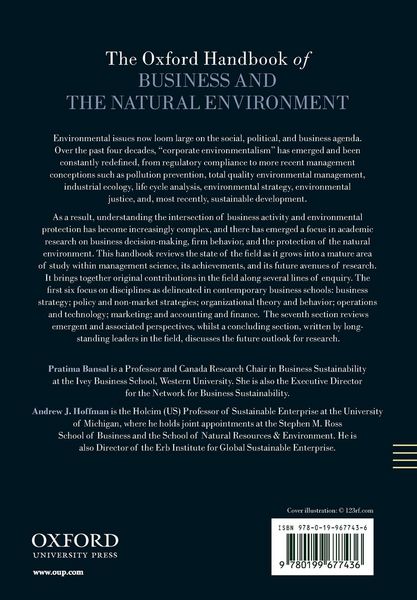
  • Produktbild: The Oxford Handbook of Business and the Natural Environment
  • Produktbild: The Oxford Handbook of Business and the Natural Environment

    • Part I: Introduction


    • 1: Andrew J. Hoffman and Tima Bansal: Introduction


    • Part II: Business Strategy


    • 2: Michael V. Russo and Amy Minto: Competitive Strategy


    • 3: Petra Christmann and Glen Taylor: International Business and the Environment


    • 4: Mike Lenox and Jeffrey G. York: Environmental Entrepreneurship


    • 5: George Kassinis: The Value of Managing Stakeholders


    • Part III: Policy and Non-Market Strategies


    • 6: Andrew King, Andrea M. Prado and Jorge Rivera: Industry Self-Regulation


    • 7: David P. Baron and Tom P. Lyon: Environmental Governance


    • 8: Cary Coglianese and Ryan Anderson: Business and Environmental Law


    • Part IV: Organizational Theory and Behavior


    • 9: Lisa L. Shu and Max H. Bazerman: Cognitive Barriers to Environmental Action: Problems and Solutions


    • 10: Leigh Plunkett Tost and Kimberly A. Wade-Benzoni: Intergenerational Beneficence and the Success of Sustainability Initiatives in Organizational Contexts


    • 11: Jennifer Howard-Grenville and Stephanie Bertels: Bringing the Environment into Organizational Culture


    • 12: Michael Lounsbury, Samantha Fairclough and Min-Dong Paul Lee: Institutional Approaches to Organizations and the Natural Environment


    • 13: Magali A. Delmas and Michael W. Toffel: Institutional Pressures and Organizational Characteristics: Implications for Environmental Strategy


    • 14: Klaus Weber and Sara B. Soderstrom: Social Movements, Business, and the Environment


    • Part V: Operations and Technology


    • 15: Robert D. Klassen and Stephan Vachon: Greener Supply Chain Management


    • 16: James D. Abbey and V. Daniel R. Guide, Jr.: Closed-Loop Supply Chains


    • 17: Reid Lifset and Frank Boons: Industrial Ecology: Business Management in a Material World


    • 18: Nigel P. Melville: Information Systems, Business, and the Natural Environment: Can Digital Business Transform Environmental Sustainability? Nigel P. Melville


    • Part VI: Marketing


    • 19: Debra Scammon and Jenny Mish: From Green Marketing to Marketing for Environmental Sustainability


    • 20: Andrew Gershoff and Julie R. Irwin: Why not Choose Green Consumer Decision Making for Environmentally Friendly Products


    • 21: Timothy M. Devinney: Using Market Segmentation Approaches to Understand the Green Consumer


    • Part VII: Accounting and Finance


    • 22: Rob Gray and Irene Herremans: Sustainability and Social Responsibility Reporting and the Emergence of the External Social Audits: The Struggle for Accountability? Rob Gray and Irene Herremans


    • 23: Nola Buhr and Rob Gray: Environmental Management, Measurement and Accounting: Information for Decision and Control? Nola Buhr and Rob Gray


    • 24: Charles Cho, Dennis Patten and Robin Roberts: Corporate Environmental Financial Reporting and Financial Markets


    • 25: Rob Bauer and Jeroen Derwall: Values-driven and Profit-seeking Dimensions of Environmentally Responsible Investing


    • 26: Jean-Louis Bertrand and Bernard Sinclair-Desgagné: Environmental Risks and Financial Markets: A Two-Way Street


    • 27: Bryan Routledge: Corporate Decision Making, Net Present Value, and the Environment


    • Part VIII: Emergent and Associated Perspectives


    • 28: Krista Bondy and Dirk Matten: Corporate Social Responsibility


    • 39: James E. Post: Business, Society and the Environment


    • 30: Linda C. Forbes and John M. Jermier: The New Corporate Environmentalism and the Symbolic Management of Organizational Culture


    • 31: Subhabrata Bobby Banerjee: Critical Perspectives on Business and the Natural Environment


    • 32: David L. Levy and Benyamin B. Lichtenstein: Approaching Business and the Environment with Complexity Theory


    • Part IX: Future Perspectives


    • 33: John R. Ehrenfeld: Beyond the Brave New World: Business for Sustainability


    • 34: Nigel Roome: Looking Back, Thinking Forward: Distinguishing Between Weak and Strong Sustainability


    • 35: Paul Shrivastava: Enterprise Sustainability 2.0: Aesthetics of Sustainability


    • 36: John Elkington and Charmain Love: Tomorrow s C-Suite Agenda


    • 37: Stuart L. Hart: The Third-Generation Corporation


    • 38: Thomas N. Gladwin: Capitalism Critique: Systemic Limits On Business Harmony With Nature