Gutscheinbedingungen

**Gültig nur für Bestellungen an die Wunsch-Poststation bis 10.06.2026 auf Spielzeug, Schreibwaren, Filme, Geschenke & Trends, Musik, tolino eReader & Zubehör, Hörbücher und Hörbuch-Downloads (außer Abo), nicht preisgebundene Bücher und Kalender online auf thalia.at und in der Thalia App. Einzelne Artikel können ausgeschlossen sein. Aufgrund der Buchpreisbindung sind deutschsprachige Bücher und eBooks ausgenommen. Zusätzlich ausgenommen sind preisgebundene Artikel, Abos & Flatrates, eBooks, Games, Geschenkkarten/-boxen, Shelfies, Software, Zeitschriften sowie einzelne Artikel von tonies®. Pro Einkauf einmal einlösbar. Kein Click & Collect möglich. Keine Barauszahlung. Nicht kombinierbar mit anderen Aktionen und Gutscheinen. Gutschein wird auf max. 500€ Bestellwert angerechnet. Nicht gültig für Versandkosten und Services.

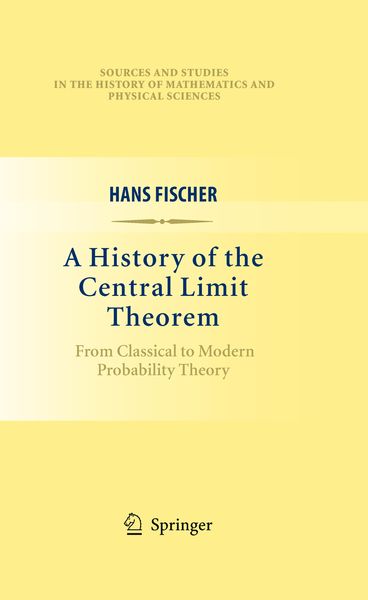
  • Produktbild: A History of the Central Limit Theorem
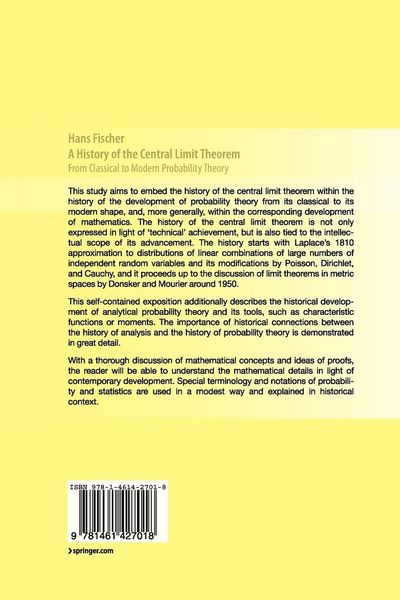
  • Produktbild: A History of the Central Limit Theorem
- 13%

A History of the Central Limit Theorem From Classical to Modern Probability Theory

13% sparen

161,99 € UVP 186,99 €

inkl. gesetzl. MwSt., Versandkostenfrei


Beschreibung

Produktdetails

Einband

Taschenbuch

Erscheinungsdatum

01.12.2012

Verlag

Springer Us

Seitenzahl

402

Maße (L/B/H)

23,5/15,5/2,3 cm

Gewicht

634 g

Auflage

Repr. d. Ausg. v. 2011

Sprache

Englisch

ISBN

978-1-4614-2701-8

Beschreibung

Rezension

From the book reviews:

“Fischer provides thorough mathematical descriptions of the development of the central limit theorem as it evolves with increasing mathematical rigor. … Fischer has probably written what will be the definitive history of the central limit theorem for many years to come. … Fischer overflows with detail, insight and excellent commentary.” (David Bellhouse, Historia Mathematica, Vol. 39, 2012)

“The book will be of interest not only to professionals in the area of probability and statistics but to a wider audience. … The author has been using a huge amount of sources and archives, including his own works, and he is successful in his goal to describe a comprehensive picture of the development of the CLT. … the book would be an excellent source for student projects on topics from probability and its applications.” (Jordan M. Stoyanov, Zentralblatt MATH, Vol. 1226, 2012)

“This work details the history of the central limit theorem and related probabilistic limit theorems roughly from 1810 through 1950, but focuses on 1810 to 1935. … Hans Fischer … authors many papers on the history of mathematics. His skill in both these areas allows him to reveal here the historical development of this important theorem in a way that can easy be adapted to the lecture hall or used in independent study.” (Tom Schulte, The Mathematical Association of America, February, 2011)

“The history of the CLT deserves a place of its own, and this book by Hans Fischer is the best … in tracing its development in meticulous historical detail and with mathematical precision. … The book by Hans Fischer is highly recommended as a well-researched comprehensive history of the CLT. One finds here the story of a galaxy of brilliant mathematicians … engaging in the quest for, and debates on, the true meaning and the correct derivation of a beautiful intriguingresult.” (Rabi Bhattacharya, SIAM Review, Vol. 53 (4), 2011)

Zitat

From the reviews: "The history of the CLT deserves a place of its own, and this book by Hans Fischer is the best ... in tracing its development in meticulous historical detail and with mathematical precision. ... The book by Hans Fischer is highly recommended as a well-researched comprehensive history of the CLT. One finds here the story of a galaxy of brilliant mathematicians ... engaging in the quest for, and debates on, the true meaning and the correct derivation of a beautiful intriguing result."--- (Rabi Bhattacharya, SIAM Review, Vol. 53 (4), 2011) "This work details the history of the central limit theorem and related probabilistic limit theorems roughly from 1810 through 1950, but focuses on 1810 to 1935. ... Hans Fischer ... authors many papers on the history of mathematics. His skill in both these areas allows him to reveal here the historical development of this important theorem in a way that can easy be adapted to the lecture hall or used in independent study." (Tom Schulte, The Mathematical Association of America, February, 2011) "The book will be of interest not only to professionals in the area of probability and statistics but to a wider audience. ... The author has been using a huge amount of sources and archives, including his own works, and he is successful in his goal to describe a comprehensive picture of the development of the CLT. ... the book would be an excellent source for student projects on topics from probability and its applications." (Jordan M. Stoyanov, Zentralblatt MATH, Vol. 1226, 2012)

Produktdetails

Einband

Taschenbuch

Erscheinungsdatum

01.12.2012

Verlag

Springer Us

Seitenzahl

402

Maße (L/B/H)

23,5/15,5/2,3 cm

Gewicht

634 g

Auflage

Repr. d. Ausg. v. 2011

Sprache

Englisch

ISBN

978-1-4614-2701-8

Herstelleradresse

Springer-Verlag KG
Sachsenplatz 4-6
1201 Wien
AT

Email: ProductSafety@springernature.com

Kundinnen und Kunden meinen

0 Bewertungen

Informationen zu Bewertungen

Zur Abgabe einer Bewertung ist eine Anmeldung im Konto notwendig. Die Authentizität der Bewertungen wird von uns nicht überprüft. Wir behalten uns vor, Bewertungstexte, die unseren Richtlinien widersprechen, entsprechend zu kürzen oder zu löschen.

Die Bewertungen sind nach Format, Anzahl Sterne und Datum sortiert.

Verfassen Sie die erste Bewertung zu diesem Artikel

Helfen Sie anderen Kund*innen durch Ihre Meinung

Kundinnen und Kunden meinen

0 Bewertungen filtern

  • Produktbild: A History of the Central Limit Theorem
  • Produktbild: A History of the Central Limit Theorem
  • Preface.- Introduction.- The central limit theorem from laplace to cauchy: changes in stochastic objectives and in analytical methods.- The hypothesis of elementary errors.- Chebyshev's and markov's contributions.- The way towards modern probability.- General limit problems.- Conclusion: the central limit theorem as a link between classical and modern probability.- Index.- Bibliography