Zitat
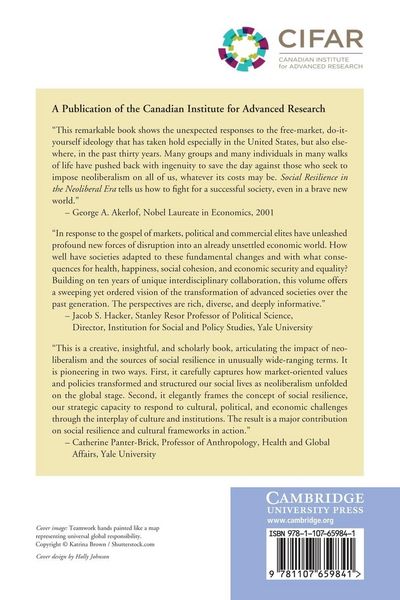
"This remarkable book shows the unexpected responses to the free-market, do-it-yourself ideology that has taken hold especially in the United States, but also elsewhere, in the past thirty years. Many groups and many individuals in many walks of life have pushed back with ingenuity to save the day against those who seek to impose neoliberalism on all of us, whatever its costs may be. Social Resilience in the Neoliberal Era tells us how to fight for a successful society, even in a brave new world." - George A Akerlof, Nobel Laureate in Economics, 2001 "Social Resilience provides a powerful new theoretical and operational foundation for the analysis of neoliberalism and its implications for individuals, nations, and organizations. Hall and Lamont, together with the volume's distinguished contributing authors, seamlessly interconnect individual well-being with macro-level societal development, offering readers a wealth of fascinating findings. A must-read for social scientists in several disciplines, indeed for all those concerned to understand the contemporary era and its possibilities for human well-being - under often challenging conditions." - Robert M. Fishman, University of Notre Dame "Social Resilience in the Neoliberal Era gives a comprehensive and original account of neoliberalism as an idea, together with its social effects and productive provocations for social scientists. The editors' introduction makes the key terms, issues, and stakes completely accessible, even for novice readers, leading the way to the contributors' analyses of diverse policy regimes and their challenges for individuals, communities, and societies. The "resilience" in the book's title reflects the other side of neoliberalism's consolidation of social security around market principles. The book neither assures nor laments; rather, it opens a conversation that invites an engaged continuation." - Carol Greenhouse, Princeton University "In response to the gospel of markets, political and commercial elites have unleashed profound new forces of disruption into an already unsettled economic world. How well have societies adapted to these fundamental changes and with what consequences for health, happiness, social cohesion, and economic security and equality? Building on ten years of unique interdisciplinary collaboration, this volume offers a sweeping yet ordered vision of the transformation of advanced societies over the past generation. The perspectives are rich, diverse, and deeply informative." - Jacob S. Hacker, Stanley Resor Professor of Political Science, Director, Institution for Social and Policy Studies, Yale University "This is a creative, insightful, and scholarly book, articulating the impact of neoliberalism and the sources of social resilience in unusually wide-ranging terms. It is pioneering in two ways. First, it carefully captures how market-oriented values and policies transformed and structured our social lives as neoliberalism unfolded on the global stage. Second, it elegantly frames the concept of social resilience, our strategic capacity to respond to cultural, political, and economic challenges through the interplay of culture and institutions. The result is a major contribution on social resilience and cultural frameworks in action." - Catherine Panter-Brick, Professor of Anthropology, Health and Global Affairs, Yale University "The problematic of Social Resilience in the Neo-Liberal Era is nothing less than understanding the effects of neoliberalism on individuals, groups, communities, policies, and societies to uncover the sources of resilience in difficult times. This is a risky enterprise. Social scientists are often willing to salute the noble flag of interdisciplinarity in faculty meetings, but they are rarely willing to move outside their disciplinary comfort zones actually to engage in it. The results, when they are as probing as those in this book, prove that the risk is worth taking. Readers are left with sharply motivating ideas and new projects about how fundamental social issues can be better understood and explored." - George Ross, University of Montreal