Gutscheinbedingungen

**Gültig bis 06.07.2026 auf fremdsprachige Bücher online auf thalia.at, in der Thalia App ab einem Mindestbestellwert von 30€ und in allen Thalia Buchhandlungen in Österreich. In den Buchhandlungen nur gültig auf lagernde Ware. Einzelne Artikel können ausgeschlossen sein. Ausgenommen sind preisgebundene Artikel & eBooks. Pro Einkauf einmal einlösbar. Nur gültig gegen Vorlage oder im Onlineshop hinterlegter Bonuscard. Infos zur Einlösung in der Buchhandlung sind auf der Bonuscard-Vorteilspreisseite zu finden. Click & Collect nur bei Onlinevorabzahlung möglich. Keine Einlösung bei Scan & Go-Bezahlung. Keine Barauszahlung. Nicht kombinierbar mit anderen Aktionen und Gutscheinen. Gutschein wird auf max. 500€ Bestellwert angerechnet. Nicht gültig für Versandkosten und Services.

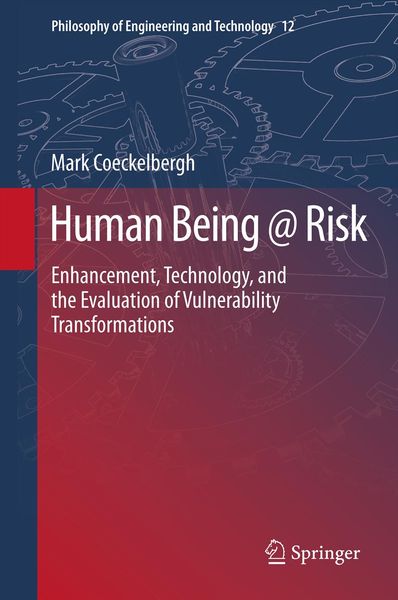
  • Produktbild: Human Being @ Risk
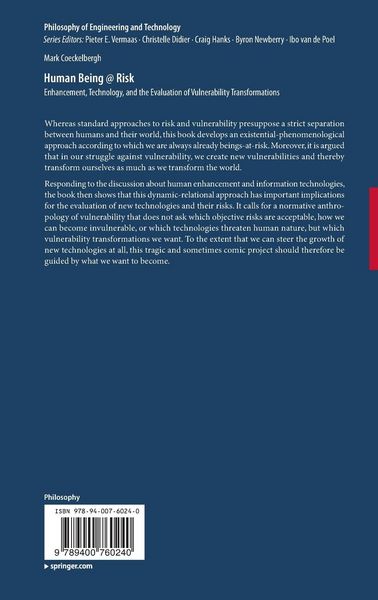
  • Produktbild: Human Being @ Risk
Band 12 - 13%

Human Being @ Risk Enhancement, Technology, and the Evaluation of Vulnerability Transformations

13% sparen

161,99 € UVP 186,99 €

inkl. gesetzl. MwSt., Versandkostenfrei


Beschreibung

Produktdetails

Einband

Gebundene Ausgabe

Erscheinungsdatum

02.03.2013

Verlag

Springer Netherland

Seitenzahl

218

Maße (L/B/H)

24,1/16/1,8 cm

Gewicht

518 g

Auflage

1. Auflage

Sprache

Englisch

ISBN

978-94-007-6024-0

Beschreibung

Rezension

“Coeckelbergh is a Belgian philosopher of technology and professor at the University of Vienna. In this interesting book, he proposes a new approach to the transhumanism debate by focusing on human vulnerability. … the book offers a new approach to the transhumanist debate, suggesting and provoking many inputs and questions … . it reminds us of the necessity and urgency of dealing with the transhumanist question, which is not only a future question, but a current one.” (Luis Torró Ferrero, ESSSAT News & Reviews, Vol. 26 (4), December, 2016)

“It is thoroughly unique and original in showing the importance and extreme usefulness of philosophical anthropology and the phenomenological tradition for thinking through the consequences of the epochal technological mutations of our time … . author has succeeded in crafting a muchmore profound and sophisticated ethical and political perspective on human enhancement than almost any other book … . It deserves to be widely read and has the potential of becoming a key reference for the debate on enhancement.” (Pieter Lemmens, Human Studies, Vol. 37, 2014)

“The book offers a complex and ambitious programme to establish a normative anthropology of vulnerability … . Coeckelbergh has written an important and original book, with a carefully constructed argument. He provides a rich discussion of fundamental and topical issues from a wide range of perspectives. … The book is valuable for scholars in many fields, not only philosophy of technology, anthropology or ethics, but also other disciplines dealing with technology and regulation of technology.” (Bert-Jaap Koops, Law, Innovation and Technology, Vol. 5 (2), 2013)

Produktdetails

Einband

Gebundene Ausgabe

Erscheinungsdatum

02.03.2013

Verlag

Springer Netherland

Seitenzahl

218

Maße (L/B/H)

24,1/16/1,8 cm

Gewicht

518 g

Auflage

1. Auflage

Sprache

Englisch

ISBN

978-94-007-6024-0

Herstelleradresse

Springer-Verlag KG
Sachsenplatz 4-6
1201 Wien
AT

Email: GPSR Kontakt

Noch keine Bewertungen vorhanden

Verfassen Sie die erste Bewertung zu diesem Artikel

Helfen Sie anderen Kundinnen und Kunden durch Ihre Meinung.

Kundinnen und Kunden meinen

Bewertungen (0)

  • Produktbild: Human Being @ Risk
  • Produktbild: Human Being @ Risk
  • Part I Descriptive Anthropology of Vulnerability.-  Chapter 1. The Transhumanist Challenge.- Chapter 2. An Anthropology of Vulnerability.- Chapter 3. Cultures and Transformations of Vulnerability.- Part II Normative Anthropology of Vulnerability.- Chapter 4. Ethics of Vulnerability (1): Implications for ethics of technology.- Chapter 5. Ethics of Vulnerability (2): Imagining the Posthuman future.- Chapter 6. Ethics of Vulnerability (3): Vulnerability in the Information Age.- Chapter 7. Politics of Vulnerability: Freedom, Justice, and the Public/Private distinction.- Chapter 8. Normative Aesthetics of Vulnerability: The Art of Coping with Vulnerability.- Conclusion.

    ¿