KI-Beratung Beta

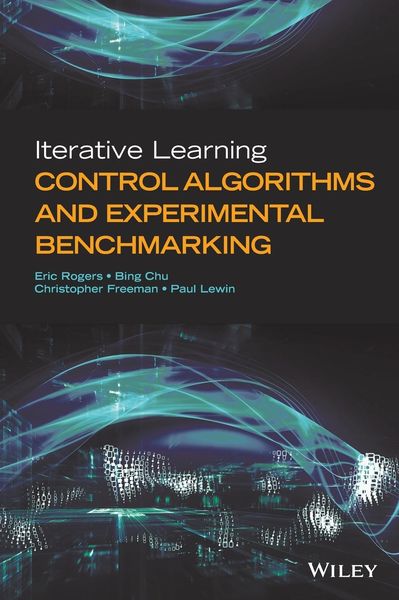
  • Produktbild: Iterative Learning Control Algorithms and Experimental Benchmarking
  • Produktbild: Iterative Learning Control Algorithms and Experimental Benchmarking

Iterative Learning Control Algorithms and Experimental Benchmarking

152,99 €

inkl. gesetzl. MwSt., Versandkostenfrei


Beschreibung

Produktdetails

Einband

Gebundene Ausgabe

Erscheinungsdatum

24.01.2023

Verlag

John Wiley & Sons

Seitenzahl

448

Maße (L/B/H)

26/18,3/2,9 cm

Gewicht

1037 g

Auflage

1. Auflage

Sprache

Englisch

ISBN

978-0-470-74504-5

Beschreibung

Produktdetails

Einband

Gebundene Ausgabe

Erscheinungsdatum

24.01.2023

Verlag

John Wiley & Sons

Seitenzahl

448

Maße (L/B/H)

26/18,3/2,9 cm

Gewicht

1037 g

Auflage

1. Auflage

Sprache

Englisch

ISBN

978-0-470-74504-5

Herstelleradresse

Libri GmbH
Europaallee 1
36244 Bad Hersfeld
DE

Email: gpsr@libri.de

Noch keine Bewertungen vorhanden

Verfassen Sie die erste Bewertung zu diesem Artikel

Helfen Sie anderen Kundinnen und Kunden durch Ihre Meinung.

Kundinnen und Kunden meinen

Bewertungen (0)

Die Leseprobe wird geladen.
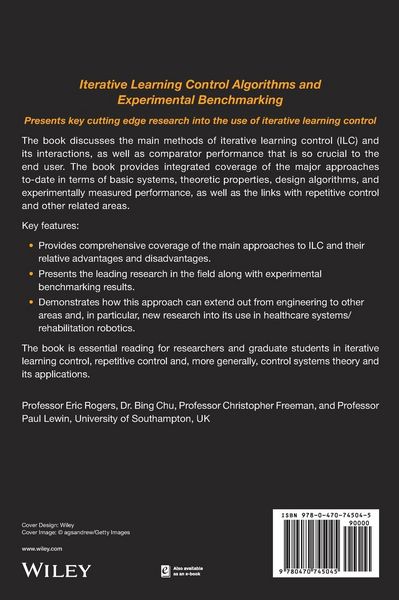
  • Produktbild: Iterative Learning Control Algorithms and Experimental Benchmarking
  • Produktbild: Iterative Learning Control Algorithms and Experimental Benchmarking
  • Preface vii
     
    1 Iterative Learning Control: Origins and General Overview 1
     
    1.1 The Origins of ILC 2
     
    1.2 A Synopsis of the Literature 5
     
    1.3 Linear Models and Control Structures 6
     
    1.3.1 Differential Linear Dynamics 7
     
    1.4 ILC for Time-Varying Linear Systems 9
     
    1.5 Discrete Linear Dynamics 11
     
    1.6 ILC in a 2D Linear Systems/Repetitive Processes Setting 16
     
    1.6.1 2D Discrete Linear Systems and ILC 16
     
    1.6.2 ILC in a Repetitive Process Setting 17
     
    1.7 ILC for Nonlinear Dynamics 18
     
    1.8 Robust, Stochastic, and Adaptive ILC 19
     
    1.9 Other ILC Problem Formulations 21
     
    1.10 Concluding Remarks 22
     
    2 Iterative Learning Control: Experimental Benchmarking 23
     
    2.1 Robotic Systems 23
     
    2.1.1 Gantry Robot 23
     
    2.1.2 Anthromorphic Robot Arm 25
     
    2.2 Electro-Mechanical Systems 26
     
    2.2.1 Nonminimum Phase System 26
     
    2.2.2 Multivariable Testbed 29
     
    2.2.3 Rack Feeder System 30
     
    2.3 Free Electron Laser Facility 32
     
    2.4 ILC in Healthcare 37
     
    2.5 Concluding Remarks 38
     
    3 An Overview of Analysis and Design for Performance 39
     
    3.1 ILC Stability and Convergence for Discrete Linear Dynamics 39
     
    3.1.1 Transient Learning 41
     
    3.1.2 Robustness 42
     
    3.2 Repetitive Process/2D Linear Systems Analysis 43
     
    3.2.1 Discrete Dynamics 43
     
    3.2.2 Repetitive Process Stability Theory 46
     
    3.2.3 Error Convergence Versus Along the Trial Performance 51
     
    3.3 Concluding Remarks 55
     
    4 Tuning and Frequency Domain Design of Simple Structure ILC Laws 57
     
    4.1 Tuning Guidelines 57
     
    4.2 Phase-Lead and Adjoint ILC Laws for Robotic-Assisted Stroke Rehabilitation 58
     
    4.2.1 Phase-Lead ILC 61
     
    4.2.2 Adjoint ILC 63
     
    4.2.3 Experimental Results 63
     
    4.3 ILC for Nonminimum Phase Systems Using a Reference Shift Algorithm 68
     
    4.3.1 Filtering 74
     
    4.3.2 Numerical Simulations 75
     
    4.3.3 Experimental Results 75
     
    4.4 Concluding Remarks 81
     
    5 Optimal ILC 83
     
    5.1 NOILC 83
     
    5.1.1 Theory 83
     
    5.1.2 NOILC Computation 86
     
    5.2 Experimental NOILC Performance 89
     
    5.2.1 Test Parameters 90
     
    5.3 NOILC Applied to Free Electron Lasers 93
     
    5.4 Parameter Optimal ILC 96
     
    5.4.1 An Extension to Adaptive ILC 98
     
    5.5 Predictive NOILC 99
     
    5.5.1 Controlled System Analysis 104
     
    5.5.2 Experimental Validation 106
     
    5.6 Concluding Remarks 116
     
    6 Robust ILC 117
     
    6.1 Robust Inverse Model-Based ILC 117
     
    6.2 Robust Gradient-Based ILC 123
     
    6.2.1 Model Uncertainty -Case (i) 127
     
    6.2.2 Model Uncertainty -Cases (ii) and (iii) 128
     
    6.3 H infinity Robust ILC 132
     
    6.3.1 Background and Early Results 132
     
    6.3.2 H infinity Based Robust ILC Synthesis 137
     
    6.3.3 A Design Example 142
     
    6.3.4 Robust ILC Analysis Revisited 151
     
    6.4 Concluding Remarks 153
     
    7 Repetitive Process-Based ILC Design 155
     
    7.1 Design with Experimental Validation 155
     
    7.1.1 Discrete Nominal Model Design 155
     
    7.1.2 Robust Design -Norm-Bounded Uncertainty 160
     
    7.1.3 Robust Design - Polytopic Uncertainty and Simplified Implementation 165
     
    7.1.4 Design for Differential Dynamics 170
     
    7.2 Repetitive Process-Based ILC Design Using Relaxed Stability Theory 170
     
    7.3 Finite Frequency Range Design and Experimental Validation 178
     
    7.3.1 Stability Analysis 178
     
    7