
Gutscheinbedingungen

**Gültig bis 06.07.2026 auf fremdsprachige Bücher online auf thalia.at, in der Thalia App ab einem Mindestbestellwert von 30€ und in allen Thalia Buchhandlungen in Österreich. In den Buchhandlungen nur gültig auf lagernde Ware. Einzelne Artikel können ausgeschlossen sein. Ausgenommen sind preisgebundene Artikel & eBooks. Pro Einkauf einmal einlösbar. Nur gültig gegen Vorlage oder im Onlineshop hinterlegter Bonuscard. Infos zur Einlösung in der Buchhandlung sind auf der Bonuscard-Vorteilspreisseite zu finden. Click & Collect nur bei Onlinevorabzahlung möglich. Keine Einlösung bei Scan & Go-Bezahlung. Keine Barauszahlung. Nicht kombinierbar mit anderen Aktionen und Gutscheinen. Gutschein wird auf max. 500€ Bestellwert angerechnet. Nicht gültig für Versandkosten und Services.

  • Produktbild: Moves in Mind
  • Produktbild: Moves in Mind

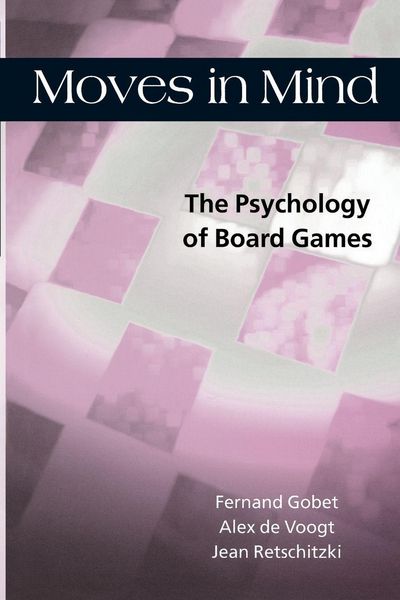
Moves in Mind The Psychology of Board Games

66,99 €

inkl. gesetzl. MwSt., Versandkostenfrei


Beschreibung

Produktdetails

Einband

Taschenbuch

Erscheinungsdatum

22.10.2012

Verlag

Taylor & Francis

Seitenzahl

288

Maße (L/B/H)

23,4/15,6/1,6 cm

Gewicht

460 g

Sprache

Englisch

ISBN

978-0-415-65565-1

Beschreibung

Produktdetails

Einband

Taschenbuch

Erscheinungsdatum

22.10.2012

Verlag

Taylor & Francis

Seitenzahl

288

Maße (L/B/H)

23,4/15,6/1,6 cm

Gewicht

460 g

Sprache

Englisch

ISBN

978-0-415-65565-1

Noch keine Bewertungen vorhanden

Verfassen Sie die erste Bewertung zu diesem Artikel

Helfen Sie anderen Kundinnen und Kunden durch Ihre Meinung.

Kundinnen und Kunden meinen

Bewertungen (0)

Die Leseprobe wird geladen.
  • Produktbild: Moves in Mind
  • Produktbild: Moves in Mind
  • Part 1: Introduction.Moves in Mind. Board Games and Cognitive Psychology. The Role of Board Games in Science. The Role of Board Games in Psychology. Structure of the Book. Part 2: Formal Analyses of Board Games. Fundamental Concepts. Board Games in Computer Science and Artificial Intelligence. Information and Complexity Analysis. Game Theory and the Concept of Error. Conclusion. Part 3: Theories of Board-game Psychology. A Brief History of Board-game Psychology. Theories of Chess Skill. Influences from Other Theories of Cognition. Theories of Development and Environment. Conclusion. Part 4: Perception and Categorization. Low-level Perception. High-level Perception and Categorization. Conclusion. Part 5: Memory, Knowledge, and Representations. Memory for Board Positions. Recall of Sequences of Moves and of Games. Estimation of the Number of Chunks in LTM. Mode of Representation. Representations Used in Blindfold Playing. Knowledge and Memory Schemata. Discussion. Conclusion. Part 6: Problem Solving and Decision Making. Empirical Data on Search Behaviour. Empirical Data on the Role of Perception in Problem Solving. Empirical Data on the Role of Knowledge in Problem Solving. Analogy Formation in Novice Players. Theoretical Accounts. Discussion. Conclusion. Part 7: Learning, Development and Ageing. Early Stages of Learning. Development of Play and Game Behaviour. Developmental Studies of Specific Board Games. Ageing. Conclusion. Part 8: Education and Training. Introduction. Board Game Instruction and the Transfer of Skill. Teaching the Rules and Basic Instruction. Training and Coaching at an Advanced Level. Conclusion. Part 9: Individual Differences and the Neuropsychology of Talent.Intelligence and Visuo-spatial Abilities. Personality. Emotions and Motivation. Board Games and Neuroscience. Overall Conclusion. Part 10: Methodology and Research Designs. Definitions of Expertise. Game Specificity. Illiterate Games. Ecological Validity. Cross-cultural Aspects. The Creation and Use of Archives and Databases. Observations and Natural Experiments. Interviews and Questionnaires. Introspection and Retrospection. Protocol Analysis. Standard Experimental Manipulations. Neuroscientific Approaches. Typical Research Designs. Mathematical and Computational Modelling. Weaknesses and Strengths of Methodologies Used in Board-game Research. Part 11: Conclusion. Board Game Complexity. Landscape of Board Games. Impact of Board-game Research. Future. References. Appendix 1: Rules of Board Games. Appendix 2: Measures of Expertise in Board Games. Appendix 3: Example of Protocol Analysis.