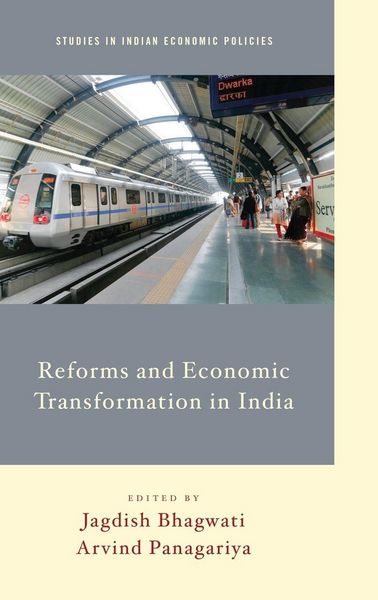
Reforms and Economic Transformation in India Book 2
117,99 €
inkl. gesetzl. MwSt.,
Beschreibung
Produktdetails
Einband
Gebundene Ausgabe
Erscheinungsdatum
02.11.2012
Abbildungen
42 illustrations
Herausgeber
Jagdish Bhagwati + weitereVerlag
Oxford University PressSeitenzahl
310
Maße (L/B/H)
24/16,1/2,3 cm
Gewicht
590 g
Sprache
Englisch
ISBN
978-0-19-991520-0
This latest volume takes as its starting point the fact that while reforms have undoubtedly delivered in terms of poverty reduction and associated social objectives, the impact has not been as substantial as seen in other reform-oriented economies such as South Korea and Taiwan in the 1960s and 1970s, and more recently, in China. The overarching hypothesis of the volume is that the smaller reduction in poverty has been the result of slower transformation of the economy from a primarily agrarian to a modern, industrial one. Even as the GDP share of agriculture has seen rapid decline, its employment share has declined very gradually. More than half of the workforce in India still remains in agriculture. In addition, non-farm workers are overwhelmingly in the informal sector. Against this background, the nine original essays by eminent economists pursue three broad themes using firm level data in both industry and services.
The papers in part I ask why the transformation in India has been slow in terms of the movement of workers out of agriculture, into industry and services, and from informal to formal employment. They address what India needs to do to speed up this transformation. They specifically show that severe labor-market distortions and policy bias against large firms has been a key factor behind the slow transformation. The papers in part II analyze the transformation that reforms have brought about within and across enterprises. For example, they investigate the impact of privatization on enterprise profitability. Part III addresses the manner in which the reforms have helped promote social transformation. Here the papers analyze the impact the reforms have had on the fortunes of the socially disadvantaged groups in terms of wage and education outcomes and as entrepreneurs.
Noch keine Bewertungen vorhanden
Verfassen Sie die erste Bewertung zu diesem Artikel
Helfen Sie anderen Kundinnen und Kunden durch Ihre Meinung.
Kurze Frage zu unserer Seite
Vielen Dank für Ihr Feedback
Wir nutzen Ihr Feedback, um unsere Produktseiten zu verbessern. Bitte haben Sie Verständnis, dass wir Ihnen keine Rückmeldung geben können. Falls Sie Kontakt mit uns aufnehmen möchten, können Sie sich aber gerne an unseren Kund*innenservice wenden.
zum Kundenservice