Gutscheinbedingungen

**Gültig bis 06.07.2026 auf fremdsprachige Bücher online auf thalia.at, in der Thalia App ab einem Mindestbestellwert von 30€ und in allen Thalia Buchhandlungen in Österreich. In den Buchhandlungen nur gültig auf lagernde Ware. Einzelne Artikel können ausgeschlossen sein. Ausgenommen sind preisgebundene Artikel & eBooks. Pro Einkauf einmal einlösbar. Nur gültig gegen Vorlage oder im Onlineshop hinterlegter Bonuscard. Infos zur Einlösung in der Buchhandlung sind auf der Bonuscard-Vorteilspreisseite zu finden. Click & Collect nur bei Onlinevorabzahlung möglich. Keine Einlösung bei Scan & Go-Bezahlung. Keine Barauszahlung. Nicht kombinierbar mit anderen Aktionen und Gutscheinen. Gutschein wird auf max. 500€ Bestellwert angerechnet. Nicht gültig für Versandkosten und Services.

  • Produktbild: Cardiac Remodeling
  • Produktbild: Cardiac Remodeling
Band 5 - 12%

Cardiac Remodeling Molecular Mechanisms

12% sparen

144,99 € UVP 164,99 €

inkl. gesetzl. MwSt., Versandkostenfrei


Beschreibung

Produktdetails

Einband

Gebundene Ausgabe

Erscheinungsdatum

16.02.2013

Abbildungen

XI, 78 illus., 46 illus. in color., schwarz-weiss Illustrationen, farbige Illustrationen

Herausgeber

Bodh I. Jugdutt + weitere

Verlag

Springer Us

Seitenzahl

569

Maße (L/B/H)

24,1/16/3,6 cm

Gewicht

977 g

Auflage

2013

Sprache

Englisch

ISBN

978-1-4614-5929-3

Beschreibung

Produktdetails

Einband

Gebundene Ausgabe

Erscheinungsdatum

16.02.2013

Abbildungen

XI, 78 illus., 46 illus. in color., schwarz-weiss Illustrationen, farbige Illustrationen

Herausgeber

Verlag

Springer Us

Seitenzahl

569

Maße (L/B/H)

24,1/16/3,6 cm

Gewicht

977 g

Auflage

2013

Sprache

Englisch

ISBN

978-1-4614-5929-3

Herstelleradresse

Springer-Verlag KG
Sachsenplatz 4-6
1201 Wien
AT

Email: GPSR Kontakt

Noch keine Bewertungen vorhanden

Verfassen Sie die erste Bewertung zu diesem Artikel

Helfen Sie anderen Kundinnen und Kunden durch Ihre Meinung.

Kundinnen und Kunden meinen

Bewertungen (0)

  • Produktbild: Cardiac Remodeling
  • Produktbild: Cardiac Remodeling
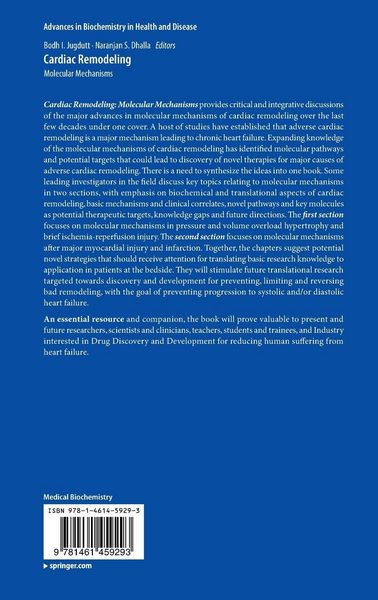
  • Part I: Molecular mechanisms of remodeling in pressure and volume overload hypertrophy and ehart failure.- ß-adrenergic receptor signaling pathway in heart failure.- Remodeling of potassium channels in cardiac hypertrophy.- Role of gender in Ca2+ cycling and cardiac remodeling due to heart failure.- The failing heart: is it an inefficient engine or an engine out of fuel?.- Regulation of cardiac hypertrophic remodeling by the USP15/SLIM1 pathway.- Role of galectin-3 pathways in the pathogenesis of cardiac remodeling and heart failure.- A mitochondriocentric pathway to cardiomyocyte necrosis:  an upstream molecular mechanism in myocardial fibrosis.- The ACE2/Ang (1-7) pathway in cardiac remodeling due to pressure-overload.- Local actions of natriuretic peptides and nitric oxide in cardiac remodelling: Implications for therapy.- Modulating G protein-coupled receptors to effect reverse cardiac remodeling.- Role of inflammation and matrix proteinases in cardiac remodeling following stress and injury.- Role of chymase in matrix and myocardial remodeling due to mitral regurgitation. Implications for therapy.- Cardiac remodeling due to aortic regurgitation and mitral regurgitation.- Reducing oxidative stress and manipulating molecular signaling events using resveratrol as a therapy for pathological cardiac hypertrophy.- Angiogenesis, arteriogenesis, and mitochondrial dysfunction.- Part II: Molecular mechanisms of remodeling after myocardial injury and infarction.- Subcellular remodeling and cardiac dysfunction due to ischemia-reperfusion injury.- Role of microRNAs in cardiac hypertrophy and post-infarction remodeling.- Negative regulators of inflammation as endogenous protective mechanisms in post-infarction remodeling.- TLR-dependent pathways and Akt/mTOR/P70S6K pathways in cardiac remodeling after myocardialinfarction.- The STAT3 pathway and downstream mechanisms in cardiac remodeling: Friend or foe.- The role of growth differentiation factor 5 in cardiac repair post myocardial infarction.- Extracellular matrix biomarkers of adverse remodeling after myocardial infarction.- Oxidative stress in cardiac repair and remodeling: Molecular pathways and therapeutic strategies.- Role of SPARC in cardiac extracellular matrix remodeling after myocardial infarction.- Tissue inhibitor of matrix metalloproteinases in the pathogenesis of heart failure syndromes.- Intracellular matrix remodeling and cardiac function in ischemia-reperfusion injury.- Aging and markers of adverse remodeling after myocardial infarction.- Optimizing stem cell therapy for cardiac repair following a myocardial infarction.- Regulation of fibrosis after myocardial infarction. Implications for ventricular remodeling.- The ACE2/Ang-(1-7) pathway in cardiac fibroblasts as a potential target for cardiac remodeling.