KI-Beratung Beta

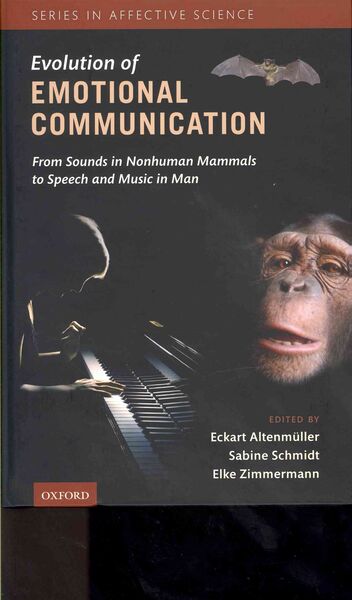
Produktbild: The Evolution of Emotional Communication

The Evolution of Emotional Communication

167,99 €

inkl. gesetzl. MwSt., Versandkostenfrei


Beschreibung

Why do we think that we can understand animal voices - such as the barking of a pet dog, the meows of the family cat? Why do we think of deep voices as dominant and high voices as submissive.This groundbreaking book presents a thorough exploration into how acoustically conveyed emotions are generated...

Beschreibung

Why do we think that we can understand animal voices - such as the barking of a pet dog, the meows of the family cat? Why do we think of deep voices as dominant and high voices as submissive.This groundbreaking book presents a thorough exploration into how acoustically conveyed emotions are generated and processed in both animals and humans.

Produktdetails

Einband

Gebundene Ausgabe

Erscheinungsdatum

12.06.2014

Herausgeber Eckart Altenmüller + weitere
Verlag Oxford Academic

Produktdetails

Einband

Gebundene Ausgabe

Erscheinungsdatum

12.06.2014

Herausgeber
Verlag Oxford Academic
Seitenzahl

392

Maße (L/B/H)

26/18,3/2,6 cm

Gewicht

868 g

Sprache

Englisch

ISBN

978-0-19-958356-0

Herstelleradresse

Libri GmbH
Europaallee 1
36244 Bad Hersfeld
DE

Email: gpsr@libri.de

Noch keine Bewertungen vorhanden

Verfassen Sie die erste Bewertung zu diesem Artikel

Helfen Sie anderen Kundinnen und Kunden durch Ihre Meinung.

Kundinnen und Kunden meinen

Bewertungen (0)

Die Leseprobe wird geladen.
  • Produktbild: The Evolution of Emotional Communication
    • Part A: Introductory Section

    • 1: M. Mortillaru, M. Mehu and K.R. Scherer: The evolutionary origin of multimodal synchronisation and emotional expression

    • 2: W.T. Fitch and K. Zuberbühler: Primate precursors to human language: Beyond discontinuity

    • 3: J.P. Rauschecker: Brain networks for the encoding of emotions in communication sounds of human and nonhuman primates

    • Part B: Different mammalian taxa

    • 4: G. Ehret: Sound communication in house mice: Emotions in their voices and ears?

    • 5: S. Brudzynks: Vocalizations as indicators of emotional states in rats and cats

    • 6: S. Schmidt: Beyond echolocation: Emotional acoustic communication in bats

    • 7: J. Soltis: Emotional communication in African Elephants

    • 8: E. Zimmermann, L. Leliveld, and S. Schehka: Toward the evolutionary roots of affective prosody in human acoustic communication: A comparative approach to mammalian voices

    • 9: C.T. Snowdon and D. Teie: Emotional communication in monkeys: Music to their ears?

    • Part C: Non-speech Human vocalizations

    • 10: P. Zeskind: Infant crying and the synchrony of arousal

    • 11: M. J. Owren, M. Philipp, E. Vanman, N. Trivedi, A. Schulman, and J.A. Bachorowski: Understanding spontaneous human laughter: The role of voicing in inducing positive emotion

    • 12: D. Szameitat, D. Wildgruber, and K. Alter: Vocal expression of emotions in laughter

    • Part D: Human Prosody

    • 13: D. Grandjean and S. Frühholz: An integrative model of brain processes for the decoding of emotional prosody

    • 14: S.A. Kotz, A.S. Hasting, and S. Paulmann: On the orbito-striatal interface in (acoustic) emotional processing

    • 15: C. Schroeder and R. Dengler: The role of dopamine in perception and expression of emotional communication in Parkinson's disease

    • 16: P.N. Juslin: Vocal affect expression: Problems and promises

    • Part E: Music

    • 17: I. Peretz, W. Aube, and J. Armony: Towards a neurobiology of musical emotions

    • 18: T. Fritz and S. Koelsch: Acoustically mediated emotional contagion as an across-species homology underlying music processing

    • 19: E. Altenmüller R. Kopiez, and O. Grewe: A contribution to the evolutionary basis of music: Lessons from the chill-response

    • Part F: Summary: Where to go?

    • 20: 1. E. Altenmüller, S. Schmidt, and E. Zimmermann: A cross-taxa concept of emotion in acoustic communication: An ethological perspective