KI-Beratung Beta

Gutscheinbedingungen

**Gültig bis 30.11.2026 auf Spielzeug, Schreibwaren, Filme, Geschenke & Trends, Musik, tolino eReader & Zubehör, Hörbücher und Hörbuch-Downloads, nicht preisgebundene Bücher und Kalender online auf thalia.at und in der Thalia App. Einzelne Artikel können ausgeschlossen sein. Aufgrund der Buchpreisbindung sind deutschsprachige Bücher und eBooks ausgenommen. Zusätzlich ausgenommen sind Abos & Flatrates, Games, Geschenkkarten/-boxen, Shelfies, Software, Zeitschriften sowie einzelne Artikel von tonies®. Pro Einkauf einmal einlösbar. Nur gültig mit im Onlineshop hinterlegter Bonuscard. Click & Collect nur bei Onlinevorabzahlung möglich. Keine Barauszahlung. Nicht kombinierbar mit anderen Aktionen und Gutscheinen. Gutschein wird auf max. 500€ Bestellwert angerechnet. Nicht gültig für Versandkosten und Services.

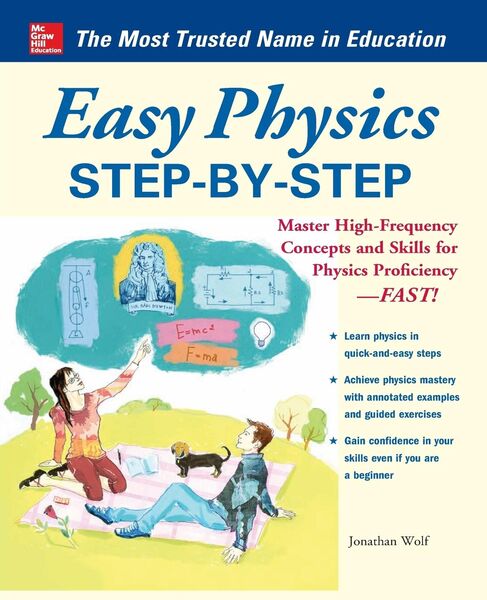
Produktbild: Easy Physics Step-by-Step

Easy Physics Step-by-Step With 95 Solved Problems

43,99 €

inkl. gesetzl. MwSt., Versandkostenfrei


Produktdetails

Einband

Taschenbuch

Erscheinungsdatum

30.04.2013

Abbildungen

Illustrationen, nicht spezifiziert

Verlag MCGRAW-HILL Professional

Produktdetails

Einband

Taschenbuch

Erscheinungsdatum

30.04.2013

Abbildungen

Illustrationen, nicht spezifiziert

Verlag MCGRAW-HILL Professional
Seitenzahl

274

Maße (L/B/H)

23,5/19,1/1,5 cm

Gewicht

518 g

Sprache

Englisch

ISBN

978-0-07-180591-9

Herstelleradresse

Libri GmbH
Europaallee 1
36244 Bad Hersfeld
DE

Email: gpsr@libri.de

Noch keine Bewertungen vorhanden

Verfassen Sie die erste Bewertung zu diesem Artikel

Helfen Sie anderen Kundinnen und Kunden durch Ihre Meinung.

Kundinnen und Kunden meinen

Bewertungen (0)

  • Produktbild: Easy Physics Step-by-Step
  • 1 Introduction to Problem Solving in Physics
    The Nature of Science
    The Problem-Solving Ring and the Process Triangle
    2 Units and Measurements
    Fundamental (SI) Units
    Conversion of Units
    Accuracy and Precision
    Significant Figures and Data Analysis
    Rule for Mathematical Operations
    3 Graphical Analysis of Data
    How to Make a Simple Linear Graph
    Proportional Relationships
    4 Linear Motion
    Motion and Frame of Reference
    Kinematic Quantities
    Finding Displacement with Uniformly Accelerated Motion
    Freely Falling Objects
    Graphical Analysis of Linear Motion
    5 Vectors
    Review of Trigonometry
    Combining Vectors
    Components of Vectors
    6 Forces
    Types of Forces
    Newton's Laws
    Equilibrium
    Hooke's Law
    Forces on Inclines
    Friction
    7 Motion in a Plane
    Horizontal Projectiles
    Projectiles Launched at an Angle
    Uniform Circular Motion
    Simple Harmonic Motion
    Torque and Rotational Equilibrium
    8 Work, Energy, and Power
    Work and Power
    Work Done by Springs
    Simple Machines
    Potential Energy and Kinetic Energy
    Conservation of Energy
    9 Momentum
    Impulse and Momentum
    Conservation of Momentum and One-Dimensional Collisions
    10 Gravitation
    Kepler's Laws of Planetary Motion
    Newton's Law of Gravitation
    Applications of Gravitation
    11 Fluids
    Static Pressure
    Archimedes' Principle
    Buoyancy
    Pascal's Principle
    Bernoulli's Principle
    12 Heat and the Kinetic Theory of Gases
    Temperature Measurements
    Heat Transfer
    Change of State
    Kinetic Theory of Gases
    13 Waves
    Properties of Mechanical Waves
    Sound
    14 Static Electricity
    Electric Charges
    Coulomb's Law and Electric Fields
    Potential Difference and Voltage
    15 Electric Circuits
    Ohm's Law
    Series Circuits
    Parallel Circuits
    16 Magnetism
    Terrestrial Magnetism
    Electromagnetism
    Electromagnetic Induction
    17 Properties of Light
    Electromagnetic Waves
    Reflection
    Refraction
    Interference and Diffraction
    18 Geometrical Optics
    Images Formed by Curved Mirrors
    Images Formed by Lenses
    19 Quantum Theory of Light
    Photoelectric Effect
    Matter Waves
    Compton Effect and Photon Momentum
    20 Atomic and Nuclear Physics
    Spectral Lines
    Radioactive Decay
    Bohr Model of the Atom
    Nuclear Models
    Nuclear Binding Energy
    Fission and Fusion
    Answer Key
    Index