Gutscheinbedingungen

**Gültig bis 15.06.2026 auf Spiele & Spielzeug online auf thalia.at, in der Thalia App ab einem Mindestbestellwert von 30€ und in allen Thalia Buchhandlungen in Österreich. In den Buchhandlungen nur gültig auf lagernde Ware. Einzelne Artikel können ausgeschlossen sein. Ausgenommen sind preisgebundene Artikel sowie online auf thalia.at und in der Thalia App einzelne Artikel von tonies®. Pro Einkauf einmal einlösbar. Nur gültig gegen Vorlage oder im Onlineshop hinterlegter Bonuscard. Infos zur Einlösung in der Buchhandlung sind auf der Bonuscard-Vorteilspreisseite zu finden. Click & Collect nur bei Onlinevorabzahlung möglich. Keine Einlösung bei Scan & Go-Bezahlung. Keine Barauszahlung. Nicht kombinierbar mit anderen Aktionen und Gutscheinen. Gutschein wird auf max. 500€ Bestellwert angerechnet. Nicht gültig für Geschenkkarten, Versandkosten und Services.

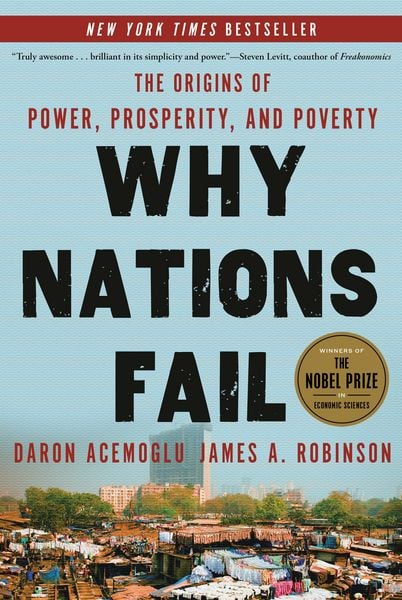
Produktbild: Why Nations Fail

Why Nations Fail The Origins of Power, Prosperity, and Poverty

2

21,99 €

inkl. gesetzl. MwSt., zzgl. Versandkosten


  • Kostenlose Lieferung ab 30 € Einkaufswert
  • Versandkostenfrei für Bonuscard-Kund*innen

Beschreibung

Produktdetails

Verkaufsrang

8297

Einband

Taschenbuch

Erscheinungsdatum

17.09.2013

Verlag

Random House LLC US

Seitenzahl

544

Maße (L/B/H)

20,3/13,3/3,3 cm

Gewicht

396 g

Sprache

Englisch

ISBN

978-0-307-71922-5

Beschreibung

Rezension

Should be required reading for politicians and anyone concerned with economic development. Jared Diamond, New York Review of Books

. . . bracing, garrulous, wildly ambitious and ultimately hopeful. It may, in fact, be a bit of a masterpiece. The Washington Post

This is an intellectually rich book that develops an important thesis with verve. It should be widely read. Financial Times

Why Nations Fail is a splendid piece of scholarship and a showcase of economic rigor. The Wall Street Journal

The main strength of this book is beyond the power of summary: it is packed, from beginning to end, with historical vignettes that are both erudite and fascinating. The Observer (UK)

A brilliant book. Bloomberg

Why Nations Fail is a wildly ambitious work that hopscotches through history and around the world to answer the very big question of why some countries get rich and others don t. The New York Times

A wonderfully readable mix of history, political science, and economics, this book will change the way we think about economic development. Steven Levitt, coauthor of Freakonomics

Without the inclusive institutions that first evolved in the West, sustainable growth is impossible, because only a truly free society can foster genuine innovation and the creative destruction that is its corollary. Niall Ferguson, author of The Ascent of Money

Two centuries from now our great-great-great grandchildren will be, similarly, reading Why Nations Fail. George Akerlof, Nobel laureate in economics, 2001

It s the politics, stupid! That is Acemoglu and Robinson s simple yet compelling explanation for why so many countries fail to develop. But they also document how sensible economic ideas and policies often achieve little in the absence of fundamental political change. Dani Rodrik, Kennedy School of Government, Harvard University

A brilliant and uplifting book yet also a deeply disturbing wake-up call. Simon Johnson, co-author of 13 Bankers and professor at MIT Sloan
 
This highly accessible book provides welcome insight to specialists and general readers alike. Francis Fukuyama, author of The End of History and the Last Man and The Origins of Political Order

This intimate connection between political and economic institutions is the heart of [the authors'] major contribution, and has resulted in a study of great vitality on one of the crucial questions in economics and political economy. Gary S. Becker, Nobel Laureate in Economics, 1992

This not only a fascinating and interesting book: it is a really important one . . . to understanding the successes and failures of societies and nations. Michael Spence, Nobel Laureate in Economics, 2001

Produktdetails

Verkaufsrang

8297

Einband

Taschenbuch

Erscheinungsdatum

17.09.2013

Verlag

Random House LLC US

Seitenzahl

544

Maße (L/B/H)

20,3/13,3/3,3 cm

Gewicht

396 g

Sprache

Englisch

ISBN

978-0-307-71922-5

Herstelleradresse

Libri GmbH
Europaallee 1
36244 Bad Hersfeld
DE

Email: gpsr@libri.de

Kundinnen und Kunden meinen

2 Bewertungen

Informationen zu Bewertungen

Zur Abgabe einer Bewertung ist eine Anmeldung im Konto notwendig. Die Authentizität der Bewertungen wird von uns nicht überprüft. Wir behalten uns vor, Bewertungstexte, die unseren Richtlinien widersprechen, entsprechend zu kürzen oder zu löschen.

Die Bewertungen sind nach Format, Anzahl Sterne und Datum sortiert.

5 Sterne

(2)

4 Sterne

(0)

3 Sterne

(0)

2 Sterne

(0)

1 Sterne

(0)

Zum Verständnis von Wohlstand und Armut

Bewertung aus München am 17.05.2021

Bewertungsnummer: 1496486

Bewertet: Buch (Taschenbuch)

Wie kommt es, dass einige Länder wohlhabend und andere arm sind? Daron Acemoglu und James Robinson gehen dieser Frage nach und leiten den Wohlstand und die Armut von Ländern heute aus deren Geschichte und aus der Zugänglichkeit / Offenheit derer politischen und wirtschaftlichen Institutionen ab. Interessant und mit vielen (historischen) Fakten geschrieben bekommt man einen anderen Blick auf die Geschichte präsentiert, der ein gutes Verständnis dafür schafft, warum manche Dinge heute so sind wie sie sind. Teilweise leider etwas mühsam zu lesen.

Zum Verständnis von Wohlstand und Armut

Bewertung aus München am 17.05.2021
Bewertungsnummer: 1496486
Bewertet: Buch (Taschenbuch)

Wie kommt es, dass einige Länder wohlhabend und andere arm sind? Daron Acemoglu und James Robinson gehen dieser Frage nach und leiten den Wohlstand und die Armut von Ländern heute aus deren Geschichte und aus der Zugänglichkeit / Offenheit derer politischen und wirtschaftlichen Institutionen ab. Interessant und mit vielen (historischen) Fakten geschrieben bekommt man einen anderen Blick auf die Geschichte präsentiert, der ein gutes Verständnis dafür schafft, warum manche Dinge heute so sind wie sie sind. Teilweise leider etwas mühsam zu lesen.

Die Analyse des schmalen Grates den Demokratien gehen

Smart Ass aus Niederbipp am 15.08.2012

Bewertungsnummer: 786615

Bewertet: Buch (Gebundene Ausgabe)

mE die brillianteste Analyse zum wohlergehen von Gesellschaften. Etwas Geschichts- und Geografiekenntnisse sind vermutlich von Vorteil. Den Begriff "Creative Destruction" hat leider der neue Running Mate von Mitt Romney nicht richtig verstanden, der denkt immer noch Menschen sein Econs und nicht Humans

Die Analyse des schmalen Grates den Demokratien gehen

Smart Ass aus Niederbipp am 15.08.2012
Bewertungsnummer: 786615
Bewertet: Buch (Gebundene Ausgabe)

mE die brillianteste Analyse zum wohlergehen von Gesellschaften. Etwas Geschichts- und Geografiekenntnisse sind vermutlich von Vorteil. Den Begriff "Creative Destruction" hat leider der neue Running Mate von Mitt Romney nicht richtig verstanden, der denkt immer noch Menschen sein Econs und nicht Humans

Kundinnen und Kunden meinen

Why Nations Fail

von Daron Acemoglu, James A. Robinson

0 Bewertungen filtern

Weitere Artikel finden Sie in

Die Leseprobe wird geladen.
  • Produktbild: Why Nations Fail
  • C o n t e n t s
     
    Preface
    Why Egyptians fi lled Tahrir Square to bring down Hosni Mubarak
    and what it means for our understanding of the causes of
    prosperity and poverty
     
    1.
    So Close and Yet So Different
    Nogales, Arizona, and Nogales, Sonora, have the same people,
    culture, and geography. Why is one rich and one poor?
     
    2.
    Theories That Don’t Work
    Poor countries are poor not because of their geographies or cultures,
    or because their leaders do not know which policies will enrich
    their citizens
     
    3.
    The Making of Prosperity and Poverty
    How prosperity and poverty are determined by the incentives
    created by institutions, and how politics determines what
    institutions a nation has
     
    4.
    Small Differences and Critical Junctures:
    The Weight of History
    How institutions change through political confl ict and how
    the past shapes the present
     
    5.
    “I’ve Seen the Future, and It Works”:
    Growth Under Extractive Institutions
    What Stalin, King Shyaam, the Neolithic Revolution, and the
    Maya city-states all had in common and how this explains why
    China’s current economic growth cannot last
     
    6.
    Drifting Apart
    How institutions evolve over time, often slowly drifting apart
     
    7.
    The Turning Point
    How a political revolution in 1688 changed institutions in
    England and led to the Industrial Revolution
     
    8.
    Not on Our Turf: Barriers to Development
    Why the politically powerful in many nations opposed the
    Industrial Revolution
     
    9.
    Reversing Development
    How European colonialism impoverished large parts of the world
     
    10.
    The Diffusion of Prosperity
    How some parts of the world took different paths to prosperity
    from that of Britain
     
    11.
    The Virtuous Circle
    How institutions that encourage prosperity create positive feedback
    loops that prevent the efforts by elites to undermine them

    12.

    The Vicious Circle
    How institutions that create poverty generate negative
    feedback loops and endure
     
    13.
    Why Nations Fail Today
    Institutions, institutions, institutions
     
    14.
    Breaking the Mold
    How a few countries changed their economic trajectory by
    changing their institutions
     
    15.
    Understanding Prosperity and Poverty
    How the world could have been different and how understanding
    this can explain why most attempts to combat poverty have failed
     
    Acknowledgments
    Bibliographical Essay and Sources
    References
    Index