• Produktbild: Computational Methods in Systems Biology
  • Produktbild: Computational Methods in Systems Biology

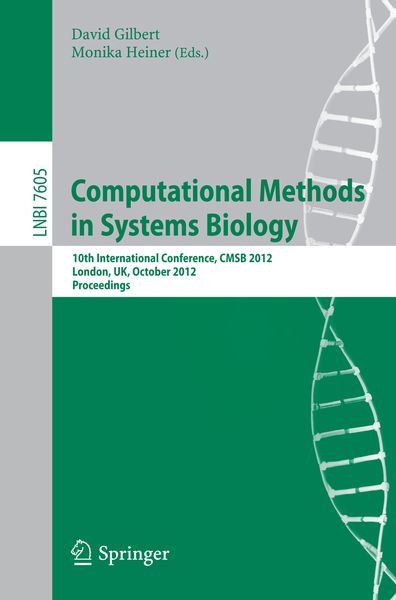
Computational Methods in Systems Biology 10th International Conference, CMSB 2012, London, UK, October 3-5, 2012, Proceedings

51,99 €

inkl. gesetzl. MwSt., Versandkostenfrei


Beschreibung

Produktdetails

Einband

Taschenbuch

Erscheinungsdatum

01.09.2012

Abbildungen

XII, 145 illus., schwarz-weiss Illustrationen

Herausgeber

David Gilbert + weitere

Verlag

Springer Berlin

Seitenzahl

396

Maße (L/B/H)

23,5/15,5/2,3 cm

Gewicht

616 g

Auflage

2012

Sprache

Englisch

ISBN

978-3-642-33635-5

Beschreibung

Produktdetails

Einband

Taschenbuch

Erscheinungsdatum

01.09.2012

Abbildungen

XII, 145 illus., schwarz-weiss Illustrationen

Herausgeber

Verlag

Springer Berlin

Seitenzahl

396

Maße (L/B/H)

23,5/15,5/2,3 cm

Gewicht

616 g

Auflage

2012

Sprache

Englisch

ISBN

978-3-642-33635-5

Herstelleradresse

Springer-Verlag KG
Sachsenplatz 4-6
1201 Wien
AT

Email: GPSR Kontakt

Noch keine Bewertungen vorhanden

Verfassen Sie die erste Bewertung zu diesem Artikel

Helfen Sie anderen Kundinnen und Kunden durch Ihre Meinung.

Kundinnen und Kunden meinen

Bewertungen (0)

  • Produktbild: Computational Methods in Systems Biology
  • Produktbild: Computational Methods in Systems Biology
  • Differential and Integral Views of Gene-Phenotype Relations.- Resolving the Three-Dimensional Histology of the Heart.- Bimodal Protein Distributions in Heterogeneous Oscillating Systems.- Expressive Statistical Model Checking of Genetic Networks with Delayed Stochastic Dynamics.- Detection of Multi-clustered Genes and Community Structure for the Plant Pathogenic Fungus.- Analysis of Modular Organization of Interaction Networks Based on Asymptotic Dynamics.- Concretizing the Process Hitting into Biological Regulatory Networks.- Investigating Co-infection Dynamics through Evolution of Bio-PEPA Model Parameters: A Combined Process Algebra and Evolutionary Computing Approach.- Population Dynamics P Systems on CUDA.- Efficient Handling of Large Signaling-Regulatory Networks by Focusing on Their Core Control.- Simulating Insulin Infusion Pump Risks by In-Silico Modeling of the Insulin-Glucose Regulatory System.- Revisiting the Training of Logic Models of Protein Signaling Networks with a Formal Approach Based on Answer Set Programming.