
Gutscheinbedingungen

**Gültig von 22.06.2026 ab 19 Uhr bis 23.06.2026 24 Uhr auf Spielzeug, Schreibwaren, Filme, Geschenke & Trends, Musik, tolino eReader & Zubehör, Hörbücher und Hörbuch-Downloads (außer Abo), nicht preisgebundene Bücher und Kalender online auf thalia.at und in der Thalia App. Einzelne Artikel können ausgeschlossen sein. Aufgrund der Buchpreisbindung sind deutschsprachige Bücher und eBooks ausgenommen. Zusätzlich ausgenommen sind preisgebundene Artikel, Abos & Flatrates, eBooks, Games, Geschenkkarten/-boxen, Shelfies, Software, Zeitschriften sowie einzelne Artikel von tonies®. Pro Einkauf einmal einlösbar. Click & Collect nur bei Onlinevorabzahlung möglich. Keine Barauszahlung. Nicht kombinierbar mit anderen Aktionen und Gutscheinen. Gutschein wird auf max. 500€ Bestellwert angerechnet. Nicht gültig für Versandkosten und Services.

  • Produktbild: Intelligent Robotics and Applications
  • Produktbild: Intelligent Robotics and Applications

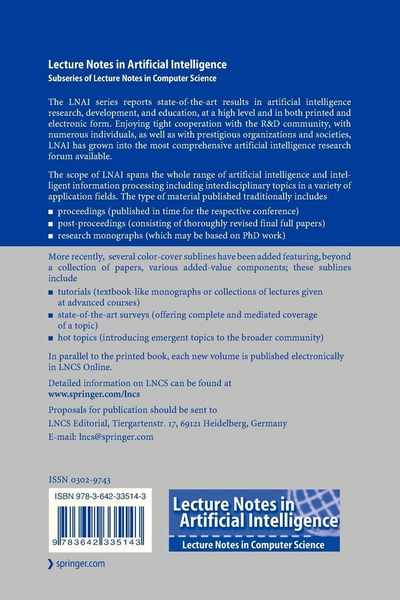
Intelligent Robotics and Applications 5th International Conference, ICIRA 2012, Montreal, Canada, October 3-5, 2012, Proceedings, Part II

51,99 €

inkl. gesetzl. MwSt., Versandkostenfrei


Beschreibung

Produktdetails

Einband

Taschenbuch

Erscheinungsdatum

18.08.2012

Abbildungen

XXI, 430 illus., schwarz-weiss Illustrationen

Herausgeber

Chun-Yi Su + weitere

Verlag

Springer Berlin

Seitenzahl

715

Maße (L/B/H)

23,5/15,5/4 cm

Gewicht

1101 g

Auflage

2012

Sprache

Englisch

ISBN

978-3-642-33514-3

Beschreibung

Produktdetails

Einband

Taschenbuch

Erscheinungsdatum

18.08.2012

Abbildungen

XXI, 430 illus., schwarz-weiss Illustrationen

Herausgeber

Verlag

Springer Berlin

Seitenzahl

715

Maße (L/B/H)

23,5/15,5/4 cm

Gewicht

1101 g

Auflage

2012

Sprache

Englisch

ISBN

978-3-642-33514-3

Herstelleradresse

Springer-Verlag GmbH
Tiergartenstr. 17
69121 Heidelberg
DE

Email: ProductSafety@springernature.com

Kundinnen und Kunden meinen

0 Bewertungen

Informationen zu Bewertungen

Zur Abgabe einer Bewertung ist eine Anmeldung im Konto notwendig. Die Authentizität der Bewertungen wird von uns nicht überprüft. Wir behalten uns vor, Bewertungstexte, die unseren Richtlinien widersprechen, entsprechend zu kürzen oder zu löschen.

Die Bewertungen sind nach Format, Anzahl Sterne und Datum sortiert.

Verfassen Sie die erste Bewertung zu diesem Artikel

Helfen Sie anderen Kund*innen durch Ihre Meinung

Kundinnen und Kunden meinen

0 Bewertungen filtern

  • Produktbild: Intelligent Robotics and Applications
  • Produktbild: Intelligent Robotics and Applications
  • Wireless Master-Slave FES Rehabilitation System Using sEMG Control.-  Intelligent Prescription-Diagnosis Function for Rehabilitation Training Robot System.-  Human Behavior Recognition by a Bio-monitoring Mobile Robot.-  Differentiated Time-Frequency Characteristics Based Real-Time Motion Decoding for Lower Extremity Rehabilitation Exoskeleton Robot.-  3D Semantic Map-Based Shared Control for Smart Wheelchair.-  Nonlinear Sliding Mode Control Implementation of an Upper Limb Exoskeleton Robot to Provide Passive Rehabilitation Therapy.-  sEMG-Based Control of an Exoskeleton Robot Arm.-  Approaches of Applying Human-Robot-Interaction-Technologies to Assist Workers with Musculoskeletal Disorders in Production.-  Simulation Study of an FES-Involved Control Strategy for Lower Limb Rehabilitation Robot.-  Development of a Rehabilitation Robot for Upper-Limb Movements.-  Dynamic Optimization with a New Performance Index for a 2-DoF Translational Parallel Manipulator.-  Research of Piezoelectric Printing Actuator for High-Power White LED Phosphor Coating.-  Development of OLED Panel Defect Detection System through Improved Otsu Algorithm.-  The Linkage Control Strategy for the Two-Phase Flow Dispensing System.-  The Transient Temperature Field Measurement System for Laser Bonding Process.-  Modeling of Electromagnetic Interference Noise Mechanism for Magneto-Rheological Damper.-  An Image Based Algorithm to Safely Locate Human Extremities for Human-Robot Collaboration.-  Research of a Multi-DOF Pathological Sampling Flexible Robot.-  Control by 3D Simulation – A New eRobotics Approach to Control Design in Automation.-  Human Intention Estimation Using Time-Varying Fuzzy Markov Modelsfor Natural Non-verbal Human Robot Interface.-  Influence of Human Driving Characteristics on Path Tracking Performance of Vehicle.-  Single Machine Oriented Match-Up Rescheduling Method for Semiconductor Manufacturing System.-  Sub-regional Flank Milling Method.-  Robotics for the Benefit of Footwear Industry.-  Application of Grey Based Taguchi Method to Determine Optimal End Milling Parameters.-  Force Prediction in Plunge Milling of Inconel 718.-  Dynamic Cutter Runout Measurement with Laser Sensor.-  Structure and Electromagnetic Actuation Systems of Microrobot.-  Modeling of Rate-Dependent Hysteresis for Piezoelectric Actuator with MPI Model-Based Hammerstein System.-  Identification of Prandtl-Ishlinskii Hysteresis Models Using Modified Particle Swarm Optimization.-  Wireless Electrical Power to Sub-millimeter Robots.-  A Digital Lock-In Amplifier Based Contact Detection Technique for Electrochemical Nanolithography.-  Optimization of a Compliant Mechanical Amplifier Based on a Symmetric Five-Bar Topology.-  Hybrid Potential Field Swarm Optimization Based Novel Targeted Drug Delivery System Using Drug Loaded Nano Carriers.-  The CSUF Unmanned Utility Ground Robotic Vehicle.-  Guaranteed Mobile Robot Tracking Using Robust Interval Constraint Propagation.-  Trajectory Tracking of Wheeled Mobile Robot with a Manipulator Considering Dynamic Interaction and Modeling Uncertainty.-  Proposal and Evaluation of Integer Inverse Kinematics for Multijoint Small Robot.-  Velocity Selection for High-Speed UGVs in Rough Unknown Terrains Using Force Prediction.-  Modeling and Autonomous Control of Multiple Mobile Manipulators Handling Rigid Objects.-  A Mobile Robotic Platform forGenerating Radiation Maps.-  Effect of Limiting Wheel Slip on Two-Wheeled Robots in Low Traction Environments.-  Nao Robot Localization and Navigation Using Fusion of Odometry and Visual Sensor Data.-  A Graph-Based Hierarchical SLAM Framework for Large-Scale Mapping.-  LOCOBOT - Low Cost Toolkit for Building Robot Co-workers in Assembly Lines.-  Model Identification and H ∞ Attitude Control for Quadrotor MAV’s.-  An Intelligent Approach to Hysteresis Compensation while Sampling Using a Fleet of Autonomous Watercraft.-  Concept of a Biologically Inspired Robust Behaviour Control System.-   MinPos : A Novel Frontier Allocation Algorithm for Multi-robot Exploration.-  Experimental Validation of the Extended Computed Torque Control Approach in the 5R Parallel Robot Prototype.-  Model-Free Robust Control for Fluid Disturbed Underwater Vehicles.-  Sliding-Mode Observer Based Flux Estimation of Induction Motors.-  A Gasoline Engine Crankshaft Fatigue Analysis and Experiment.-  High Precision Embedded Control of a High Acceleration Positioning System.-  Rapid Control Selection through Hill-Climbing Methods.-  Robust Mode-Free Sliding Mode Control of Multi-fingered Hand with Position Synchronization in the Task Space.-  An FPGA-Based Real-Time Solution for Networked Motion Control Systems.-  Synchronous Control for Trajectory Tracking in Networked Multi-agent Systems.-  Multirobot Behavior Synchronization through Direct Neural Network Communication.-  Virtual Field Testing for Performance Evaluation of Cooperative MultipleRobots.-  Leader-Follower Formation Control Using PID Controller.-  Internet-Based Telerobotics of Mobile Manipulators: Application on RobuTER/ULM.-   Multi-agent Control Architecture of Mobile Manipulators: Pulling Doors Open.-  Planar Surface Area Transformation and Calculation Using Camera and Orientation Sensor.-  Multi-modal People Tracking for an Awareness Behavior of an Interactive Tour-Guide Robot.-  A Robotic Pan and Tilt 3-D Target Tracking System by Data Fusion of Vision, Encoder, Accelerometer, and Gyroscope Measurements.-  A DSmT-Based Approach for Data Association in the Context of Multiple Target Tracking.-  Planning Sensor Feedback for Assembly Skills by Using Sensor State Space Graphs.