Gutscheinbedingungen

**Gültig bis 15.06.2026 auf Spiele & Spielzeug online auf thalia.at, in der Thalia App ab einem Mindestbestellwert von 30€ und in allen Thalia Buchhandlungen in Österreich. In den Buchhandlungen nur gültig auf lagernde Ware. Einzelne Artikel können ausgeschlossen sein. Ausgenommen sind preisgebundene Artikel sowie online auf thalia.at und in der Thalia App einzelne Artikel von tonies®. Pro Einkauf einmal einlösbar. Nur gültig gegen Vorlage oder im Onlineshop hinterlegter Bonuscard. Infos zur Einlösung in der Buchhandlung sind auf der Bonuscard-Vorteilspreisseite zu finden. Click & Collect nur bei Onlinevorabzahlung möglich. Keine Einlösung bei Scan & Go-Bezahlung. Keine Barauszahlung. Nicht kombinierbar mit anderen Aktionen und Gutscheinen. Gutschein wird auf max. 500€ Bestellwert angerechnet. Nicht gültig für Geschenkkarten, Versandkosten und Services.

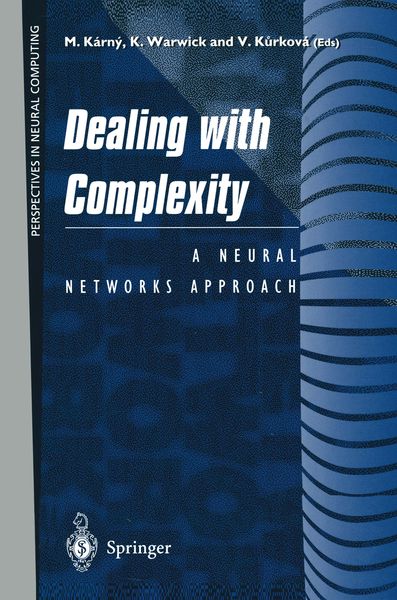
  • Produktbild: Dealing with Complexity
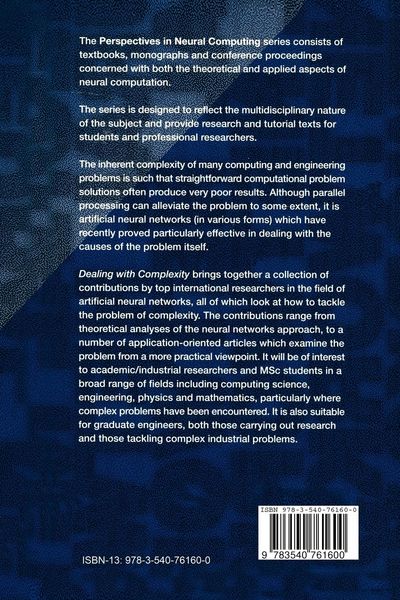
  • Produktbild: Dealing with Complexity

Dealing with Complexity A Neural Networks Approach

99,99 €

inkl. gesetzl. MwSt., Versandkostenfrei


Beschreibung

Produktdetails

Einband

Taschenbuch

Erscheinungsdatum

07.11.1997

Herausgeber

Mirek Karny + weitere

Verlag

Springer Berlin

Seitenzahl

308

Maße (L/B/H)

23,5/15,5/1,8 cm

Gewicht

500 g

Auflage

1st Edition.

Sprache

Englisch

ISBN

978-3-540-76160-0

Beschreibung

Produktdetails

Einband

Taschenbuch

Erscheinungsdatum

07.11.1997

Herausgeber

Verlag

Springer Berlin

Seitenzahl

308

Maße (L/B/H)

23,5/15,5/1,8 cm

Gewicht

500 g

Auflage

1st Edition.

Sprache

Englisch

ISBN

978-3-540-76160-0

Herstelleradresse

Springer-Verlag KG
Sachsenplatz 4-6
1201 Wien
AT

Email: ProductSafety@springernature.com

Kundinnen und Kunden meinen

0 Bewertungen

Informationen zu Bewertungen

Zur Abgabe einer Bewertung ist eine Anmeldung im Konto notwendig. Die Authentizität der Bewertungen wird von uns nicht überprüft. Wir behalten uns vor, Bewertungstexte, die unseren Richtlinien widersprechen, entsprechend zu kürzen oder zu löschen.

Die Bewertungen sind nach Format, Anzahl Sterne und Datum sortiert.

Verfassen Sie die erste Bewertung zu diesem Artikel

Helfen Sie anderen Kund*innen durch Ihre Meinung

Kundinnen und Kunden meinen

0 Bewertungen filtern

  • Produktbild: Dealing with Complexity
  • Produktbild: Dealing with Complexity
  • 1 Recurrent Neural Networks: Some Systems-Theoretic Aspects.- 1 Introduction.- 2 System-Theory Results: Statements.- 3 System-Theory Results: Discussion.- 4 Computational Power.- 5 Some Remarks.- 2 The Use of State Space Control Theory for Analysing Feedforward Neural Networks.- 1 Introduction.- 2 State Space Theory.- 3 State Space Representation of Feedforward Neural Networks.- 4 Observability of Feedforward Neural Networks.- 5 Controllability.- 6 Stability.- 7 Discussion.- 8 Appendix: Linear Systems of Equations [7].- 3 Statistical Decision Making and Neural Networks.- 1 Introduction.- 2 Statistical Decision Making.- 3 Bayesian Learning.- 4 On Ingredients of Bayesian Learning.- 5 Interlude on Gaussian Linear Regression Model.- 6 Approximate On-Line Estimation.- 7 Conclusions.- 4 A Tutorial on the EM Algorithm and its Applications to Neural Network Learning.- 1 Introduction.- 2 The EM Algorithm.- 3 Practical Applications.- 4 Convergence Properties.- 5 Concluding Remarks.- 5 On the Effectiveness of Memory-Based Methods inMachine Learning.- 1 Introduction.- 2 Background.- 3 The Curse of Dimensionality.- 4 The Barron-Jones Theory.- 5 Experimental Results.- 6 Analysis of Memory-Based Methods.- 7 Discussion.- 6 A Study of Non Mean Square Error Criteria for the Training of Neural Networks.- 1 Introduction.- 2 Statement of the Problem.- 3 Cost Function Minimisation for ? = E(y/x).- 4 Cost Function Minimisation for the Median of p(y/x).- 5 Simulation Results.- 6 Conclusion.- 7 A Priori Information in Network Design.- 1 Introduction.- 2 Preliminaries.- 3 Recurrent Networks and Relative Order.- 4 Simulations.- 5 Conclusions.- 8 Neurofuzzy Systems Modelling: A Transparent Approach.- 1 Empirical Data Modelling.- 2 Neurofuzzy Construction Algorithms.- 3 Modelling Case Studies.- 4 Conclusions.- 9 Feature Selection and Classification by a Modified Model with Latent Structure.- 1 Introduction.- 2 Modified Model with Latent Structure.- 3 Optimizing Model Parameters.- 4 Approach to Feature Selection.- 5 Pseudo-Bayes Decision Rule.- 6 Experiments.- 7 Summary and Conclusion.- 10 Geometric Algebra Based Neural Networks.- 1 Introduction.- 2 Complex-Valued Neural Networks.- 3 Comments on the Applicability of CVNNs to n-Dimensional Signals.- 4 Generalisations of CVNNs Within a GA Framework.- 5 Summary.- 11 Discrete Event Complex Systems: Scheduling with Neural Networks.- 1 Introduction.- 2 The DNN Architecture.- 3 Continuous Time Control Law.- 4 Real-Time Scheduling.- 5 Simulation Results.- 6 Summary.- 12 Incremental Approximation by Neural Networks.- 1 Introduction.- 2 Approximation of Functions by One-Hidden-Layer Networks.- 3 Rates of Approximation of Incremental Approximants.- 4 Variation with Respect to a Set of Functions.- 5 Incremental Approximation by Perceptron and RBF Networks.- 6 Discussion.- 13 Approximation of Smooth Functions by Neural Networks.- 1 Introduction.- 2 Preliminaries.- 3 Complexity Theorems.- 4 Local Approximation.- 5 Some Open Problems.- 14 Rates of Approximation in a Feedforward Network Depend on the Type of Computational Unit.- 1 Introduction.- 2 Feedforward Networks with Various Computational Units.- 3 Discussion.- 15 Recent Results and Mathematical Methods for Functional Approximation by Neural Networks.- 1 Introduction.- 2 Individual vs Variable Context.- 3 Nonlinear Approximation.- 4 Feedforward Architectures.- 5 Lower Bounds on Rate of Approximation.- 6 Uniqueness of Approximation by Neural Networks.- 7 Other Approaches.- 16 Differential Neurocontrol of Multidimensional Systems.- 1 Introduction.- 2 Neurophysiological Basis.- 3 Scheme of the Differential Neurocontroller.- 4 Multiplicative Units.- 5 Feedback Block.- 6 Feedforward Block.- 7 Convergence of Learning.- 8 Computer Simulations.- 9 Conclusions.- 17 The Psychological Limits of Neural Computation.- 1 Neural Networks and Turing Machines.- 2 Function Approximation.- 3 Representation of Logical Functions Using Neural Networks.- 4 The Complexity of Learning in Neural Networks.- 5 Learning Logical Functions.- 6 The Optimization of Circuits.- 7 Final Remarks.- 18 A Brain-Like Design to Learn Optimal Decision Strategies in Complex Environments.- 1 Introduction.- 2 Time-Chunked Approximate Dynamic Programming.- 3 Temporal Chunking with Neural Networks.- 4 Spatial Chunking and Critical Subsystems.- 5 Adding the Third Brain.- Research Acknowledgements.