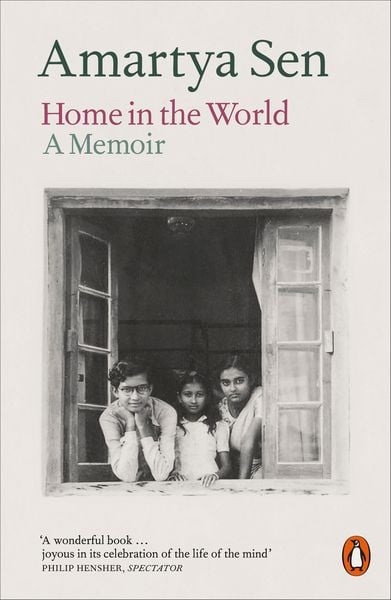
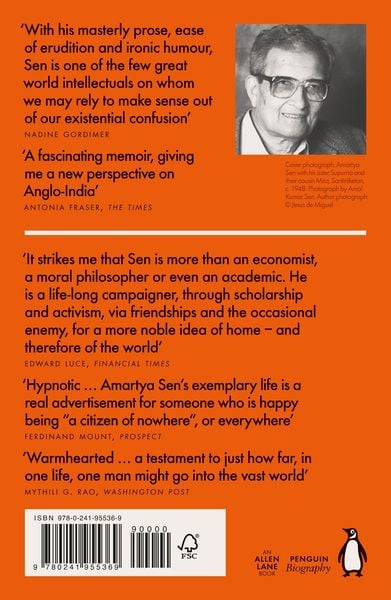
Home in the World A Memoir
-
- Hardcover
- Taschenbuch ausgewählt
- eBook
-
Sprache:Englisch
12,99 €
UVP
18,50 €
inkl. gesetzl. MwSt.,
- Kostenlose Lieferung ab 30 € Einkaufswert
- Versandkostenfrei für Bonuscard-Kund*innen
Beschreibung
Produktdetails
Einband
Taschenbuch
Erscheinungsdatum
09.06.2022
Verlag
Penguin Books LtdSeitenzahl
461
Maße (L/B/H)
19,1/13,3/3 cm
Gewicht
333 g
Farbe
Lichtgrau / Anthrazit
Sprache
Englisch
ISBN
978-0-241-95536-9
The extraordinary early life in India and England of one of the world's leading public intellectuals
Where is 'home'? For Amartya Sen, home has been many places - Dhaka in modern Bangladesh, the little university town of Santiniketan, where he was raised as much by his grandparents as by his parents, Calcutta where he first studied economics and was active in student movements, and Trinity College, Cambridge, to which he came aged 19.
Sen brilliantly recreates the atmosphere in each of these. He remembers his river journeys between Dhaka and his parents' ancestral homes and wonderfully explores the rich history and culture of Bengal. In 1943 he witnessed the disastrous unfolding of the Bengal Famine, and the following year the inflaming of tensions between Hindus and Muslims. In the years before Independence, some of his family were imprisoned for their opposition to British rule.
Central to Sen's formation was the intellectually liberating school in Santiniketan founded by Rabindranath Tagore (who gave him his name Amartya) and exciting conversations in the Coffee House on College Street in Calcutta. In Cambridge, he engaged with many of the leading economists and philosophers of the day, especially with the great Marxist thinker Piero Sraffa, who provided a direct connection not only to Wittgenstein, but to Antonio Gramsci and the anti-fascist battles in Italy in the 1920s. After years in Europe and America, the book ends when he returns to Delhi in 1963.
Home in the World shows how Sen's experience shaped his ideas - about economics, philosophy, identity, community, famines, gender inequality, social choice and the power of discussion in public life. The joys of learning and the importance of friendship are powerfully conveyed. He invokes some of the great thinkers of the past and his own time - from Ashoka in the third century BC and Akbar in the sixteenth, to David Hume, Adam Smith, Karl Marx, John Maynard Keynes, Maurice Dobb, Kenneth Arrow and Eric Hobsbawm. Above all, Sen emphasises the importance of enlarging our views as much as we can, of human sympathy and understanding across time and distance, and of being at home in the world.
Noch keine Bewertungen vorhanden
Verfassen Sie die erste Bewertung zu diesem Artikel
Helfen Sie anderen Kundinnen und Kunden durch Ihre Meinung.
Kurze Frage zu unserer Seite
Vielen Dank für Ihr Feedback
Wir nutzen Ihr Feedback, um unsere Produktseiten zu verbessern. Bitte haben Sie Verständnis, dass wir Ihnen keine Rückmeldung geben können. Falls Sie Kontakt mit uns aufnehmen möchten, können Sie sich aber gerne an unseren Kund*innenservice wenden.
zum Kundenservice