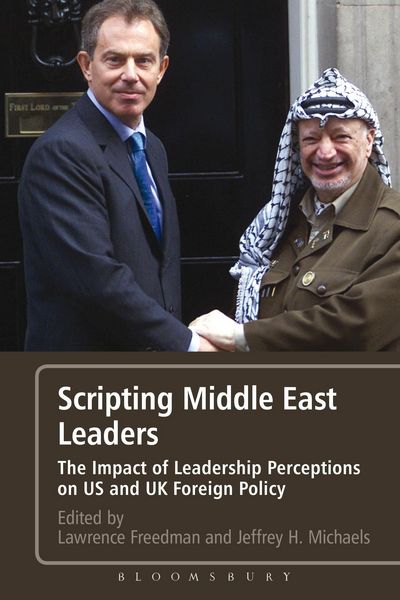
Produktbild: Scripting Middle East Leaders

Scripting Middle East Leaders The Impact of Leadership Perceptions on U.S. and UK Foreign Policy

58,99 €

inkl. gesetzl. MwSt., Versandkostenfrei


Beschreibung

Produktdetails

Einband

Taschenbuch

Erscheinungsdatum

20.12.2012

Herausgeber

Lawrence Freedman + weitere

Verlag

Bloomsbury USA

Seitenzahl

248

Maße (L/B/H)

22,8/15,4/1,7 cm

Gewicht

405 g

Sprache

Englisch

ISBN

978-1-4411-0841-8

Beschreibung

Zitat

This is really a marvelous project - timely, important, and with absolutely first-rate authors. Students, professionals in the field, and members of the interested public will find it fascinating and instructive. -- Robert Jervis, Adlai E. Stevenson Professor of International Affairs, Columbia University, USA Freedman and Michaels have assembled a powerful set of contributors in support of their model of how the US and UK have naively scripted Middle East leaders as players in Western dramas, often casting the same leader at different times in roles as needed reformer, ally of convenience, villain, diabolical enemy, outlaw or irrelevance. This collection of essays should be read by any who reach for arguments from the past for action (or to justify inaction) using slogans such as Munich, Pearl Harbour, Suez, Vietnam, and most recently Afghanistan. This is a substantial contribution to our understanding of the unconscious influences on Western policies towards the Middle East: those who conceived the 2003 invasion of Iraq would have benefited especially from the analytic essay on strategic scripts by Professor Freedman that opens this book. -- Sir David Omand GCB, former UK Security and Intelligence Coordinator 2002-2005 This collection of well-researched essays describes the images that American and British policy-makers have formed of their ten major Middle East adversaries over recent years - from Abdul Nasser through Arafat and Saddam Hussein to Bashar al-Asad and Ahmadinejad - and how these images have influenced their policies. The portraits are revealing and intriguing, even entertaining. Academics who cannot indulge in entertainment should still find the time to read the valuable introductory chapters, illuminating, with reference to recent advances in cognitive science, the processes by which policy-makers, inevitably swayed by complex emotions, try to make sense of the information coming to them, and devise "strategic scripts" as a basis for action. -- Sir Harold Walker, Former British ambassador to Bahrain, the UAE, Ethiopia and Iraq Summing Up: Recommended. Upper-division undergraduate, graduate, research, and professional collections. -- A. R. Abootalebi, University of Wisconsin, Eau Claire CHOICE

Produktdetails

Einband

Taschenbuch

Erscheinungsdatum

20.12.2012

Herausgeber

Verlag

Bloomsbury USA

Seitenzahl

248

Maße (L/B/H)

22,8/15,4/1,7 cm

Gewicht

405 g

Sprache

Englisch

ISBN

978-1-4411-0841-8

Herstelleradresse

Libri GmbH
Europaallee 1
36244 Bad Hersfeld
DE

Email: GPSR Kontakt

Noch keine Bewertungen vorhanden

Verfassen Sie die erste Bewertung zu diesem Artikel

Helfen Sie anderen Kundinnen und Kunden durch Ihre Meinung.

Kundinnen und Kunden meinen

Bewertungen (0)

Die Leseprobe wird geladen.
  • Produktbild: Scripting Middle East Leaders
  • 1. Introduction (Lawrence Freedman and Jeffrey Michaels)
    2. Strategic Scripts (Lawrence Freedman)
    3. Emotion and Threat Perception: New Frontiers of Research (Janice Gross Stein)
    4. Hitler on the Nile? British and American Perceptions of the Nasser Regime, 1952-70 (Nigel Ashton)
    5. Seeing Sadat, Thinking Nasser (Dina Rezk)
    6. Getting Khomeini Wrong - Perceptions and Misperceptions of Iran's Revolutionary Leadership (David Patrick Houghton)
    7. Envisioning Arafat: Views from Washington from Richard Nixon to George W. Bush (William B. Quandt)
    8. Waiting for the coup; Oriental Despotism, Saddam Hussein and Anglo-American policy, 1990-2003 (Toby Dodge)
    9. British Intelligence and Gaddafi (Christopher Andrew)
    10. Western Views of Osama bin Laden (Peter R. Neumann)
    11. Desperately Seeking Mahmoud: Misreadings of (and Beyond) Ahmadinejad (William Scott Lucas)
    12. Mubarak: The Embodiment of 'Moderate Arab' Leadership (Rosemary Hollis)
    13. Conclusion