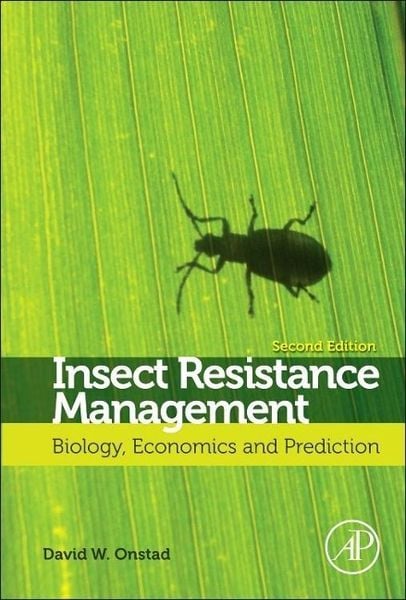
Insect Resistance Management Biology, Economics, and Prediction
-
Sprache:Englisch
-
Verlag:Elsevier LTD, Oxford
68,99 €
UVP
78,10 €
inkl. gesetzl. MwSt.,
Beschreibung
Produktdetails
Einband
Gebundene Ausgabe
Erscheinungsdatum
23.10.2013
Abbildungen
mit Illustrationen
Herausgeber
Onstad David W.Verlag
Elsevier LTD, OxfordSeitenzahl
560
Maße (L/B/H)
23,6/15,4/4 cm
Gewicht
940 g
Auflage
2. Auflage
Sprache
Englisch
ISBN
978-0-12-396955-2
Neither pest management nor resistance management can occur with only an understanding of pest biology. For years, entomologists have understood, with their use of economic thresholds, that at least a minimal use of economics was necessary for proper integrated pest management. IRM is even more complicated and dependent on understanding and using socioeconomic factors. The new edition of Insect Resistance Management addresses these issues and much more.
Many new ideas, facts and case studies have been developed since the previous edition of Insect Resistance Management published. With a new chapter focusing on Resistance Mechanisms Related to Plant-incorporated Toxins and heavily expanded revisions of several existing chapters, this new volume will be an invaluable resource for IRM researchers, practitioners, professors and advanced students. Authors in this edition include professors at major universities, leaders in the chemical and seed industry, evolutionary biologists and active IRM practitioners. This revision also contains more information about IRM outside North America, and a modeling chapter contains a large new section on uncertainty analysis, a subject recently emphasized by the U.S. Environmental Protection Agency. The final chapter contains a section on insecticidal seed treatments.
No other book has the breadth of coverage of Insect Resistance Management, 2e. It not only covers molecular to economic issues, but also transgenic crops, seed treatments and other pest management tactics such as crop rotation. Major themes continuing from the first edition include the importance of using IRM in the integrated pest management paradigm, the need to study and account for pest behavior, and the influence of human behavior and decision making in IRM.
Noch keine Bewertungen vorhanden
Verfassen Sie die erste Bewertung zu diesem Artikel
Helfen Sie anderen Kundinnen und Kunden durch Ihre Meinung.
Kurze Frage zu unserer Seite
Vielen Dank für Ihr Feedback
Wir nutzen Ihr Feedback, um unsere Produktseiten zu verbessern. Bitte haben Sie Verständnis, dass wir Ihnen keine Rückmeldung geben können. Falls Sie Kontakt mit uns aufnehmen möchten, können Sie sich aber gerne an unseren Kund*innenservice wenden.
zum Kundenservice