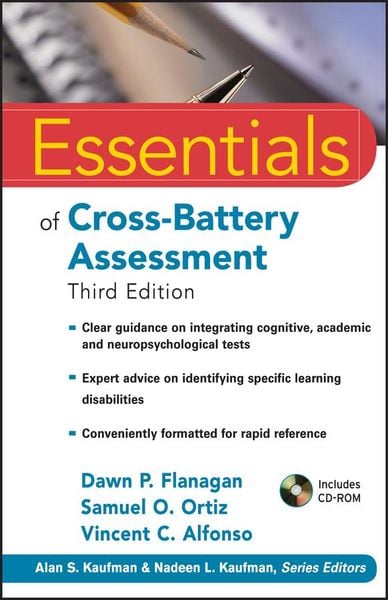
Essentials of Cross-Battery Assessment
-
- Englisch ausgewählt
-
Auflage:3rd Revised edition
- 4th edition 63,99 €
- 3rd Revised edition 69,99 € ausgewählt
69,99 €
inkl. gesetzl. MwSt.,
Beschreibung
Produktdetails
Einband
Taschenbuch
Erscheinungsdatum
01.04.2013
Herausgeber
Alan S Kaufman + weitereVerlag
John Wiley & SonsSeitenzahl
576
Maße (L/B/H)
21,6/13,9/4,3 cm
Gewicht
675 g
Auflage
3rd Revised edition
Sprache
Englisch
ISBN
978-0-470-62195-0
The Cross-Battery assessment approach--also referred to as the XBA approach--is a time-efficient assessment method grounded solidly in contemporary theory and research. The XBA approach systematically integrates data across cognitive, achievement, and neuropsychological batteries, enabling practitioners to expand their traditional assessments to more comprehensively address referral concerns. This approach also includes guidelines for identification of specific learning disabilities and assessment of cognitive strengths and weaknesses in individuals from culturally and linguistically diverse backgrounds.
Like all the volumes in the Essentials of Psychological Assessment series, Essentials of Cross-Battery Assessment, Third Edition is designed to help busy practitioners quickly acquire the knowledge and skills they need to make optimal use of psychological assessment instruments. Each concise chapter features numerous callout boxes highlighting key concepts, bulleted points, and extensive illustrative material, as well as test questions that help you to gauge and reinforce your grasp of the information covered.
Essentials of Cross-Battery Assessment, Third Edition is updated to include the latest editions of cognitive ability test batteries , such as the WISC-IV, WAIS-IV, and WJ III COG, and special purpose cognitive tests including the WMS-IV and TOMAL-II. This book now also overs many neuropsychological batteries such as the NEPSY-II and D-KEFS and provides extensive coverage of achievement batteries and special purpose tests, including the WIAT-III, KM-3, WRMT-3 and TOWL-4. In all, this book includes over 100 psychological batteries and 750 subtests, all of which are classified according to CHC (and many according to neuropsychlogical theory. This useful guide includes a timesaving CD-ROM, Essential Tools for Cross-Battery Assessment (XBA) Applications and Interpretation, which allows users to enter data and review results and interpretive statements that may be included in psychological reports.
Note: CD-ROM/DVD and other supplementary materials are not included as part of eBook file.
Noch keine Bewertungen vorhanden
Verfassen Sie die erste Bewertung zu diesem Artikel
Helfen Sie anderen Kundinnen und Kunden durch Ihre Meinung.
Kurze Frage zu unserer Seite
Vielen Dank für Ihr Feedback
Wir nutzen Ihr Feedback, um unsere Produktseiten zu verbessern. Bitte haben Sie Verständnis, dass wir Ihnen keine Rückmeldung geben können. Falls Sie Kontakt mit uns aufnehmen möchten, können Sie sich aber gerne an unseren Kund*innenservice wenden.
zum Kundenservice