Gutscheinbedingungen

**Gültig bis 24.09.2026 ab einem Mindestbestellwert von 30€ auf Spielzeug, Schreibwaren, Filme, Geschenke & Trends, Musik, tolino eReader & Zubehör, Hörbücher und Hörbuch-Downloads, nicht preisgebundene Bücher und Kalender online auf thalia.at und in der Thalia App. Einzelne Artikel können ausgeschlossen sein. Aufgrund der Buchpreisbindung sind deutschsprachige Bücher und eBooks ausgenommen. Zusätzlich ausgenommen sind Abos & Flatrates, Games, Geschenkkarten/-boxen, Shelfies, Software, Zeitschriften sowie einzelne Artikel von tonies®. Pro Einkauf einmal einlösbar. Click & Collect nur bei Onlinevorabzahlung möglich. Keine Barauszahlung. Nicht kombinierbar mit anderen Aktionen und Gutscheinen. Gutschein wird auf max. 500€ Bestellwert angerechnet. Nicht gültig für Versandkosten und Services. Preisgebundene Artikel sind vom Mindestbestellwert ausgeschlossen.

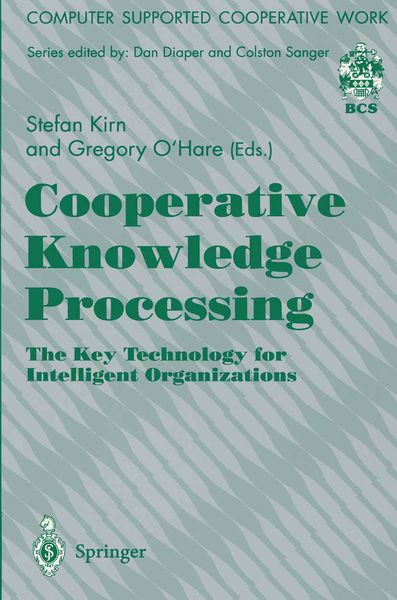
Produktbild: Cooperative Knowledge Processing

Cooperative Knowledge Processing The Key Technology for Intelligent Organizations

99,99 €

inkl. gesetzl. MwSt., Versandkostenfrei


Beschreibung

Produktdetails

Einband

Taschenbuch

Erscheinungsdatum

26.11.1996

Abbildungen

XXV, 296 p. 25 illus.

Herausgeber

Stefan Kirn + weitere

Verlag

Springer Berlin

Seitenzahl

296

Maße (L/B/H)

23,5/15,5/1,8 cm

Gewicht

493 g

Auflage

1st Edition

Sprache

Englisch

ISBN

978-3-540-19951-9

Beschreibung

Produktdetails

Einband

Taschenbuch

Erscheinungsdatum

26.11.1996

Abbildungen

XXV, 296 p. 25 illus.

Herausgeber

Verlag

Springer Berlin

Seitenzahl

296

Maße (L/B/H)

23,5/15,5/1,8 cm

Gewicht

493 g

Auflage

1st Edition

Sprache

Englisch

ISBN

978-3-540-19951-9

Herstelleradresse

Springer-Verlag KG
Sachsenplatz 4-6
1201 Wien
AT

Email: ProductSafety@springernature.com

Noch keine Bewertungen vorhanden

Verfassen Sie die erste Bewertung zu diesem Artikel

Helfen Sie anderen Kundinnen und Kunden durch Ihre Meinung.

Kundinnen und Kunden meinen

Bewertungen (0)

  • Produktbild: Cooperative Knowledge Processing
  • 1 Cooperative Knowledge Processing — Research Framework and Applications.- 1.1 Introduction.- 1.2 Organizational Paradigms: Evolving Role of Information Technology.- 1.3 New Organizational Strategies: A Brief Review.- 1.4 Technology of Cooperative Knowledge Processing.- 1.5 Application Perspectives.- 1.6 Summary.- 2 Coordination in Organizations.- 2.1 Introduction.- 2.2 Organizational Coordination.- 2.3 Computers and Coordination.- 2.4 Design Issues and Applications.- 2.5 Example of a Strategy Related Coordination System.- 3 Communication-Oriented Approaches to Support Multi-User Processes in Office Work.- 3.1 Introduction.- 3.2 Office Work.- 3.3 Requirements to Support Multi-User Processes in Office Work.- 3.4 Communication Orientated Approaches for Supporting Office Work.- 3.5 Evaluation of the Approaches Presented.- 3.6 Summary.- 4 Coordinating Human and Software Agents through Electronic Mail.- 4.1 Introduction.- 4.2 Software Support Tools.- 4.3 Modes of Interaction with Adcmail.- 4.4 The Coordination Mechanism.- 4.5 Conclusions.- 5 User Control over Coordination Mechanisms in Office Information Systems.- 5.1 Introduction.- 5.2 Office Model in ECHOES.- 5.3 Collaborative Work Scenarios.- 5.4 Modeling Coordination Mechanisms in ECHOES.- 5.5 Related Research.- 5.6 The ECHOES Project.- 5.7 Summary and Conclusion.- 6 Computational Support for the Management of Social Processes within Organizational Teams.- 6.1 Introduction.- 6.2 The Cooperative Requirements Capture (CRC) Project.- 6.3 The CRC Prototype.- 6.4 Description of the CRC User Interface.- 6.5 Why Facilitation?.- 6.6 The Role of the Facilitator.- 6.7 CRC Support for the Social Process.- 6.8 Facilitator Support within CRC Prototype.- 6.9 Future Work.- 6.10 Conclusions.- 7 The Wolf in Sheep’s Clothing: HowLocks Can Gently Control Collaboration.- 7.1 Introduction.- 7.2 Concurrency Control and Cooperative Work.- 7.3 Locks in the Context of Nested Transactions.- 7.4 Rules on Locks and Notification Services.- 7.5 Object-Related Locks.- 7.6 Subject-Related Locks.- 7.7 Conclusion.- 8 Enhancing Organizational Intelligence through Cooperative Problem Solving.- 8.1 Introduction.- 8.2 Organisational Intelligence (OI).- 8.3 Incorporating Organizational Intelligence into Distributed AI Systems.- 8.4 The Contribution of Distributed AI to the Intelligence of Computerized Enterprises.- 9 Organizational Intelligence and Negotiation Based DAI Systems — Theoretical Foundations and Experimental Results.- 9.1 Introduction.- 9.2 Theoretical Foundations.- 9.3 Extension of Contract Net-Based Systems by OI Components.- 9.4 Realization in a Scenario.- 9.5 Presentation and Evaluation of the Results.- 9.6 Conclusion.- 10 Incorporating Organizational Design Principles and Experiences into the Design and Implementation of Multi Agent Systems.- 10.1 Introduction.- 10.2 Distributed Artificial Intelligence (DAI).- 10.3 Organizational Theory (OT).- 10.4 A DAI Perspective on Organisations.- 10.5 Synthesizing DAI & OT.- 10.6 Design Principles.- 10.7 Agent Oriented Programming (AOP).- 10.8 Warehouse World.- 10.9 Design and Experimental Testing of Emergent Organizations.- 10.10 Conclusions.- 11 Coordination Protocols.- 11.1 Introduction.- 11.2 From Speech Acts to Dialogs.- 11.3 Protocols.- 11.4 Conclusion.- 12 Modeling Distributed Industrial Processes in a Multi-Agent Framework.- 12.1 Introduction.- 12.2 The Application Domain.- 12.3 A Specification Framework for Multi-Agent Systems.- 12.4 Formal Model and Specification of a Multi-Agent System.- 12.5 Discussion.- 13 Utilitarian Coalition FormationBetween Autonomous Agents for Cooperative Information Gathering.- 13.1 Introduction.- 13.2 A Brief Introduction to some Related Research Areas.- 13.3 The FCSI-Agent: Functionality and Architecture.- 13.4 Coalitions of FCSI Agents.- 13.5 IDEAS — an Environment for the Implementation of FCSI Agents.- 13.6 Conclusion and Discussion.- 13.7 Appendix.- Epilogue: Computers, Networks and the Corporation.- References.- Name Index.