Gutscheinbedingungen

**Gültig bis 14.09.2026 auf Spielzeug, Schreibwaren, Filme, Geschenke & Trends, Musik, tolino eReader & Zubehör, Hörbücher, nicht preisgebundene Bücher und Kalender in der Thalia App. Einzelne Artikel können ausgeschlossen sein. Aufgrund der Buchpreisbindung sind deutschsprachige Bücher und eBooks ausgenommen. Zusätzlich ausgenommen sind Abos & Flatrates, Games, Geschenkkarten/-boxen, Shelfies, Software, Zeitschriften sowie einzelne Artikel von tonies®. Pro Einkauf einmal einlösbar. Nur gültig mit im Onlineshop hinterlegter Bonuscard. Click & Collect nur bei Onlinevorabzahlung möglich. Keine Barauszahlung. Nicht kombinierbar mit anderen Aktionen und Gutscheinen. Gutschein wird auf max. 500€ Bestellwert angerechnet. Nicht gültig für Versandkosten und Services.

  • Produktbild: Time-Frequency Representations
  • Produktbild: Time-Frequency Representations

Time-Frequency Representations

99,99 €

inkl. gesetzl. MwSt., Versandkostenfrei


Beschreibung

Produktdetails

Einband

Taschenbuch

Erscheinungsdatum

22.02.2012

Abbildungen

XIV, 284 p.

Verlag

Birkhäuser Boston

Seitenzahl

284

Maße (L/B/H)

23,5/15,5/1,7 cm

Gewicht

464 g

Auflage

1998

Sprache

Englisch

ISBN

978-1-4612-8676-9

Beschreibung

Rezension

"On the one side, the book seems to be dedicated to theory-interested specialists in the area of harmonic analysis, on the other side the last chapter shows that highly theoretical constructs can efficiently be used in modern applications."
—Simulation News Europe


"[The book], devoted to the subject of time-frequency representation, shows that there are still many interesting and useful aspects of Gabor analysis, in particular, in the discrete setting."
—Zentralblatt Math


Produktdetails

Einband

Taschenbuch

Erscheinungsdatum

22.02.2012

Abbildungen

XIV, 284 p.

Verlag

Birkhäuser Boston

Seitenzahl

284

Maße (L/B/H)

23,5/15,5/1,7 cm

Gewicht

464 g

Auflage

1998

Sprache

Englisch

ISBN

978-1-4612-8676-9

Herstelleradresse

Springer-Verlag GmbH
Tiergartenstr. 17
69121 Heidelberg
DE

Email: ProductSafety@springernature.com

Noch keine Bewertungen vorhanden

Verfassen Sie die erste Bewertung zu diesem Artikel

Helfen Sie anderen Kundinnen und Kunden durch Ihre Meinung.

Kundinnen und Kunden meinen

Bewertungen (0)

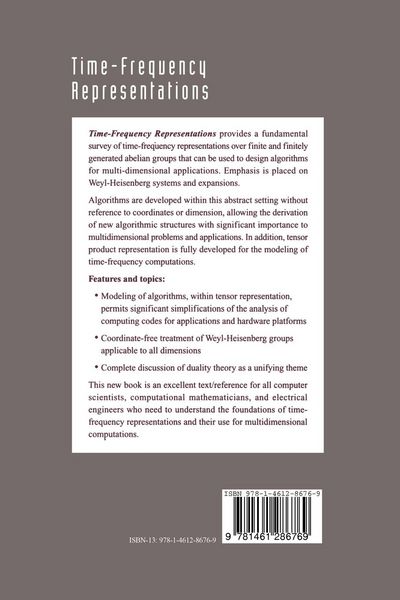
  • Produktbild: Time-Frequency Representations
  • Produktbild: Time-Frequency Representations
  • 1 Review of algebra.- 1.1 Introduction.- 1.2 Definitions and examples of groups.- 1.3 Subgroups, cosets, and quotients.- 1.4 Ideals.- 1.5 Mappings.- 1.6 Finitely generated abelian groups.- References.- 2 Linear algebra and abelian groups.- 2.1 Introduction.- 2.2 Vector space L(A).- 3 Fourier transform over A.- 3.1 Introduction.- 3.2 Character groups.- 3.3 Character formulas.- 3.4 Duality theory.- 3.5 Character group basis.- 3.6 Fourier transform.- 3.7 Shift and multiplication operators.- References.- Problems.- 4 Poisson summation formula.- 4.1 Introduction.- 4.2 Statement and proof.- 4.3 Fourier transform of periodic functions.- 4.4 Periodization-decimation operators.- References.- Problems.- 5 Zak transform.- 5.1 Introduction.- 5.2 Fourier analysis on A x A*.- 5.3 Zak transform.- 5.4 Functional equation.- 5.5 Fourier and Zak transform.- 5.6 Isometry.- 5.7 Algorithm for computing Zak transform.- References.- Problems.- 6 Weyl-Heisenberg systems.- 6.1 Introduction.- 6.2 Translates.- 6.3 W-H systems.- 6.4 Sampling rates.- 6.5 Divide-and-conquer.- References.- Problems.- 7 Zak transform and W-H systems.- 7.1 Introduction.- 7.2 Basic results.- 7.3 Fundamental formulas.- 7.4 Zak space characterization of W-H systems.- 7.5 Zero set characterization.- Problems.- 8 Algorithms for W-H systems.- 8.1 Introduction.- 8.2 Critical sampling algorithm.- 8.3 Integer over-sampling algorithm.- 8.4 General over-sampling algorithm.- References.- Problems.- 9 Orthogonal projection theorem.- 9.1 Introduction.- 9.2 Orthogonal projection algorithm.- 9.3 Iterative W-H coefficient set algorithm.- 10 Cross-ambiguity function.- 10.1 Introduction.- 10.2 Basic results.- 10.3 Direct algorithm.- 10.4 Critical sampling algorithm.- 10.5 Integer over-sampling algorithm.- 10.6 General divide-and-conquer algorithm.- References.- Problems.- 11 Ambiguity surfaces.- 11.1 Introduction.- 11.2 Fourier transform of ambiguity surfaces.- 11.3 Formulas D1 and D2.- References.- 12 Orthonormal W-H systems.- 12.1 Introduction.- 12.2 Orthonormal W-H systems.- References.- Problems.- 13 Duality.- 13.1 Introduction.- 13.2 Biorthogonal.- 13.3 Algorithms for computing biorthogonals.- References.- Problems.- 14 Frames.- 14.1 Introduction.- 14.2 Frame Operator.- 14.3 Frames.- 14.4 Frame biorthogonals.- 14.5 Operator interpretation.- 14.6 Tight frames.- References.- 15 Implementation.- 15.1 Introduction.- 15.2 Tensor product.- 15.3 Multidimensional arrays.- 15.4 Computing the Zak transform.- References.- Problems.- 16 Algebra of multirate structures.- 16.1 Introduction.- 16.2 Algebra.- 16.3 Exact sequences.- 16.4 Main theorem.- 16.5 Representatives mapping theorem.- 16.6 Integer matrices.- References.- Problems.- 17 Multirate structures.- 17.1 Introduction.- 17.2 Decimation operator.- 17.3 Polyphase representation.- 17.4 Integer rate bands.- 17.5 Reduction theorems.- 17.6 Decimators and expanders.- References.- 18 A Time-frequency search for stock market anomalies.- 18.1 Introduction.- 18.2 Time-frequency trees.- 18.3 Analysis of the log-differenced DJIA and S&P 500 data.- References.