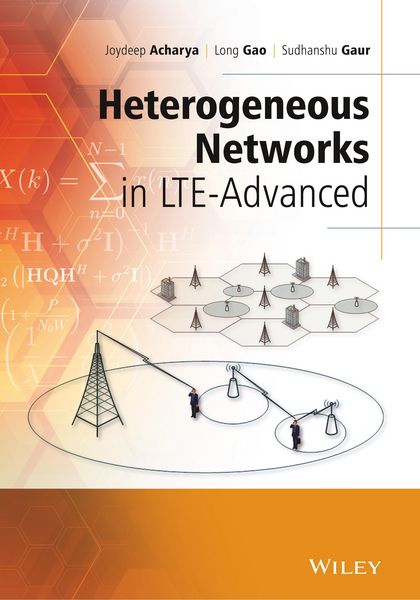
Beschreibung
Produktdetails
Einband
Gebundene Ausgabe
Erscheinungsdatum
12.05.2014
Verlag
John Wiley & Sons IncSeitenzahl
296
Maße (L/B/H)
25/17,5/2,1 cm
Gewicht
696 g
Auflage
1. Auflage
Sprache
Englisch
ISBN
978-1-118-51186-2
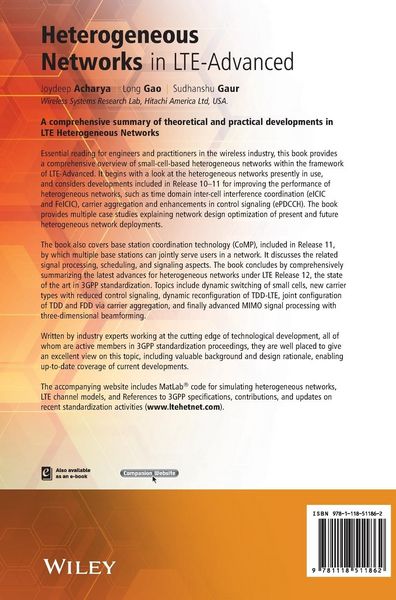
A comprehensive summary of theoretical and practical developments in LTE Heterogeneous Networks
The last decade has witnessed the proliferation of mobile broadband data and the trend is likely to increase in the coming years. Current cellular networks are ill equipped to deal with this surge in demand. To satisfy user demand and maximize profits, a new paradigm to operate networks is needed. Heterogeneous networks, that deploy an overlay of small cells with limited coverage and transmit power, over a macro coverage area is the solution by providing capacity and coverage where it is needed.
This book presents a comprehensive overview of small cell based heterogeneous networks within the framework of 3GPP LTE-Advanced which is the major enabler of current and future heterogeneous networks. The book first establishes the basics of LTE standards 8 -10. Wherever relevant, the underlying theory of wireless communications is explained and the signaling and protocol aspects of LTE Releases 8-10 are presented. Next the book presents a systematic study of the inter cell interference (eICIC and FeICIC) mechanisms that have been standardized in LTE releases 10 and 11 to mitigate the interference arising in heterogeneous networks. From simple blank subframe design and implementation, the book discusses more advanced transceiver signal processing and carrier aggregation (CA) based mechanisms to improve performance. Besides data, control channel enhancements such as enhanced PDCCH (ePDCCH) are also discussed.
Subsequently the book discusses the possibility of base stations being allowed to coordinate to manage interference. This technique, called CoMP, has the potential of vastly improving network performance. However several practical challenges first have to be overcome before this potential can be realized. The book presents the different CoMP categories introduced in LTE release 11, the required signal processing and the changes that were introduced in Release-11 for supporting CoMP. The book then presents the state of the art developments in heterogeneous networks that are currently taking place in 3GPP with the initiation of Release 12. A whole array of new technologies have been introduced such as dynamic switching of small cells, new carrier types with reduced control signaling, dynamic reconfiguration of TDD-LTE, joint configuration of TDD and FDD via carrier aggregation and lastly advanced MIMO signal processing with three dimensional beamforming. All these technologies will work in unison leading to efficient operations of small cells.
The authors thus comprehensively summarize the advances in heterogeneous networks over the last couple of years as reflected in various LTE releases and then look ahead at what to expect in the future. Fully illustrated throughout and with an accompanying website including Matlab code for simulating heterogeneous networks, LTE channel models, and References to 3GPP specifications, contributions, and updates on recent standardization activities. The authors, being involved in LTE standardization, are well placed to give an excellent view on this topic, including valuable background and design rationale.
* A comprehensive summary of wireless communications theory and practical developments in LTE heterogeneous networks.
* Authors are experts in this field and are active members in standardization proceedings, enabling up-to-date coverage of current developments
* Multiple case studies explain network design optimization of various heterogeneous network deployments.
* Accompanying website includes Matlab code for simulating heterogeneous networks, LTE channel models, and References to 3GPP specifications, contributions, and updates on recent standardization activities
Essential reading for Engineers and practitioners in wireless industry.
The last decade has witnessed the proliferation of mobile broadband data and the trend is likely to increase in the coming years. Current cellular networks are ill equipped to deal with this surge in demand. To satisfy user demand and maximize profits, a new paradigm to operate networks is needed. Heterogeneous networks, that deploy an overlay of small cells with limited coverage and transmit power, over a macro coverage area is the solution by providing capacity and coverage where it is needed.
This book presents a comprehensive overview of small cell based heterogeneous networks within the framework of 3GPP LTE-Advanced which is the major enabler of current and future heterogeneous networks. The book first establishes the basics of LTE standards 8 -10. Wherever relevant, the underlying theory of wireless communications is explained and the signaling and protocol aspects of LTE Releases 8-10 are presented. Next the book presents a systematic study of the inter cell interference (eICIC and FeICIC) mechanisms that have been standardized in LTE releases 10 and 11 to mitigate the interference arising in heterogeneous networks. From simple blank subframe design and implementation, the book discusses more advanced transceiver signal processing and carrier aggregation (CA) based mechanisms to improve performance. Besides data, control channel enhancements such as enhanced PDCCH (ePDCCH) are also discussed.
Subsequently the book discusses the possibility of base stations being allowed to coordinate to manage interference. This technique, called CoMP, has the potential of vastly improving network performance. However several practical challenges first have to be overcome before this potential can be realized. The book presents the different CoMP categories introduced in LTE release 11, the required signal processing and the changes that were introduced in Release-11 for supporting CoMP. The book then presents the state of the art developments in heterogeneous networks that are currently taking place in 3GPP with the initiation of Release 12. A whole array of new technologies have been introduced such as dynamic switching of small cells, new carrier types with reduced control signaling, dynamic reconfiguration of TDD-LTE, joint configuration of TDD and FDD via carrier aggregation and lastly advanced MIMO signal processing with three dimensional beamforming. All these technologies will work in unison leading to efficient operations of small cells.
The authors thus comprehensively summarize the advances in heterogeneous networks over the last couple of years as reflected in various LTE releases and then look ahead at what to expect in the future. Fully illustrated throughout and with an accompanying website including Matlab code for simulating heterogeneous networks, LTE channel models, and References to 3GPP specifications, contributions, and updates on recent standardization activities. The authors, being involved in LTE standardization, are well placed to give an excellent view on this topic, including valuable background and design rationale.
* A comprehensive summary of wireless communications theory and practical developments in LTE heterogeneous networks.
* Authors are experts in this field and are active members in standardization proceedings, enabling up-to-date coverage of current developments
* Multiple case studies explain network design optimization of various heterogeneous network deployments.
* Accompanying website includes Matlab code for simulating heterogeneous networks, LTE channel models, and References to 3GPP specifications, contributions, and updates on recent standardization activities
Essential reading for Engineers and practitioners in wireless industry.
Noch keine Bewertungen vorhanden
Verfassen Sie die erste Bewertung zu diesem Artikel
Helfen Sie anderen Kundinnen und Kunden durch Ihre Meinung.
Kurze Frage zu unserer Seite
Vielen Dank für Ihr Feedback
Wir nutzen Ihr Feedback, um unsere Produktseiten zu verbessern. Bitte haben Sie Verständnis, dass wir Ihnen keine Rückmeldung geben können. Falls Sie Kontakt mit uns aufnehmen möchten, können Sie sich aber gerne an unseren Kund*innenservice wenden.
zum Kundenservice