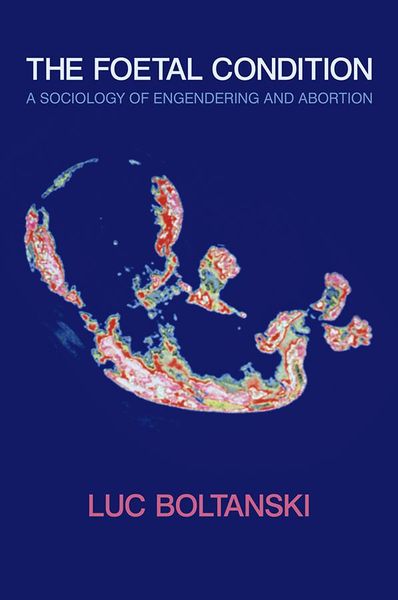
The Foetal Condition A Sociology of Engendering and Abortion
-
- Hardcover ausgewählt
- Taschenbuch
-
Sprache:Englisch
95,99 €
inkl. gesetzl. MwSt.,
Beschreibung
Produktdetails
Einband
Gebundene Ausgabe
Erscheinungsdatum
10.07.2013
Verlag
WileySeitenzahl
448
Maße (L/B/H)
23,1/15,7/3,3 cm
Gewicht
635 g
Sprache
Englisch
ISBN
978-0-7456-4730-2
'An utterly original treatment of an interminably discussed issue. Combining anthropological reflection with interviews, social theorizing with hospital reports, Boltanski produces an account that recasts the question of abortion, even as it cannot fail to annoy all sides in the current debate'
Nancy Fraser, The New School for Social Research
'The Foetal Condition is not a political intervention, it does not rehash for us the endless arguments for or against abortion. Rather, it is about a far more startling topic: the connection between abortion and the process of engendering, becoming a member of the human species, at once generic and particular. Using a large range of anthropological evidence, Boltanski shows that societies have always practiced abortion, and that the silences, prohibitions or tacit acceptation of abortion touch on the troubling question of how societies define a "human being". This highly original book cannot fail to become a classic among anthropologists, sociologists, philosophers, and ethicists.'
Eva IIIouz, Hebrew University of Jerusalem
Abortion is a contentious issue in social life but it has rarely been subjected to careful scrutiny in the social sciences. While the legalization of abortion has brought in into the public domain, it still remains a sensitive topic in many cultures, often hidden from view and rarely spoken about, consigned to a shadowy existence.
Drawing on reports gathered from hospital settings and in-depth interviews with women who have had abortions, Luc Boltanski sets out to explain the ambiguous status of this social practice. Abortion, he argues, has to remain in the shadows, for it reveals a contradiction at the heart of the social contract: the principle of the uniqueness of beings conflicts with the postulate of their replaceable nature, a postulate without which no society would achieve demographic renewal.
This leads Boltanski to explore the way human beings are engendered and to analyse the symbolic constraints that preside over their entry into society. What makes a human being is not the foetus as such, ensconced within the body, but rather the process by which it is taken up symbolically in speech - that is, its symbolic adoption. But this symbolic adoption presupposes the possibility of discriminating among embryos that are indistinguishable. For society, and sometimes for individuals, the arbitrary character of this discrimination is hard to tolerate. The contradiction is made bearable by a grammatical categorization: the 'authentic' foetus - adopted by its parents, who use speech to welcome the new being and give it a name - is juxtaposed with the 'tumoral' foetus, an accidental embryo that will not be the object of a life-forming project.
Bringing together grammar, narrations of life experience and a historical perspective, this highly original book sheds fresh light on a social phenomenon that is widely practiced but poorly understood
Kundinnen und Kunden meinen
Verfassen Sie die erste Bewertung zu diesem Artikel
Helfen Sie anderen Kund*innen durch Ihre Meinung
Kurze Frage zu unserer Seite
Vielen Dank für Ihr Feedback
Wir nutzen Ihr Feedback, um unsere Produktseiten zu verbessern. Bitte haben Sie Verständnis, dass wir Ihnen keine Rückmeldung geben können. Falls Sie Kontakt mit uns aufnehmen möchten, können Sie sich aber gerne an unseren Kund*innenservice wenden.
zum Kundenservice