Gutscheinbedingungen

**Gültig bis 06.07.2026 auf fremdsprachige Bücher online auf thalia.at, in der Thalia App ab einem Mindestbestellwert von 30€ und in allen Thalia Buchhandlungen in Österreich. In den Buchhandlungen nur gültig auf lagernde Ware. Einzelne Artikel können ausgeschlossen sein. Ausgenommen sind preisgebundene Artikel & eBooks. Pro Einkauf einmal einlösbar. Nur gültig gegen Vorlage oder im Onlineshop hinterlegter Bonuscard. Infos zur Einlösung in der Buchhandlung sind auf der Bonuscard-Vorteilspreisseite zu finden. Click & Collect nur bei Onlinevorabzahlung möglich. Keine Einlösung bei Scan & Go-Bezahlung. Keine Barauszahlung. Nicht kombinierbar mit anderen Aktionen und Gutscheinen. Gutschein wird auf max. 500€ Bestellwert angerechnet. Nicht gültig für Versandkosten und Services.

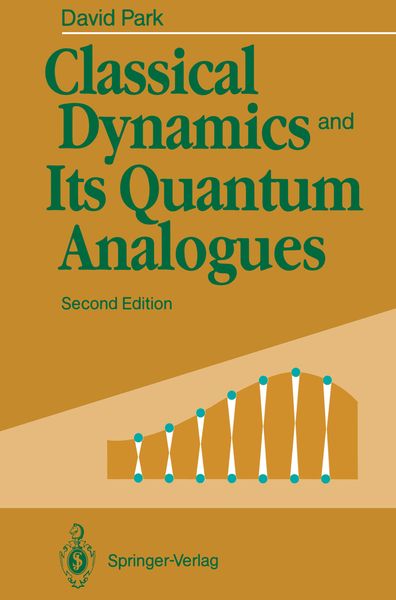
  • Produktbild: Classical Dynamics and Its Quantum Analogues
  • Produktbild: Classical Dynamics and Its Quantum Analogues
- 11%

Classical Dynamics and Its Quantum Analogues

11% sparen

116,99 € UVP 131,99 €

inkl. gesetzl. MwSt., Versandkostenfrei


Beschreibung

Produktdetails

Einband

Taschenbuch

Erscheinungsdatum

22.11.2011

Verlag

Springer Berlin

Seitenzahl

333

Maße (L/B/H)

23,5/15,5/1,9 cm

Gewicht

527 g

Auflage

Second Edition 1990

Sprache

Englisch

ISBN

978-3-642-74924-7

Beschreibung

Produktdetails

Einband

Taschenbuch

Erscheinungsdatum

22.11.2011

Verlag

Springer Berlin

Seitenzahl

333

Maße (L/B/H)

23,5/15,5/1,9 cm

Gewicht

527 g

Auflage

Second Edition 1990

Sprache

Englisch

ISBN

978-3-642-74924-7

Herstelleradresse

Springer-Verlag KG
Sachsenplatz 4-6
1201 Wien
AT

Email: GPSR Kontakt

Noch keine Bewertungen vorhanden

Verfassen Sie die erste Bewertung zu diesem Artikel

Helfen Sie anderen Kundinnen und Kunden durch Ihre Meinung.

Kundinnen und Kunden meinen

Bewertungen (0)

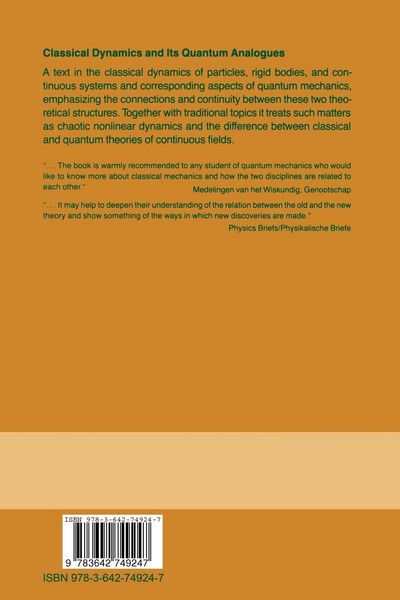
  • Produktbild: Classical Dynamics and Its Quantum Analogues
  • Produktbild: Classical Dynamics and Its Quantum Analogues
  • 1. Rays of Light.- 1.1 Waves, Rays, and Orbits.- 1.2 Phase Velocity and Group Velocity.- 1.3 Dynamics of a Wave Packet.- 1.4 Fermat’s Principle of Least Time.- 1.5 Interlude on the Calculus of Variations.- 1.6 Optics in a Gravitational Field.- 2. Orbits of Particles.- 2.1 Ehrenfest’s Theorems.- 2.2 Oscillators and Pendulums.- 2.3 Interlude on Elliptic Functions.- 2.4 Driven Oscillators.- 2.5 A Driven Anharmonic Oscillator.- 2.6 Quantized Oscillators.- 2.7 Coherent States.- 3. Lagrangian Dynamics.- 3.1 Lagrange’s Equations.- 3.2 The Double Pendulum.- 3.3 Planets and Atoms.- 3.4 Orbital Oscillations and Stability.- 3.5 Orbital Motion: Vectorial Integrals and Hyperbolic Orbits.- 3.6 Other Forces.- 3.7 Bohr Orbits and Quantum Mechanics: Degeneracy.- 3.8 The Principle of Maupertuis and Its Practical Utility.- 4. N-Particle Systems.- 4.1 Center-of-Mass Theorems.- 4.2 Two-Particle Systems.- 4.3 Vibrating Systems.- 4.4 Coupled Oscillators.- 4.5 The Virial Theorem.- 4.6 Hydrodynamics.- 5. Hamiltonian Dynamics.- 5.1 The Canonical Equations.- 5.2 Magnetic Forces.- 5.3 Canonical Transformations.- 5.4 Infinitesimal Transformations.- 5.5 Generating Finite Transformations from Infinitesimal Ones.- 5.6 Deduction of New Integrals.- 5.7 Commutators and Poisson Brackets.- 5.8 Gauge Invariance.- 6. The Hamilton-Jacobi Theory.- 6.1 The Hamilton-Jacobi Equation.- 6.2 Step-by-Step Integration of the Hamilton-Jacobi Equation.- 6.3 Interlude on Planetary Motion in General Relativity.- 6.4 Jacobi’s Generalization.- 6.5 Orbits and Integrals.- 6.6 “Chaos”.- 6.7 Coordinate Systems.- 6.8 Curvilinear Coordinates.- 6.9 Interlude on Classical Optics.- 7. Action and Phase.- 7.1 The Old Quantum Theory.- 7.2 Hydrogen Atom in the Old Quantum Theory.- 7.3 The Adiabatic Theorem.- 7.4 Connections with Quantum Mechanics.- 7.5 Heisenberg’s Quantum Mechanics.- 7.6 Matter Waves.- 7.7 Schrödinger’s “Derivation”.- 7.8 Construction of a Wave Function.- 7.9 Phase Shifts in Dynamics.- 8. Theory of Perturbations.- 8.1 Secular and Periodic Perturbations.- 8.2 Perturbations in Quantum Mechanics.- 8.3 Adiabatic Perturbations.- 8.4 Degenerate States.- 8.5 Quantum Perturbation Theory for Positive-Energy States.- 8.6 Action and Angle Variables.- 8.7 Canonical Perturbation Theory.- 8.8 Newtonian Precession.- 9. The Motion of a Rigid Body.- 9.1 Angular Velocity and Momentum.- 9.2 The Inertia Tensor.- 9.3 Dynamics in a Rotating Coordinate System.- 9.4 Euler’s Equations.- 9.5 The Precession of the Equinoxes.- 9.6 Quantum Mechanics of a Rigid Body.- 9.7 Spinors.- 9.8 Particles with Spin.- 10. Continuous Systems.- 10.1 Stretched Strings.- 10.2 Four Modes of Description.- 10.3 Example: A Plucked String.- 10.4 Practical Use of Variation Principles.- 10.5 More Than One Dimension.- 10.6 Waves in Space.- 10.7 The Matter Field.- 10.8 Quantized Fields.- 10.9 The Mössbauer Effect.- 10.10 Classical and Quantum Descriptions of Nature.- References.- Notation.