Gutscheinbedingungen

**Gültig bis 15.06.2026 auf Spiele & Spielzeug online auf thalia.at, in der Thalia App ab einem Mindestbestellwert von 30€ und in allen Thalia Buchhandlungen in Österreich. In den Buchhandlungen nur gültig auf lagernde Ware. Einzelne Artikel können ausgeschlossen sein. Ausgenommen sind preisgebundene Artikel sowie online auf thalia.at und in der Thalia App einzelne Artikel von tonies®. Pro Einkauf einmal einlösbar. Nur gültig gegen Vorlage oder im Onlineshop hinterlegter Bonuscard. Infos zur Einlösung in der Buchhandlung sind auf der Bonuscard-Vorteilspreisseite zu finden. Click & Collect nur bei Onlinevorabzahlung möglich. Keine Einlösung bei Scan & Go-Bezahlung. Keine Barauszahlung. Nicht kombinierbar mit anderen Aktionen und Gutscheinen. Gutschein wird auf max. 500€ Bestellwert angerechnet. Nicht gültig für Geschenkkarten, Versandkosten und Services.

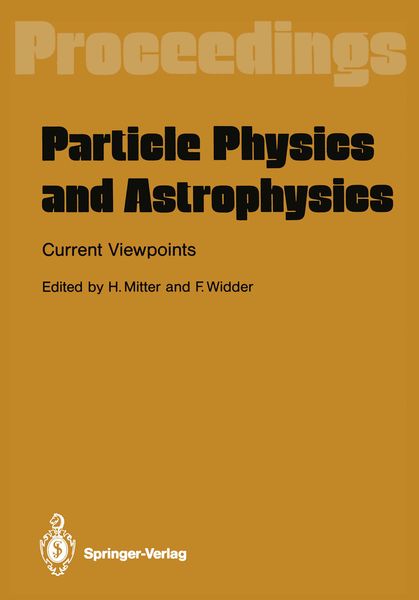
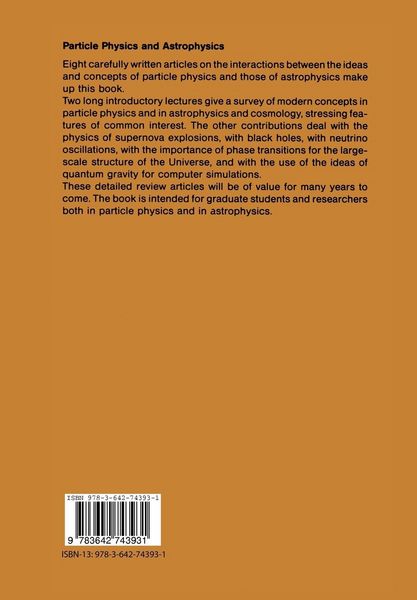
  • Produktbild: Particle Physics and Astrophysics. Current Viewpoints
  • Produktbild: Particle Physics and Astrophysics. Current Viewpoints

Particle Physics and Astrophysics. Current Viewpoints Proceedings of the XXVII Int. Universitätswochen für Kernphysik Schladming, Austria, February 1988

99,99 €

inkl. gesetzl. MwSt., Versandkostenfrei


Beschreibung

Produktdetails

Einband

Taschenbuch

Erscheinungsdatum

29.12.2011

Herausgeber

Heinrich Mitter + weitere

Verlag

Springer Berlin

Seitenzahl

309

Maße (L/B/H)

24,4/17/1,8 cm

Gewicht

567 g

Auflage

Softcover reprint of the original 1st ed. 1989

Sprache

Englisch

ISBN

978-3-642-74393-1

Beschreibung

Produktdetails

Einband

Taschenbuch

Erscheinungsdatum

29.12.2011

Herausgeber

Verlag

Springer Berlin

Seitenzahl

309

Maße (L/B/H)

24,4/17/1,8 cm

Gewicht

567 g

Auflage

Softcover reprint of the original 1st ed. 1989

Sprache

Englisch

ISBN

978-3-642-74393-1

Herstelleradresse

Springer-Verlag KG
Sachsenplatz 4-6
1201 Wien
AT

Email: ProductSafety@springernature.com

Kundinnen und Kunden meinen

0 Bewertungen

Informationen zu Bewertungen

Zur Abgabe einer Bewertung ist eine Anmeldung im Konto notwendig. Die Authentizität der Bewertungen wird von uns nicht überprüft. Wir behalten uns vor, Bewertungstexte, die unseren Richtlinien widersprechen, entsprechend zu kürzen oder zu löschen.

Die Bewertungen sind nach Format, Anzahl Sterne und Datum sortiert.

Verfassen Sie die erste Bewertung zu diesem Artikel

Helfen Sie anderen Kund*innen durch Ihre Meinung

Kundinnen und Kunden meinen

0 Bewertungen filtern

  • Produktbild: Particle Physics and Astrophysics. Current Viewpoints
  • Produktbild: Particle Physics and Astrophysics. Current Viewpoints
  • and Survey I: Concepts from Particle Physics.- 1. Introduction.- 2. The Standard Model of Elektro-Weak and Strong Interaction.- 3. Spontaneous Symmetry Breaking.- 3.1 The Z2 Goldstone Model.- 3.2 The U(l) Goldstone Model.- 3.3 The U(l) Higgs Model.- 4. Topologically Stable Configurations (Defects).- 4.1 Solitons in the Z2 Goldstone Model.- 4.2 Vortices in the U(l) Higgs Model.- 4.3 Magnetic Monopoles (‘t Hooft Polyakov).- 4.4 Solitons.- 4.5 Some General Remarks on Topological Defects.- 5. Transitions Between Different Ground States (Vacua).- 6. Restoration of Spontaneously Broken Symmetries at Finite Temperatures.- 7. Grand Unified Theories.- 8. Photon Splitting in a Strong Magnetic Field.- 9. Candidates for Dark Matter from Particle Physics.- 9.1 Neutrinos with a Non Vanishing Mass.- 9.2 New Particles from Supersymmetry or Supergravity.- 9.2.1 Supersymmetry.- 9.2.2 Supergravity.- 9.3 New Particles from String Theories.- 9.4 Axions.- References.- and Survey II: Concepts from Astrophysics and Cosmology.- 1. Stellar Evolution.- 1.1 The Fusion Reactor.- 1.2 Explosive Nucleosynthesis.- 1.3 Final States of Stellar Evolution.- 1.4 Bounds on Axions from Stellar Evolution.- 1.5 Observations of Neutron Stars.- 1.6 Very High Energy Gamma Ray Sources.- 2. The Standard Big Bang Model of the Universe.- 2.1 Basic features.- 2.2 Cosmological Observations.- 2.3 Thermodynamics of the Radiation Dominated Phase.- 2.4 Nucleosynthesis.- 2.5 Baryon Synthesis.- 2.6 The Inflationary Universe.- 3. Formation of Large-Scale Structure in the Universe.- 3.1 Problems of the Gravitational Instability Picture.- 3.2 Basic Information from Observations.- 3.3 Typical Scales.- 3.4 The “Pancake Scenario” of Zel’dovich.- References.- Physics of Type II Supernova Explosions.- I. Introduction and Historical Remarks.- II. Some Observational Facts.- III. Presupernova Evolution of Massive Stars.- III.1 Formation of Iron Cores.- III.2 Qualitative Considerations on Stellar Evolution.- III.3 Detailed Models.- III.4 Neutrino Losses in Advanced Evolutionary Phases.- III.5 Core Instability.- III.6 Progenitor Star of SN 1987 A.- IV. Physics of Stellar Collapse, Shock Energy.- IV.1 Neutronization.- IV.2 Neutrino Trapping.- IV.3 Entropy and Equation of State During Collapse.- IV.4 Adiabatic Collapse.- IV.5 Shock Formation and Shock Energy.- V. Neutrino Radiation.- V.1 Estimates of the Properties of the Neutrino Burst.- V.2 Estimate of the Total Neutrino Loss of SN 1987 A.- V.3 Bounds on the Electron Neutrino Mass.- V.4 Detailed Models.- VI. Basic Equations for Gravitational Collapse.- VII. Prompt and Delayed Explosions.- VIII. Conclusions and Supplementary Remarks.- Appendix A. Energy-Momentum Conservation.- Appendix B. Core Instabilities.- Appendix C. Diffusion Approximation, Flux-Limited Diffusion.- Appendix D. Plasma-Neutrino Process.- References.- Evidence for Black Holes.- I. Introduction.- II. Mechanics of Binary Systems.- III. Upper Bound for the Mass of a Neutron Star.- IV. Three Black Hole Candidates.- 1. Cyguns X-1.- 2. LMC X-3.- 3. A0620-00.- References.- Principles of Black Hole Energetics.- 1. Introduction.- 2. Model of Gravitational Collapse.- 3. Positive Energy Theorems.- 4. Hawking Effect.- 5. Calculations of T?v.- 6. Model of Back Reaction.- References.- Quantum Gravity Motivated Computer Simulations.- 1. Introduction.- 2. Regge-Einstein Action and Quantization.- 3. The Monte Carlo Method.- 3.1 Example: Two-Dimensional 0(3) ?-Model.- 3.2 The Monte Carlo Algorithm for Regge Skeletons.- 4. A Simulation with the Regge-Einstein Action.- 5. Higher Derivative Gravity.- 6. De Sitter Lattice Gravity.- 7. Conclusions and Outlook.- Appendix A: Some Parameters and Constants.- Appendix B: Basic Geometry.- References.- Neutrino Oscillations and Their Damping.- 1. Particle Oscillations.- 2. Effects of a Medium.- 3. Adiabatic Case.- 4. Damping of Particle Oscillations.- References.- Phase Transitions as the Origin of Large Scale Structure in the Universe.- 1. Very Large Scale Structure and Gravity.- 1.1 Observations and Motivations.- 1.2 Dark Matter.- 1.3 Newtonian Approximation.- 1.4 Linear Perturbations in Cold Dark Matter.- 1.5 Local Nonlinearity “doesn’t matter”.- 1.6 Peculiar Velocities.- 1.7 Sources.- 1.8 Hot Dark Matter.- 1.9 Linearising Liouville.- 1.10 Phase Space Constraints for Hot Dark Matter.- 1.11 Summary.- 2. Phase Transitions, Defects and Fluctuations.- 2.1 A Physical Picture of Phase Transitions.- 2.2 Gaussian Approximation.- 2.3 Spatial Distribution of Fields near Tc.- 2.4 Out of Equilibrium: Defect Formation.- 2.5 Defects and Topology.- 2.6 A Useful Theorem.- 2.7 Cosmic Strings.- 2.8 Simulating String Formation.- 2.9 Evolution of Strings.- 2.10 Free Strings in an Expanding Universe.- 2.11 Inside the Horizon: Free Strings in Flat Spacetime.- 2.12 Interacting String Networks in an Expanding Universe: the Scaling Solution.- 2.13 Loops.- 2.14 Strings as Density Perturbations.- 2.15 Accretion by Loops.- 2.16 Loops as Seeds for Galaxies and Clusters.- 2.17 Cosmic String and Hot Dark Matter.- 2.18 Cosmic String and Inflation?.- 2.19 Cosmic String Versus Inflation.- 2.20 Other Observational Tests for Cosmic Strings.- References.