KI-Beratung Beta

Gutscheinbedingungen

**Gültig am 20.11.2026 ab einem Mindestbestellwert von 30€ auf Spielzeug, Schreibwaren, Filme, Geschenke & Trends, Musik, tolino eReader & Zubehör, Hörbücher und Hörbuch-Downloads, nicht preisgebundene Bücher und Kalender online auf thalia.at und in der Thalia App. Einzelne Artikel können ausgeschlossen sein. Aufgrund der Buchpreisbindung sind deutschsprachige Bücher und eBooks ausgenommen. Zusätzlich ausgenommen sind Abos & Flatrates, Games, Geschenkkarten/-boxen, Shelfies, Software, Zeitschriften sowie einzelne Artikel von tonies®. Pro Einkauf einmal einlösbar. Click & Collect nur bei Onlinevorabzahlung möglich. Keine Barauszahlung. Nicht kombinierbar mit anderen Aktionen und Gutscheinen. Gutschein wird auf max. 500€ Bestellwert angerechnet. Nicht gültig für Versandkosten und Services. Preisgebundene Artikel sind vom Mindestbestellwert ausgeschlossen.

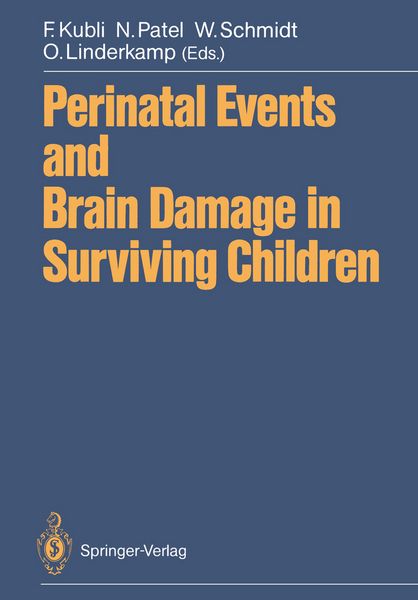
  • Produktbild: Perinatal Events and Brain Damage in Surviving Children
  • Produktbild: Perinatal Events and Brain Damage in Surviving Children

Perinatal Events and Brain Damage in Surviving Children Based on Papers Presented at an International Conference Held in Heidelberg in 1986

99,99 €

inkl. gesetzl. MwSt., Versandkostenfrei


Beschreibung

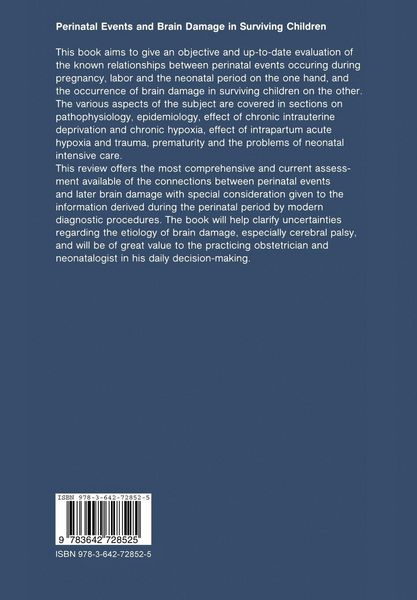
Decision making in modem obstetrics and perinatology is con trolled by a variety of different factors, but there is little doubt that in industrialized countries one of the most powerful single factors is the concern and fear of causing permanent brain damage in the unborn and newborn. The dramatic increase...

Beschreibung

Decision making in modem obstetrics and perinatology is con trolled by a variety of different factors, but there is little doubt that in industrialized countries one of the most powerful single factors is the concern and fear of causing permanent brain damage in the unborn and newborn. The dramatic increase in the rates of abdom inal deliveries in many parts of the world is certainly rooted to a substantial part in the ~bstetrician's concern not so much about possible perinatal death, but more so about permanent brain dam age in surviving children. This trend has been accelerated by the increasing number of litigations in connection with brain damage observed in many societies. This problem itself has many aspects, but it seems evident that litigation - justified or unjustified - is one modem expression of the human and social tragedy inflicted on individuals and families by the birth of a brain-damaged child. The medical, social, and human importance of the problem is in sharp contrast to the relative lack of scientific knowledge avail able. This became very clear when the National Institutes of Health published the excellent review in 1985 on "Prenatal and Perinatal Factors Associated with Brain Disorders" and its editor, J. M.

Produktdetails

Einband

Taschenbuch

Erscheinungsdatum

06.12.2011

Abbildungen

XX, 338 p.

Herausgeber Fred Kubli + weitere

Produktdetails

Einband

Taschenbuch

Erscheinungsdatum

06.12.2011

Abbildungen

XX, 338 p.

Herausgeber
Verlag Springer Berlin
Seitenzahl

338

Maße (L/B/H)

24,4/17/2 cm

Gewicht

628 g

Auflage

Softcover reprint of the original 1st ed. 1988

Sprache

Englisch

ISBN

978-3-642-72852-5

Herstelleradresse

Springer-Verlag GmbH
Tiergartenstr. 17
69121 Heidelberg
DE

Email: ProductSafety@springernature.com

Noch keine Bewertungen vorhanden

Verfassen Sie die erste Bewertung zu diesem Artikel

Helfen Sie anderen Kundinnen und Kunden durch Ihre Meinung.

Kundinnen und Kunden meinen

Bewertungen (0)

  • Produktbild: Perinatal Events and Brain Damage in Surviving Children
  • Produktbild: Perinatal Events and Brain Damage in Surviving Children
  • Epidemiology.- Definitions, Risks and Indices.- The Quantification of Risk Factors in Major Neurodevelopmental Disorders.- Epidemiologic Panorama of Brain Impairments and Causative Factors — Swedish Experiences.- Low Birthweight and Neurological Sequelae — A Summary of Some Swedish Studies.- Biology and Pathogenetic Mechanisms.- Genetic Factors Leading to Birth Defects and Diseases of the Newborn.- Developmental Neurology of the Fetus and Newborn.- Pathophysiological Mechanisms Leading to Permanent Brain Damage in Surviving Children.- Trauma and the Developing Brain.- How and When Does Antenatal Hypoxia Damage Fetal Brains?.- Intrauterine Deprivation — Growth Retardation and Chronic Hypoxia.- Antepartum Events and Cerebral Handicap.- Available Evidence Relating Intrauterine Growth Retardation to Neuromotor Dysfunction and Mental Handicap.- Growth Retardation: Individual Risk Assessment During Pregnancy.- Management of Growth Retardation with a View to Preventing Neuromotor Dysfunction and Mental Handicaps ..- Abnormal Antepartum Cardiotocogram and Neuromotor Dysfunction in Term and Preterm Babies.- Antepartum Fetal Heart Rate and Movement Pattern in Relation to Oxygenation and Neonatal Neurological Morbidity.- Intrapartum Asphyxia and Birth Trauma.- Intrapartum Events and Cerebral Palsy.- The Relationship Between Obstetrically Preventable Intrapartum Asphyxia, Abnormal Neonatal Neurological Signs and Subsequent Motor Impairment in Babies Born at or After Term.- Available Evidence Relating Abnormal Intrapartum Fetal Acid Base Balance (pH) to Neuromotor Dysfunction and Mental Handicap.- Intrapartum Cardiotocogram, Apgar Score and Acidaemia at Birth: Relationship to Neonatal Neurological Morbidity.- Neurological Morbidity of Term Infants as an Indicator of SafeObstetrical Practice.- Breech Delivery in the Term Fetus — Relation to Neuromotor Dysfunction and Mental Handicap.- Intracranial Hemorrhage and Ischemia.- Pathological Anatomy of Intraventricular Hemorrhage in the Preterai Baby.- Hypoxia, Loss of Autoregulation and Intracranial Hemorrhage.- Obstetrical Factors and Intracranial Hemorrhage.- Prevention of Intraventricular Hemorrhage: Role of Atraumatic Birth and Sedation.- Prediction of Outcome: Periventricular Hemorrhage Versus Ischemia.- Magnetic Resonance Spectroscopy of the Brain and Early Neurodevelopmental Outcome.- Prognosis of the Very Low Birthweight and Very Preterm Infant.- Outcome of Very Low Birthweight or Very Preterm Infants with Special Consideration of Perinatal Events.- Role of Transport for the Prognosis of the Very Low Birthweight Preterm Infant.- Improved Outcome of Very Low Birthweight Infants 1977–1986. Critical Analysis of Results and Possible Mechanisms.- Decreasing Incidence of Neurological Morbidity and Changes of Perinatal Care Strategies in Very Low Birthweight Infants.- Prevention of Preterm Labor — A Means of Preventing Handicaps?.- Recent Follow-up Studies.- Causes of Handicap and Impairment in a Total Population of Dundee (Scotland) Children Aged 8 Weeks to 7 Years.- The Uruguayan Follow-up Study of Perinatal Events and Mental Handicaps.- First Results of the Multicenter Finnish-Bavarian Study.- Neurological Sequelae of Infants with Very Low Birthweight in Hamburg — First Results of a Regional Study.- Perinatal Mortality Statistics of the Avon County (UK) Population, 1976–1985, Using Figo 1982 Methodology.