Gutscheinbedingungen

**Gültig bis 14.09.2026 auf Spielzeug, Schreibwaren, Filme, Geschenke & Trends, Musik, tolino eReader & Zubehör, Hörbücher, nicht preisgebundene Bücher und Kalender in der Thalia App. Einzelne Artikel können ausgeschlossen sein. Aufgrund der Buchpreisbindung sind deutschsprachige Bücher und eBooks ausgenommen. Zusätzlich ausgenommen sind Abos & Flatrates, Games, Geschenkkarten/-boxen, Shelfies, Software, Zeitschriften sowie einzelne Artikel von tonies®. Pro Einkauf einmal einlösbar. Nur gültig mit im Onlineshop hinterlegter Bonuscard. Click & Collect nur bei Onlinevorabzahlung möglich. Keine Barauszahlung. Nicht kombinierbar mit anderen Aktionen und Gutscheinen. Gutschein wird auf max. 500€ Bestellwert angerechnet. Nicht gültig für Versandkosten und Services.

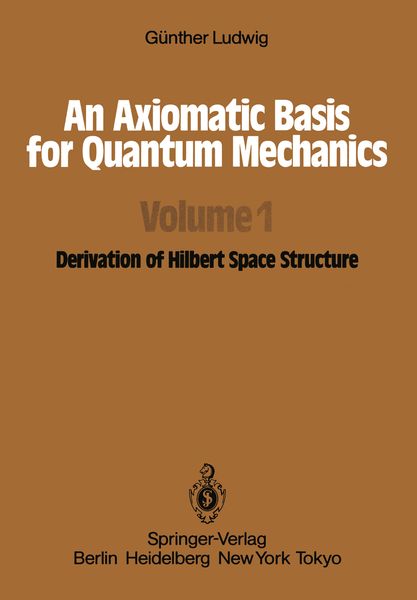
Produktbild: An Axiomatic Basis for Quantum Mechanics

An Axiomatic Basis for Quantum Mechanics Volume 1 Derivation of Hilbert Space Structure

51,99 €

inkl. gesetzl. MwSt., Versandkostenfrei


Beschreibung

Produktdetails

Einband

Taschenbuch

Erscheinungsdatum

17.11.2011

Abbildungen

X, 246 p.

Verlag

Springer Berlin

Seitenzahl

246

Maße (L/B/H)

24,4/17/1,5 cm

Gewicht

455 g

Auflage

Softcover reprint of the original 1st ed. 1985

Übersetzt von

L.F. Boron

Sprache

Englisch

ISBN

978-3-642-70031-6

Beschreibung

Produktdetails

Einband

Taschenbuch

Erscheinungsdatum

17.11.2011

Abbildungen

X, 246 p.

Verlag

Springer Berlin

Seitenzahl

246

Maße (L/B/H)

24,4/17/1,5 cm

Gewicht

455 g

Auflage

Softcover reprint of the original 1st ed. 1985

Übersetzt von

L.F. Boron

Sprache

Englisch

ISBN

978-3-642-70031-6

Herstelleradresse

Springer-Verlag KG
Sachsenplatz 4-6
1201 Wien
AT

Email: ProductSafety@springernature.com

Noch keine Bewertungen vorhanden

Verfassen Sie die erste Bewertung zu diesem Artikel

Helfen Sie anderen Kundinnen und Kunden durch Ihre Meinung.

Kundinnen und Kunden meinen

Bewertungen (0)

  • Produktbild: An Axiomatic Basis for Quantum Mechanics
  • I The Problem of Formulating an Axiomatics for Quantum Mechanics.- § 1 Is There an Axiomatic Basis for Quantum Mechanics?.- § 2 Concepts Unsuitable in a Basis for Quantum Mechanics.- § 3 Experimental Situations Describable Solely by Pretheories.- § 4 Mathematical Problems.- § 5 Progress to More Comprehensive Theories.- II Pretheories for Quantum Mechanics.- § 1 State Space and Trajectory Space.- § 2 Preparation and Registration Procedures.- § 3 Trajectory Preparation and Registration Procedures.- § 4 Transformations of Preparation and Registration Procedures.- § 5 The Macrosystems as Physical Objects.- III Base Sets and Fundamental Structure Terms for a Theory of Microsystems.- § 1 Composite Macrosystems.- § 2 Preparation and Registration Procedures for Composite Macrosystems.- § 3 Directed Interactions.- § 4 Action Carriers.- § 5 Ensembles and Effects.- § 6 Objectivating Method of Describing Experiments.- § 7 Transport of Systems Relative to Each Other.- IV Embedding of Ensembles and Effect Sets in Topological Vector Spaces.- § 1 Embedding of K, L in a Dual Pair of Vector Spaces.- § 2 Uniform Structures of the Physical Imprecision on K and L.- § 3 Embedding of K and L in Topologically Complete Vector Spaces.- § 4 ?, ?’, D, D’ Considered as Ordered Vector Spaces.- § 5 The Faces of K and L.- § 6 Some Convergence Theorems.- V Observables and Preparators.- § 1 Coexistent Effects and Observables.- § 4 Coexistent and Complementary Observables.- § 5 Realization of Observables.- § 6 Coexistent De-mixing of Ensembles.- § 7 Complementary De-mixings of Ensembles.- § 8 Realizations of De-mixings.- § 9 Preparators and Faces of K.- § 10 Physical Objects as Action Carriers.- § 11 Operations and Transpreparators.- VI Main Laws of Preparation andRegistration.- § 1 Main Laws for the Increase in Sensitivity of Registrations.- § 2 Relations Between Preparation and Registration Procedures.- § 3 The Lattice G.- § 4 Commensurable Decision Effects.- § 5 The Orthomodularity of G.- § 6 The Main Law for Not Coexistent Registrations.- § 7 The Main Law of Quantization.- VII Decision Observables and the Center.- § 1 The Commutator of a Set of Decision Effects.- § 2 Decision Observables.- § 3 Structures in That Class of Observables Whose Range also Contains Elements of G.- § 4 Commensurable Decision Observables.- § 5 Decomposition of ? and ?’ Relative to the Center Z.- § 6 System Types and Super Selection Rules.- VIII Representation of ?, ?’ by Banach Spaces of Operators in a Hilbert Space.- § 1 The Finite Elements of G.- § 2 The General Representation Theorem for Irreducible G.- § 3 Some Topological Properties of G.- § 4 The Representation Theorem for K, L.- § 5 Some Theorems for Finite-dimensional and Irreducible ?.- A II Banach Lattices.- A III The Axiom AVid and the Minimal Decomposition Property.- A IV The Bishop-Phelps Theorem and the Ellis Theorem.- List of Frequently Used Symbols.- List of Axioms.