Gutscheinbedingungen

**Gültig nur für Bestellungen an die Wunsch-Poststation bis 10.06.2026 auf Spielzeug, Schreibwaren, Filme, Geschenke & Trends, Musik, tolino eReader & Zubehör, Hörbücher und Hörbuch-Downloads (außer Abo), nicht preisgebundene Bücher und Kalender online auf thalia.at und in der Thalia App. Einzelne Artikel können ausgeschlossen sein. Aufgrund der Buchpreisbindung sind deutschsprachige Bücher und eBooks ausgenommen. Zusätzlich ausgenommen sind preisgebundene Artikel, Abos & Flatrates, eBooks, Games, Geschenkkarten/-boxen, Shelfies, Software, Zeitschriften sowie einzelne Artikel von tonies®. Pro Einkauf einmal einlösbar. Kein Click & Collect möglich. Keine Barauszahlung. Nicht kombinierbar mit anderen Aktionen und Gutscheinen. Gutschein wird auf max. 500€ Bestellwert angerechnet. Nicht gültig für Versandkosten und Services.

Produktbild: Money

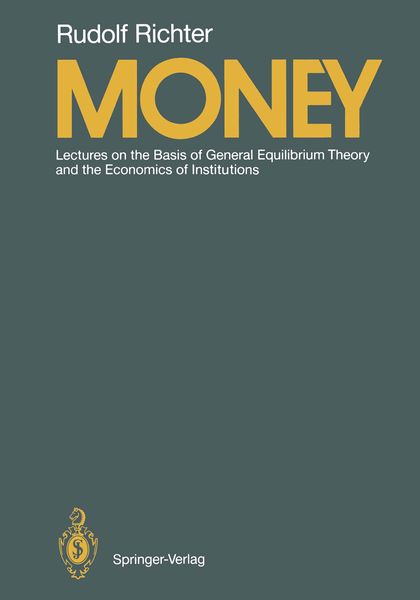
Money Lectures on the Basis of General Equilibrium Theory and the Economics of Institutions

51,99 €

inkl. gesetzl. MwSt., Versandkostenfrei


Beschreibung

Produktdetails

Einband

Taschenbuch

Erscheinungsdatum

10.12.2011

Verlag

Springer Berlin

Seitenzahl

399

Maße (L/B/H)

24,4/17/2,3 cm

Gewicht

720 g

Auflage

Softcover reprint of the original 1st ed. 1989

Übersetzt von

Wolfgang F. Stolper

Sprache

Englisch

ISBN

978-3-642-74039-8

Beschreibung

Produktdetails

Einband

Taschenbuch

Erscheinungsdatum

10.12.2011

Verlag

Springer Berlin

Seitenzahl

399

Maße (L/B/H)

24,4/17/2,3 cm

Gewicht

720 g

Auflage

Softcover reprint of the original 1st ed. 1989

Übersetzt von

Wolfgang F. Stolper

Sprache

Englisch

ISBN

978-3-642-74039-8

Herstelleradresse

Springer-Verlag KG
Sachsenplatz 4-6
1201 Wien
AT

Email: ProductSafety@springernature.com

Kundinnen und Kunden meinen

0 Bewertungen

Informationen zu Bewertungen

Zur Abgabe einer Bewertung ist eine Anmeldung im Konto notwendig. Die Authentizität der Bewertungen wird von uns nicht überprüft. Wir behalten uns vor, Bewertungstexte, die unseren Richtlinien widersprechen, entsprechend zu kürzen oder zu löschen.

Die Bewertungen sind nach Format, Anzahl Sterne und Datum sortiert.

Verfassen Sie die erste Bewertung zu diesem Artikel

Helfen Sie anderen Kund*innen durch Ihre Meinung

Kundinnen und Kunden meinen

0 Bewertungen filtern

  • Produktbild: Money
  • I. Theoretical Foundations: An Elementary Overview.- 1. General Equilibrium Theory: An Outline.- 1.1 General Equilibrium Theory Without Production.- 1.2 General Equilibrium Theory With Production.- 1.3 The Purchasing Power of Money: Definition.- 1.4 The Determination of the Purchasing Power of Money.- 1.4.1 The Case of a Commodity Standard: The Pure Gold Coin Standard.- 1.4.2 The Case of a Paper Standard: A Pure Paper Circulation.- 1.5 The Classical Dichotomy and the Patinkin Controversy.- Appendix to Chapter 1.- 1. The Determination of the Optimal Consumption Plan of a Household.- 2. The Determination of the Optimal Production Plan of a Firm.- 3. Walras’s Law With Any Number of Households and Firms.- Suggested Readings to Chapter 1.- 1. Theory of General Equilibrium.- 2. The Purchasing Power of Money.- 3. Determination of the Purchasing Power of Money.- 2. Capital Theory.- 2.1 The General Approach.- 2.2 A Simple Robinson Economy.- 2.3 Two Present and Two Future Goods: Does “the” Real Rate of Interest Exist?.- 2.4 The Robinson Economy in Stationary Equilibrium.- 2.5 The Young and the Old Robinsons: The Stationary Theory of Overlapping Generations.- 2.5.1 An Overlapping Generations Model Without Production.- 2.5.2 An Overlapping Generations Model With Production.- Appendix to Chapter 2.- The Stationary Rate of Interest May be Different from Zero.- Suggested Readings to Chapter 2.- 1. The Robinson Economy.- 2. The General Case.- 3. The Optimal Capital Stock of an Economy.- 4. Two Approaches to Capital Theory.- 5. General Discussion of Capital and Interest Theory.- 6. The Model of Overlapping Generations.- 3. The Economics of Institutions.- 3.1 Topics of Modern Institutional Economics.- 3.2 What are Transaction Costs?.- 3.3 Transaction Costs in General Equilibrium Theory: A Simple Example.- 3.4 Why Economic Institutions?.- 3.4.1 The Market as an Institution: Auction Markets or Direct Negotiations?.- 3.4.2 Why Do Firms Exist?.- 3.4.3 Why Relational Contracts?.- 3.4.4 Why Public Regulation?.- 3.5 General Equilibrium and Institutional Economics: Some Conceptual Considerations.- Appendix to Chapter 3.- Utility Maximization of the Household Including Transaction Costs.- Suggested Readings to Chapter 3.- 1. Property Rights and Transaction Costs in General.- 2. Transaction Costs in General Equilibrium Theory.- 3. Why Economic Institutions?.- a) Auction Markets or Direct Negotiations?.- b) Why Do Firms Exist?.- c) Why Relational Contracts?.- d) Internalization of External Effects.- e) Why Public Regulation?.- 4. On the Economic Theory of Institutions.- II. Monetary Theory.- 4. The Nature of Money.- 4.1 The Elementary Currency Order: Some Basic Considerations.- 4.2 Further Discussion of the Elementary Currency Order.- 4.2.1 The Bookkeeping Order.- 4.2.2 The Order of Safeguarding the Value of Money.- 4.3 Economic Explanation of an Elementary Currency Order: The Bookkeeping Order.- 4.3.1 An Illustration of the Advantages of a General Unit of Account.- 4.3.2 An Illustration of the Advantages of General Means of Exchange as a Means of Payment.- 4.4 Economic Explanation of the Elementary Currency Order: The Value Safeguarding Order.- 4.5 Money Loans.- 4.6 Competition in Currencies.- Appendix to Chapter 4.- The Black-Fama-Hall System.- Suggested Readings to Chapter 4.- 1. The Elementary Currency Order.- 2. The Economic Explanation of the Use of Money.- 3. The Economic Explanation of the Order of Safeguarding the Value of Money.- 4. The Early History of Money.- 5. The Law of Money.- 6. On Currency Competition.- 5. An Abstract Book-Money Economy.- 5.1 A Central Accounting System.- 5.1.1 The Account of the Household Robinson.- 5.1.2 The Account of the Firm Robinson.- 5.2 Money Loan Transactions.- 5.3 The Neo-Classical Theory of the Money or Nominal Rate of Interest: A Simple Case.- 5.4 The Neo-Classical Theory of the Money or Nominal Rate of Interest: Some Extensions.- 5.4.1 Two Present and Two Future Goods.- 5.4.2 One Good and Three Periods.- 5.5 Interest and Prices.- 5.6 The Case of Two Currencies: Some Elementary Arbitrage Calculations.- 5.7 Fixed or Flexible Exchange Rates? Some Elementary Considerations.- 5.7.1 Flexible Exchange Rates.- 5.7.2 Fixed Exchange Rates.- 5.8 Neutral Money.- Suggested Readings to Chapter 5.- 1. A Pure Book-Money System.- 2. The Neoclassical Theory of the Nominal Rate of Interest.- 3. The Theory of Commodity Futures Markets.- 4. The Term Structure of Interest Rates.- 5. Wicksell’s Theory on the Spread Between Real and Nominal Interest Rates.- 6. The Purchasing-Power-Parity Theory (PPP).- 7. The Theory of Forward Exchange.- 8. Fixed versus Flexible Exchange Rates.- 9. Neutral Money.- 6. The Quantity of Money and the Prices of Goods.- 6.1 A World With Transaction Costs.- 6.2 Optimal Cash Balances.- 6.3 Cash Balances in General Equilibrium: A Monetary Overlapping Generations Model.- 6.4 An Illustration of the Monetary Overlapping Generations Model.- 6.5 A Simple Stationary Equilibrium With Rational Expectations.- 6.6 Neutrality of Money With Cash Balances.- Appendix to Chapter 6.- 1. The Dimension of the Marginal Costs of Transaction.- 2. The Optimal Consumption and Investment Plan of the Household: An Example.- 3. On the Direct Utility Approach to the Demand for Money and Bonds.- Suggested Readings to Chapter 6.- 1. Temporary Equilibrium.- 2. Optimal Cash Balances.- 3. Once More: The Model of Overlapping Generations.- 4. Rational Expectations.- 5. The Problem of the Non-Neutrality of Money.- 6. The Monetarism Debate.- 7. Safeguarding the Value of Money - Some Basic Institutional Solutions.- 7.1 Safeguarding the Value of Money With a Redeemable Paper Currency: The Case of a Single Currency.- 7.2 Safeguarding the Value of Money With Redeemable Paper Currencies: The Case of Two Currencies.- 7.3 Safeguarding the Value of Money With an Inconvertible Paper Currency: The Case of a Single Currency.- 7.4 Safeguarding the Value of Money With Inconvertible Paper Currencies: Two Currencies.- 7.4.1 The System of Flexible Exchange Rates.- 7.4.2 The System of Fixed Exchange Rates.- 7.5 Gold or Paper? A Retrospective of This Chapter.- Suggested Readings to Chapter 7.- 1. The Gold Standard.- 2. The Paper Standard.- 3. Balance of Payments Theories.- 4. The Problem of the Stability of Flexible Exchange Rates.- 5. Arguments and Proposals for an International Coordination of Exchange Rate Policy.- 6. Gold or Paper?.- 8. Money and Banks.- 8.1 The Theory of the Banking Firm: Preliminary Considerations.- 8.2 The Banking Firm as a Financial Intermediary: A Simple Model.- 8.3 The Demand For Bank Money.- 8.4 The Banking Firm as the Central Agent of a Primary Currency Community: The Commodity Standard.- 8.5 The Banking Firm as the Central Agent of a Primary Currency Community: The Paper Standard.- 8.6 The Banking Firm as the Central Agent of a Secondary Currency Community.- 8.7 Comments on the Public Regulation of Money and Banking.- 8.7.1 Public Regulation of the Central Agents of Primary Currency Communities (Central Banks).- 8.7.2 Public Regulation of the Central Agents of Secondary Currency Communities (Commercial Banks).- Appendix to Chapter 8.- 1. Profit Maximization of the Bank Assuming Cost of Obtaining Reserves (Section 8.2).- 2. Determination of the Optimal Intertemporal Consumption and Investment Plans of the Consumer: The Direct Utility Approach (Section 8.3).- 3. Determination of the Optimal Intertemporal Consumption and Investment Plan of the Consumer: The Transaction Costs Approach (Section 8.3).- Suggested Readings to Chapter 8.- 1. The Theory of the Banking Firm.- 2. The Currency-Banking Debate.- 3. The Real Bills Doctrine.- 4. Maximization of Seigniorage.- 5. The Theory of Credit Creation.- 6. Minimum Reserves.- 7. The New Monetary Economics.- 8. The Rational Justification of a Central Bank: Free Banking or Central Banking?.- 9. The Theory and Practice of Central Bank Constitutions.- 10. Bank Regulation.- Name Index.