• Produktbild: Verification of Arms Reductions
  • Produktbild: Verification of Arms Reductions

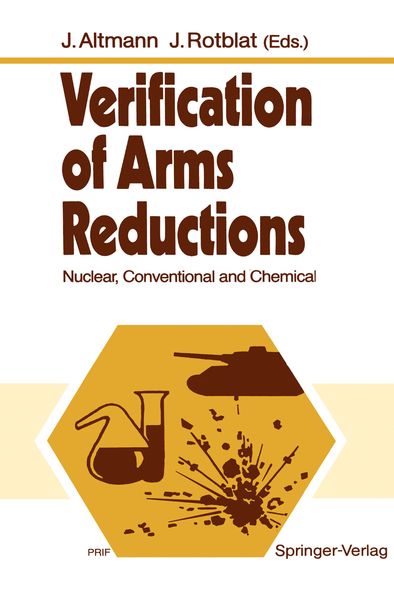
Verification of Arms Reductions Nuclear, Conventional and Chemical

99,99 €

inkl. gesetzl. MwSt., Versandkostenfrei


Beschreibung

Produktdetails

Einband

Taschenbuch

Erscheinungsdatum

23.03.2012

Herausgeber

Jürgen Altmann + weitere

Verlag

Springer Berlin

Seitenzahl

228

Maße (L/B/H)

23,5/15,5/1,4 cm

Gewicht

381 g

Auflage

Softcover reprint of the original 1st ed. 1989

Sprache

Englisch

ISBN

978-3-642-46686-1

Beschreibung

Produktdetails

Einband

Taschenbuch

Erscheinungsdatum

23.03.2012

Herausgeber

Verlag

Springer Berlin

Seitenzahl

228

Maße (L/B/H)

23,5/15,5/1,4 cm

Gewicht

381 g

Auflage

Softcover reprint of the original 1st ed. 1989

Sprache

Englisch

ISBN

978-3-642-46686-1

Herstelleradresse

Springer-Verlag GmbH
Tiergartenstr. 17
69121 Heidelberg
DE

Email: ProductSafety@springernature.com

Kundinnen und Kunden meinen

0 Bewertungen

Informationen zu Bewertungen

Zur Abgabe einer Bewertung ist eine Anmeldung im Konto notwendig. Die Authentizität der Bewertungen wird von uns nicht überprüft. Wir behalten uns vor, Bewertungstexte, die unseren Richtlinien widersprechen, entsprechend zu kürzen oder zu löschen.

Die Bewertungen sind nach Format, Anzahl Sterne und Datum sortiert.

Verfassen Sie die erste Bewertung zu diesem Artikel

Helfen Sie anderen Kund*innen durch Ihre Meinung

Kundinnen und Kunden meinen

0 Bewertungen filtern

  • Produktbild: Verification of Arms Reductions
  • Produktbild: Verification of Arms Reductions
  • I Role of Verification and Recent Experience.- 1. Transforming the East-West Conflict: The Crucial Role of Verification.- 1.1 Introduction.- 1.2 Arms Control and Verification: Some Conceptual Thoughts.- 1.3 Verification and the Political Debate.- 1.4 Towards Cooperative Security 5.- 1.5 The Role of Verification in the Process of Cooperative Security.- 1.6 Methods of Verification.- 1.7 Technology and Verification.- 1.8 Conclusions.- 1.9 Notes and References.- 2. Experience with INF Treaty Verification and Prospects for Effective Verification of Strategic Arms Reductions.- 2.1 Introduction.- 2.2 The INF Verification Regime.- 2.2.1 The Overall Concept.- 2.2.2 The Details.- 2.2.3 Implementation.- 2.3 Status of Treaty Implementation.- 2.3.1 The On-Site Inspection Agency (OSIA).- 2.3.2 The Inspection Process 24.- 2.3.3 The Special Verification Commission (SVC).- 2.4 Verification Problems in Strategic Arms Reductions.- 2.5 Concluding Remarks.- 2.6 Notes.- 3. Experience with INF Treaty Verification and Prospects for the Future.- 3.1 Verification and Arms Control.- 3.2 Verification of the INF Treaty.- 3.3 Future Prospects of Verification.- 4. Mechanisms for Raising and Resolving Compliance Issues.- 4.1 Compliance Problems.- 4.2 Possible New Compliance Mechanisms.- 4.3 A Supranational Arbitration Agency.- 4.4 Notes and References.- II Verification of Mobile Missiles, Nuclear Warheads and Fissile Material.- 5. Verification of Sea-Launched Cruise Missiles.- 5.1 Introduction.- 5.2 SLCMs and Arms Control.- 5.3 SLCM Verification Problems.- 5.4 Verification Approaches.- 5.4.1 Maximal Inspection.- 5.4.2 Minimal Inspection.- 5.4.3 Intermediate Inspection.- 5.5 Conclusion.- 5.6 Notes and References.- 6. Passive Detection of Nuclear Warheads.- 6.1 Introduction.- 6.2 Weapon models.- 6.3 Passive Detection.- 6.3.1 Neutrons.- 6.3.2 Photons.- 6.4 Radiation Detection.- 6.5 Accuracy of Detection Analysis.- 6.6 Evading Passive Detection.- 6.7 Notes and References.- 7. Disposal of Fissile Material from Nuclear Weapons.- 7.1 Introduction.- 7.2 How to Achieve Nuclear Disarmament?.- 7.3 Recycling Plutonium in Nuclear Reactors.- 7.4 Molten Salt Reactors (MSR).- 7.5 How to Burn Nuclear Weapons?.- 7.6 Proliferation Advantages of MSR.- 7.7 Cost of Destroying Nuclear Weapons.- 7.8 Conclusion.- 7.9 Notes and References.- 8. The IAEA’s Controls on Fissile Material: Limits and Successes.- 8.1 The Aim of Safeguards: Verification, not Control.- 8.2 Inherent Constraints in a World of Nation States.- 8.3 Incomplete Coverage.- 8.4 Other Limitations.- 8.5 How Safeguards Work.- 8.6 The Size of the Operation.- 8.7 How Effective are IAEA Safeguards?.- 8.8 What Have IAEA Safeguards Achieved?.- 8.9 Risks and Opportunities for IAEA Safeguards.- 8.10 Notes and References.- III Verification of a Nuclear Test Ban.- 9. Can Nuclear Weapons Be Developed Without Full Testing?.- 9.1 Pure Fission Weapons.- 9.2 Boosted Fission Weapons.- 9.3 Thermonuclear Weapons.- 9.4 “Third Generation” Nuclear Weapons.- 9.5 Notes and References.- 10. Recent Developments and Outlook for the Verification of a Nuclear Test Ban.- 10.1 Introduction.- 10.2 Recent Developments.- 10.2.1 The Joint Verification Experiment.- 10.2.2 Controversy over CORRTEX.- 10.2.3 Non-Governmental Verification Developments.- 10.2.4 The Ad-Hoc Group of Seismic Experts at the UN Conference on Disarmament.- 10.2.5 Expenditure on Test-Ban Verification Research.- 10.3 The Office of Technology Assessment Report and its Implications.- 10.4 Prospects for Test Ban Verification.- 10.5 Summary and Conclusions.- 10.6 Notes and References.- 11. UK-USSR and US-USSR Joint Research Programmes in Seismic Verification.- 11.1 Introduction.- 11.2 USA-USSR Programmes.- 11.3 UK-USSR Programmes.- 11.4 Preliminary Analyses of BSVRP Data.- 11.5 Future Developments.- 11.6 Notes and References.- IV Control of Space Weapons.- 12. Recent Developments in Space Weapons.- 12.1 Introduction.- 12.2 Recent Changes in the SDI Program.- 12.3 A New Political Strategy for Star Wars.- 12.4 Star Wars and the ABM Treaty.- 12.5 Anti-Satellite Weapons.- 12.6 Future Prospects.- 13. Verification of a Ban on Space Weapons.- 13.1 Introduction.- 13.2 Components to be Verified.- 13.3 Parameters.- 13.4 Ban on Nuclear Power in Orbits.- 13.5 Notes and References.- V Conventional Stability in Europe.- 14. Concepts of Conventional Stability and Reductions of Arms in Europe.- 14.1 Principles of Conventional Stability.- 14.2 Objects and Difficulties of Negotiations.- 14.3 Stability-Oriented Reductions of Armed Forces in Europe.- 15. Enhancing Conventional Stability in Europe.- 15.1 Introduction.- 15.2 Specific Features of a Conventional Stability Regime.- 15.3 Other Measures.- 15.4 Notes and References.- VI Confidence and Security-Building Measures in Europe.- 16. Verification of Confidence and Security Building Measures: Evolution and Future Prospects.- 16.1 Evolution of CSBMs.- 16.2 The Helsinki Regime.- 16.3 The Stockholm Regime.- 16.4 Future Prospects.- 16.5 Notes and References.- 17. Observations of Military Exercises and On-Site Inspections in Europe.- 17.1 Introduction.- 17.2 The Stockholm Document.- 17.3 NATO Exercises.- 17.4 Need for Extending of CSBMs.- 17.5 Notes and References.- VII Verification of Conventional Force Reductions.- 18. Conventional Arms Reduction in Europe: A Verification Model.- 18.1 Introduction.- 18.2 Verification and the European Scenario.- 18.3 Verification Methods.- 18.3.1 Space-Based Sensors.- 18.3.2 Airborne Sensors.- 18.4 Coverage Problem.- 18.4.1 Types of Areas.- 18.4.2 Complementary Verification Methods.- 18.4.3 Treaty Effectiveness.- 18.5 Conclusions.- 19. Aspects of the Verification of Conventional Arms Control Measures in Europe.- 19.1 Introduction.- 19.2 What is the Real Problem of Verification?.- 19.3 The Envelope Scheme.- 19.4 Tags.- 19.5 Conclusion.- 19.6 Notes and References.- 20. The Verification of Conventional Disarmament Treaties by Remote Sensing.- 20.1 Introduction.- 20.2 Visible light- and near infrared imaging.- 20.2.1 Optics and field of view.- 20.2.2 Sensors.- 20.3 Sensing with Thermal Infrared.- 20.4 Synthetic Aperture Radar.- 20.5 Airborne or Space-Based Remote Sensing?.- 20.6 Possible Verification Tasks.- 20.7 Weather Conditions in Germany.- 20.8 Data Processing and Data Integration.- 20.9 Concluding Remarks.- 20.10 Notes and References.- 21. Verification Techniques for Heavy Land Vehicles Using Short-Range Sensors.- 21.1 Context.- 21.1.1 Geographical and Numerical Limits in Europe.- 21.1.2 Verification Methods.- 21.2 Sensors for Very Short Distances.- 21.3 Sensors for Near Distances.- 21.4 General Problems.- 21.5 Conclusion.- 21.6 Notes and References.- VIII Verification of a Chemical Weapons Ban.- 22. Challenge Inspections in a Chemical Weapons Convention.- 22.1 Introduction.- 22.2 Mandatory Character.- 22.3 Equal Rights, Equal Application.- 22.4 Avoiding the Use for Other Purposes.- 22.5 The Position of the USSR 199.- 22.6 Notes and References.- 23. Verification Procedures for a Chemical Weapons Treaty.- 23.1 Introduction.- 23.2 The Likely Form of the Projected Chemical Weapons Treaty.- 23.3 The Verification System Now Envisaged.- 23.4 Notes and References.- Contributors.- Abbreviations.