Gutscheinbedingungen

**Gültig nur für Bestellungen an die Wunsch-Poststation bis 10.06.2026 auf Spielzeug, Schreibwaren, Filme, Geschenke & Trends, Musik, tolino eReader & Zubehör, Hörbücher und Hörbuch-Downloads (außer Abo), nicht preisgebundene Bücher und Kalender online auf thalia.at und in der Thalia App. Einzelne Artikel können ausgeschlossen sein. Aufgrund der Buchpreisbindung sind deutschsprachige Bücher und eBooks ausgenommen. Zusätzlich ausgenommen sind preisgebundene Artikel, Abos & Flatrates, eBooks, Games, Geschenkkarten/-boxen, Shelfies, Software, Zeitschriften sowie einzelne Artikel von tonies®. Pro Einkauf einmal einlösbar. Kein Click & Collect möglich. Keine Barauszahlung. Nicht kombinierbar mit anderen Aktionen und Gutscheinen. Gutschein wird auf max. 500€ Bestellwert angerechnet. Nicht gültig für Versandkosten und Services.

Produktbild: Field Theory Concepts

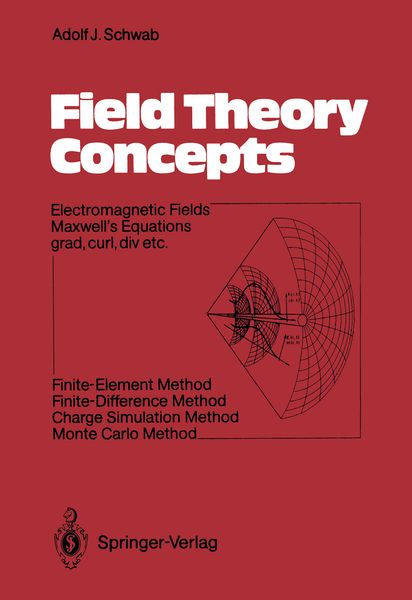
Field Theory Concepts Electromagnetic Fields. Maxwell’s Equations grad, curl, div. etc. Finite-Element Method. Finite-Difference Method. Charge Simulation Method. Monte Carlo Method

51,99 €

inkl. gesetzl. MwSt., Versandkostenfrei


Beschreibung

Produktdetails

Einband

Taschenbuch

Erscheinungsdatum

14.04.2012

Verlag

Springer Berlin

Seitenzahl

218

Maße (L/B/H)

24,4/17/1,3 cm

Gewicht

414 g

Auflage

Softcover reprint of the original 1st ed. 1988

Sprache

Englisch

ISBN

978-3-642-48943-3

Beschreibung

Produktdetails

Einband

Taschenbuch

Erscheinungsdatum

14.04.2012

Verlag

Springer Berlin

Seitenzahl

218

Maße (L/B/H)

24,4/17/1,3 cm

Gewicht

414 g

Auflage

Softcover reprint of the original 1st ed. 1988

Sprache

Englisch

ISBN

978-3-642-48943-3

Herstelleradresse

Springer-Verlag GmbH
Tiergartenstr. 17
69121 Heidelberg
DE

Email: ProductSafety@springernature.com

Kundinnen und Kunden meinen

0 Bewertungen

Informationen zu Bewertungen

Zur Abgabe einer Bewertung ist eine Anmeldung im Konto notwendig. Die Authentizität der Bewertungen wird von uns nicht überprüft. Wir behalten uns vor, Bewertungstexte, die unseren Richtlinien widersprechen, entsprechend zu kürzen oder zu löschen.

Die Bewertungen sind nach Format, Anzahl Sterne und Datum sortiert.

Verfassen Sie die erste Bewertung zu diesem Artikel

Helfen Sie anderen Kund*innen durch Ihre Meinung

Kundinnen und Kunden meinen

0 Bewertungen filtern

  • Produktbild: Field Theory Concepts
  • 1 Elementary Concepts of Electric and Magnetic Fields.- 1.1 Flux and Flux Density of Vector Fields.- 1.2 Equations of Matter — Constitutive Relations.- 2 Types of Vector Fields.- 2.1 Electric Source Fields.- 2.2 Electric and Magnetic Vortex Fields.- 2.3 General Vector Fields.- 3 Field Theory Equations.- 3.1 Integral Form of Maxwells Equations.- 3.1.1 Faraday’s Induction Law in Integral Form Vortex Strength of Electric Vortex Fields.- 3.1.2 Ampere’s Circuital Law in Integral Form Vortex Strength of Magnetic Vortex Fields.- 3.1.3 Gauss’s Law of the Electric Field Source Strength of Electric Fields.- 3.1.4 Gauss’s Law of the Magnetic Field Source Strength of Magnetic Fields.- 3.2 Law of Continuity in Integral Form Source Strength of Current Density Fields.- 3.3 Differential Form of Maxwell’s Equations.- 3.3.1 Faradays Induction Law in Differential Form Vortex Density of Electric Vortex Fields.- 3.3.2 Ampere’s Circuital Law in Differential Form Vortex Density of Magnetic Vortex Fields.- 3.3.3 Divergence of Electric Fields Source Density of Electric Fields.- 3.3.4 Divergence of Magnetic Fields Source Density of Magnetic Fields.- 3.4 Law of Continuity in Differential Form Source Density of Current Density Fields.- 3.5 Maxwell’s Equations in Complex Notation.- 3.6 Integral Theorems of Stokes and Gauss.- 3.7 Network Model of Induction.- 4 Gradient, Potential, Potential Function.- 4.1 Gradient of a Scalar Field.- 4.2 Potential and Potential Function of Static Electric Fields.- 4.3 Development of the Potential Function from a Given Charge Distribution.- 4.3.1 Potential Function of a Line Charge.- 4.3.2 Potential Function of a General Charge Distribution.- 4.4 Potential Equations.- 4.4.1 Potential Equations for Fields without Space Charges.- 4.4.2 Potential Equations for Fields with Space Charges.- 4.5 Electric Vector Potential.- 4.6 Vector Potential of the Conduction Field.- 5 Potential and Potential Function of Magnetostatic Fields.- 5.1 Magnetic Scalar Potential.- 5.2 Potential Equation for Magnetic Scalar Potentials.- 5.3 Magnetic Vector Potential.- 5.4 Potential Equation for Magnetic Vector Potentials.- 6 Classification of Electric and Magnetic Fields.- 6.1 Stationary Fields.- 6.1.1 Electrostatic Fields.- 6.1.2 Magnetostatic Fields.- 6.1.3 Static Conduction Field (DC Current-Conduction Field).- 6.2 Quasi-Stationary Fields (Steady-State) Fields.- 6.2.1 Quasi-Static Electric Fields.- 6.2.2 Quasi-Static Magnetic Fields.- 6.2.3 Quasi-Static Conduction Fields.- 6.2.4 Conduction Fields with Skin Effect.- 6.3 Nonstationary Fields, Electromagnetic Waves.- 6.3.1 Wave Equation.- 6.3.2 Retarded Potentials.- 6.3.3 Hertz Potentials.- 6.3.4 Energy Density in Electric and Magnetic Fields, Energy Flow Density in Electromagnetic Waves.- 7 Transmission-Line Equations.- 8 Typical Differential Equations of Electrodynamics and Mathematical Physics.- 8.1 Generalized Telegraphist’s Equation.- 8.2 Telegraphist’s Equation with a, b>0; c=0.- 8.3 Telegraphist’s Equation with a>0; b=0; c=0.- 8.4 Telegraphist’s Equation with b>0; a=0; c=0.- 8.5 Helmholtz Equation.- 8.6 Schroedinger Equation.- 8.7 Lorentz’s Invariance of Maxwell’s Equations.- 9 Numerical Calculation of Potential Fields.- 9.1 Finite-Element Method.- 9.2 Finite-Difference Method.- 9.3 Charge Simulation Method.- 9.4 Monte Carlo Method.- 9.5 General Remarks on Numerical Field Calculation.- A1 Units.- A2 Scalar and Vector Integrals.- A3 Vector Operations in Special Coordinate Systems.- A5 Complex Notation of Harmonic Quantities.- Literature.