
Gutscheinbedingungen

**Gültig nur für Bestellungen an die Wunsch-Poststation bis 10.06.2026 auf Spielzeug, Schreibwaren, Filme, Geschenke & Trends, Musik, tolino eReader & Zubehör, Hörbücher und Hörbuch-Downloads (außer Abo), nicht preisgebundene Bücher und Kalender online auf thalia.at und in der Thalia App. Einzelne Artikel können ausgeschlossen sein. Aufgrund der Buchpreisbindung sind deutschsprachige Bücher und eBooks ausgenommen. Zusätzlich ausgenommen sind preisgebundene Artikel, Abos & Flatrates, eBooks, Games, Geschenkkarten/-boxen, Shelfies, Software, Zeitschriften sowie einzelne Artikel von tonies®. Pro Einkauf einmal einlösbar. Kein Click & Collect möglich. Keine Barauszahlung. Nicht kombinierbar mit anderen Aktionen und Gutscheinen. Gutschein wird auf max. 500€ Bestellwert angerechnet. Nicht gültig für Versandkosten und Services.

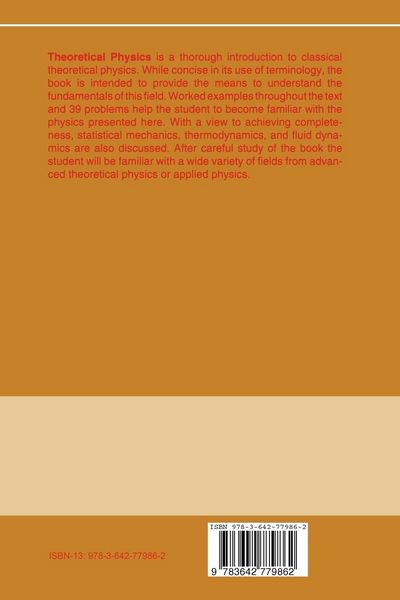
  • Produktbild: Theoretical Physics
  • Produktbild: Theoretical Physics
- 11%

Theoretical Physics A Classical Approach

11% sparen

96,99 € UVP 109,99 €

inkl. gesetzl. MwSt., Versandkostenfrei


Beschreibung

Produktdetails

Einband

Taschenbuch

Erscheinungsdatum

16.12.2011

Verlag

Springer Berlin

Seitenzahl

569

Maße (L/B/H)

23,5/15,5/3,2 cm

Gewicht

879 g

Auflage

Softcover reprint of the original 1st ed. 1993

Übersetzt von

H. Pollack

Sprache

Englisch

ISBN

978-3-642-77986-2

Beschreibung

Produktdetails

Einband

Taschenbuch

Erscheinungsdatum

16.12.2011

Verlag

Springer Berlin

Seitenzahl

569

Maße (L/B/H)

23,5/15,5/3,2 cm

Gewicht

879 g

Auflage

Softcover reprint of the original 1st ed. 1993

Übersetzt von

H. Pollack

Sprache

Englisch

ISBN

978-3-642-77986-2

Herstelleradresse

Springer-Verlag KG
Sachsenplatz 4-6
1201 Wien
AT

Email: ProductSafety@springernature.com

Kundinnen und Kunden meinen

0 Bewertungen

Informationen zu Bewertungen

Zur Abgabe einer Bewertung ist eine Anmeldung im Konto notwendig. Die Authentizität der Bewertungen wird von uns nicht überprüft. Wir behalten uns vor, Bewertungstexte, die unseren Richtlinien widersprechen, entsprechend zu kürzen oder zu löschen.

Die Bewertungen sind nach Format, Anzahl Sterne und Datum sortiert.

Verfassen Sie die erste Bewertung zu diesem Artikel

Helfen Sie anderen Kund*innen durch Ihre Meinung

Kundinnen und Kunden meinen

0 Bewertungen filtern

  • Produktbild: Theoretical Physics
  • Produktbild: Theoretical Physics
  • 1. Introduction.- 2. Newtonian Mechanics.- 2.1 Space and Time in Classical Mechanics.- 2.2 Newton’s Laws.- 2.3 A Few Important Force Laws.- 2.4 The Energy of a Particle in a Force Field.- 2.4.1 Line Integrals.- 2.4.2 Work and Energy.- 2.5 Several Interacting Particles.- 2.6 Momentum and Momentum Conservation.- 2.7 Angular Momentum.- 2.8 The Two-Body Problem.- 2.9 The Kepler Problem.- 2.10 Scattering.- 2.10.1 Relative Motion in the Scattering Process.- 2.10.2 The Center of Mass System and the Laboratory System.- 2.11 The Scattering Cross-Section.- 2.12 The Virial Theorem.- 2.13 Mechanical Similarity.- 2.14 Some General Observations About the Many-Body Problem.- Problems.- 3. Lagrangian Methods in Classical Mechanics.- 3.1 A Sketch of the Problem and Its Solution in the Case of a Pendulum.- 3.2 The Lagrangian Method of the First Type.- 3.3 The Lagrangian Method of the Second Type.- 3.4 The Conservation of Energy in Motions Which are Limited by Constraints.- 3.5 Non-holonomic Constraints.- 3.6 Invariants and Conservation Laws.- 3.7 The Hamiltonian.- 3.7.1 Lagrange’s Equations and Hamilton’s Equations.- 3.7.2 Aside on the Further Development of Theoretical Mechanics and the Theory of Dynamical Systems.- 3.8 The Hamiltonian Principle of Stationary Action.- 3.8.1 Functionals and Functional Derivatives.- 3.8.2 Hamilton’s Principle.- 3.8.3 Hamilton’s Principle for Systems with Holonomic Constraints.- Problems.- 4. Rigid Bodies.- 4.1 The Kinematics of the Rigid Body.- 4.2 The Inertia Tensor and the Kinetic Energy of a Rigid Body.- 4.2.1 Definition and Elementary Properties of the Inertia Tensor.- 4.2.2 Calculation of Inertia Tensors.- 4.3 The Angular Momentum of a Rigid Body, Euler’s Equations.- 4.4 The Equations of Motion for the Eulerian Angles.- Problems.- 5. Motion in a Noninertial System of Reference.- 5.1 Fictitious Forces in Noninertial Systems.- 5.2 Foucault’s Pendulum.- 6. Linear Oscillations.- 6.1 Linear Approximations About a Point of Equilibrium.- 6.2 A Few General Remarks About Linear Differential Equations.- 6.3 Homogeneous Linear Systems with One Degree of Freedom and Constant Coefficients.- 6.4 Homogeneous Linear Systems with n Degrees of Freedom and Constant Coefficients.- 6.4.1 Normal Modes and Eigenfrequencies.- 6.4.2 Examples of the Calculation of Normal Modes.- 6.5 The Response of Linear Systems to External Forces.- 6.5.1 External Oscillating Forces.- 6.5.2 Superposition of External Harmonic Forces.- 6.5.3 Periodic External Forces.- 6.5.4 Arbitrary External Forces.- Problems.- 7. Classical Statistical Mechanics.- 7.1 Thermodynamic Systems and Distribution Functions.- 7.2 Entropy.- 7.3 Temperature, Pressure, and Chemical Potential.- 7.3.1 Systems with Exchange of Energy.- 7.3.2 Systems with an Exchange of Volume.- 7.3.3 Systems with Exchanges of Energy and Particles.- 7.4 The Gibbs Equation and the Forms of Energy Exchange.- 7.5 The Canonical Ensemble and the Free Energy.- 7.6 Thermodynamic Potentials.- 7.7 Material Constants.- 7.8 Changes of State.- 7.8.1 Reversible and Irreversible Processes.- 7.8.2 Adiabatic and Non-adiabatic Processes.- 7.8.3 The Joule-Thomson Process.- 7.9 The Transformation of Heat into Work, the Carnot Efficiency.- 7.10 The Laws of Thermodynamics.- 7.11 The Phenomenological Basis of Thermodynamics.- 7.11.1 Thermodynamics and Statistical Mechanics.- 7.11.2 The First Law of Thermodynamics.- 7.11.3 The Second and Third Laws.- 7.11.4 The Thermal and Caloric Equations of State.- 7.12 Equilibrium and Stability Conditions.- 7.12.1 Equilibrium and Stability in Exchange Processes.- 7.12.2 Equilibrium, Stability and Thermodynamic Potentials.- Problems.- 8. Applications of Thermodynamics.- 8.1 Phase Transformations and Phase Diagrams.- 8.2 The Latent Heat of Phase Transitions.- 8.3 Solutions.- 8.4 Henry’s Law, Osmosis.- 8.4.1 Henry’s Law.- 8.4.2 Osmosis.- 8.5 Phase Transitions in Solutions.- 8.5.1 Case (2): Miscibility in Only One Phase.- 8.5.2 Case (3): Miscibility in Two Phases.- Problem.- 9. Elements of Fluid Mechanics.- 9.1 A Few Introductory Remarks About Fluid Mechanics.- 9.2 The General Balance Equation.- 9.3 Particular Balance Equations.- 9.4 Entropy Production, Generalized Forces, and Fluids.- 9.5 The Differential Equations of Fluid Mechanics.- 9.6 A Few Elementary Applications of the Navier-Stokes Equations.- Problem.- 10. The Most Important Linear Partial Differential Equations of Physics.- 10.1 General Considerations.- 10.1.1 Types of Linear Partial Differential Equations, the Formulation of Boundary and Initial Value Problems.- 10.1.2 Initial Value Problems in ?D.- 10.1.3 Inhomogeneous Equations and Green’s Functions.- 10.2 Solutions of the Wave Equation.- 10.3 Boundary Value Problems.- 10.3.1 Initial Observations.- 10.3.2 Examples of Boundary Value Problems.- 10.3.3 The General Treatment of Boundary Value Problems.- 10.4 The Helmholtz Equation in Spherical Coordinates, Spherical Harmonics, and Bessel Functions.- 10.4.1 Separation of Variables.- 10.4.2 The Angular Equations, Spherical Harmonics.- 10.4.3 The Radial Equation, Bessel Functions.- 10.4.4 Solutions of the Helmholtz Equation.- 10.4.5 Supplementary Considerations.- Problems.- 11. Electrostatics.- 11.1 The Basic Equations of Electrostatics and Their First Consequences.- 11.1.1 Coulomb’s Law and the Electric Field.- 11.1.2 Electrostatic Potential and the Poisson Equation.- 11.1.3 Examples and Important Properties of Electrostatic Fields.- 11.2 Boundary Value Problems in Electrostatics, Green’s Functions.- 11.2.1 Dirichlet and Neumann Green’s Functions.- 11.2.2 Supplementary Remarks on Boundary Value Problems in Electrostatics.- 11.3 The Calculation of Green’s Functions, the Method of Images.- 11.4 The Calculation of Green’s Functions, Expansion in Spherical Harmonics.- 11.5 Localized Charge Distributions, the Multipole Expansion.- 11.6 Electrostatic Potential Energy.- Problems.- 12. Moving Charges, Magnetostatics.- 12.1 The Biot-Savart Law, the Fundamental Equations of Magnetostatics.- 12.1.1 Electric Current Density and Magnetic Fields.- 12.1.2 The Vector Potential and Ampère’s Law.- 12.1.3 The SI-System of Units in Electrodynamics.- 12.2 Localized Current Distributions.- 12.2.1 The Magnetic Dipole Moment.- 12.2.2 Force, Potential, and Torque in a Magnetic Field.- 13. Time Dependent Electromagnetic Fields.- 13.1 Maxwell’s Equations.- 13.2 Potentials and Gauge Transformations.- 13.3 Electromagnetic Waves in a Vacuum, the Polarization of Transverse Waves.- 13.4 Electromagnetic Waves, the Influence of Sources.- 13.5 The Energy of the Electromagnetic Field.- 13.5.1 Balance of Energy and the Poynting Vector.- 13.5.2 The Energy Flux of the Radiation Field.- 13.5.3 The Energy of the Electric Field.- 13.5.4 The Energy of the Magnetic Field.- 13.5.5 Self-Energy and Interaction Energy.- 13.6 The Momentum of the Electromagnetic Field.- 14. Elements of the Electrodynamics of Continuous Media.- 14.1 The Macroscopic Maxwell Equations.- 14.1.1 Microscopic and Macroscopic Fields.- 14.1.2 The Average Charge Density and Electric Displacement.- 14.1.3 The Average Current Density and the Magnetic Field Strength.- 14.2 Electrostatic Fields in Continuous Media.- 14.3 Magnetostatic Fields in Continuous Media.- 14.4 Plane Waves in Matter, Wave Packets.- 14.4.1 The Frequency Dependence of Susceptibility.- 14.4.2 Wave Packets, Phase and Group Velocity.- 14.5 Reflection and Refraction at Plane Boundary Surfaces.- 14.5.1 Boundary Conditions, the Laws of Reflection and Refraction.- 14.5.2 Fresnel’s Equations.- 14.5.3 Special Effects of Reflection and Refraction.- Appendices.- A. The ?-Function.- B. Conic Sections.- C. Tensors.- D. Fourier Series and Fourier Integrals.- D.1 Fourier Series.- D.2 Fourier Integrals and Fourier Transforms.- E. Distributions and Green’s Functions.- E.1 Distributions.- E.2 Green’s Functions.- F. Vector Analysis and Curvilinear Coordinates.- F.1 Vector Fields and Scalar Fields.- F.2 Line, Surface, and Volume Integrals.- F.3 Stokes’s Theorem.- F.4 Gauss’s Theorem.- F.5 Applications of the Integral Theorems.- F.6 Curvilinear Coordinates.- Problems.- References.