Gutscheinbedingungen

**Gültig bis 06.07.2026 auf fremdsprachige Bücher online auf thalia.at, in der Thalia App ab einem Mindestbestellwert von 30€ und in allen Thalia Buchhandlungen in Österreich. In den Buchhandlungen nur gültig auf lagernde Ware. Einzelne Artikel können ausgeschlossen sein. Ausgenommen sind preisgebundene Artikel & eBooks. Pro Einkauf einmal einlösbar. Nur gültig gegen Vorlage oder im Onlineshop hinterlegter Bonuscard. Infos zur Einlösung in der Buchhandlung sind auf der Bonuscard-Vorteilspreisseite zu finden. Click & Collect nur bei Onlinevorabzahlung möglich. Keine Einlösung bei Scan & Go-Bezahlung. Keine Barauszahlung. Nicht kombinierbar mit anderen Aktionen und Gutscheinen. Gutschein wird auf max. 500€ Bestellwert angerechnet. Nicht gültig für Versandkosten und Services.

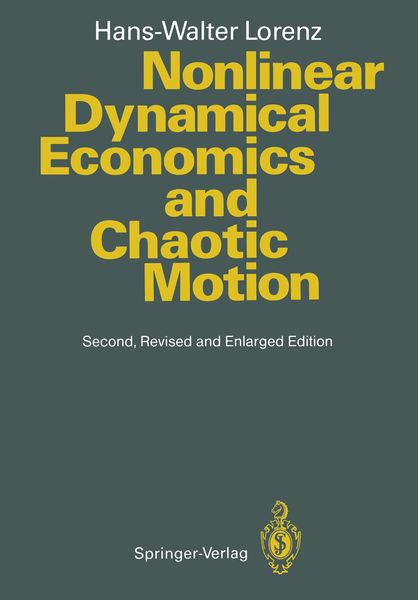
Produktbild: Nonlinear Dynamical Economics and Chaotic Motion

Nonlinear Dynamical Economics and Chaotic Motion

109,99 €

inkl. gesetzl. MwSt., Versandkostenfrei


Beschreibung

Produktdetails

Einband

Taschenbuch

Erscheinungsdatum

16.12.2011

Verlag

Springer Berlin

Seitenzahl

320

Maße (L/B/H)

24,2/17/1,9 cm

Gewicht

583 g

Auflage

Second Edition 1993

Sprache

Englisch

ISBN

978-3-642-78326-5

Beschreibung

Produktdetails

Einband

Taschenbuch

Erscheinungsdatum

16.12.2011

Verlag

Springer Berlin

Seitenzahl

320

Maße (L/B/H)

24,2/17/1,9 cm

Gewicht

583 g

Auflage

Second Edition 1993

Sprache

Englisch

ISBN

978-3-642-78326-5

Herstelleradresse

Springer-Verlag KG
Sachsenplatz 4-6
1201 Wien
AT

Email: GPSR Kontakt

Noch keine Bewertungen vorhanden

Verfassen Sie die erste Bewertung zu diesem Artikel

Helfen Sie anderen Kundinnen und Kunden durch Ihre Meinung.

Kundinnen und Kunden meinen

Bewertungen (0)

  • Produktbild: Nonlinear Dynamical Economics and Chaotic Motion
  • 1. Economic Dynamics, Linearities, and the Classical Mechanistic Worldview.- 1.1. Some Reflections on the Origin of Economic Dynamics.- 1.2. The Deterministic Worldview and Deterministic Theories.- 1.3. The Dominance of Linear Dynamical Systems in Economics.- 2. Nonlinearities and Economic Dynamics.- 2.1. Preliminary Concepts.- 2.2. The Poincaré-Bendixson Theorem.- 2.2.1. The Existence of Limit Cycles.- 2.2.2. The Kaldor Model as a Prototype Model in Nonlinear Economic Dynamics.- 2.2.3. A Classical Cross-Dual Adjustment Process.- 2.3. The Uniqueness of Limit Cycles.- 2.3.1. The Liénard Equation and Related Tools.- 2.3.2. The Symmetric Case: Unique Cycles in a Modified Phillips Model.- 2.3.3. The Asymmetric Case: Unique Cycles in a Kaldor Model.- 2.4. Predator-Prey Models.- 2.4.1. The Dynamics of Conservative Dynamical Systems.- 2.4.2. Goodwin’s Predator-Prey Model of the Class Struggle.- 2.4.3. Other Examples and Predator-Prey Structures in Dissipative Systems.- 2.5. Relaxation Oscillations.- 2.6. Irreversibility and Determinism in Dynamical Systems.- 3. Bifurcation Theory and Economic Dynamics.- 3.1. Preliminaries and Different Concepts of Structural Stability.- 3.2. Local Bifurcations in Continuous-Time Dynamical Systems.- 3.2.1. Fold, Transcritical, and Pitchfork Bifurcations.- 3.2.2. The Hopf Bifurcation in Continuous-Time Dynamical Systems.- 3.2.2.1. The Hopf Bifurcation in Business-Cycle Theory.- 3.2.2.2. Closed Orbits in Optimal Economic Growth.- 3.3. Local Bifurcations in Discrete-Time Dynamical Systems.- 3.3.1. Fold, Transcritical, Pitchfork, and Flip Bifurcations.- 3.3.2. The Hopf Bifurcation in Discrete-Time Dynamical Systems.- 4. Chaotic Dynamics in Discrete-Time Economic Models.- 4.1. Chaos in One-Dimensional, Discrete-Time Dynamical Systems.- 4.1.1. Basic Concepts.- 4.1.2. Chaos in Descriptive Growth Theory.- 4.1.3. Chaos in Discrete-Time Models of Optimal Economic Growth.- 4.1.4. Other Economic Examples.- 4.2. Chaos in Higher-Dimensional Discrete-Time Systems.- 4.2.1. Some Basic Ideas.- 4.2.2. An Economic Example.- 4.3. Complex Transients in Discrete-Time Dynamical Systems.- 4.3.1. Complex Transient Behavior in One-Dimensional Systems.- 4.3.2. Horseshoes, Homoclinic Orbits, and Complicated Invariant Sets.- 5. Chaotic Dynamics in Continuous-Time Economic Models.- 5.1. Basic Ideas.- 5.2. The Coupling of Oscillators.- 5.2.1. Toroidal Motion.- 5.2.2. International Trade as the Coupling of Oscillators.- 5.3. The Forced Oscillator.- 5.3.1. Forced Oscillator Systems and Chaotic Motion.- 5.3.2. Goodwins’s Nonlinear Accelerator as a Forced Oscillator.- 5.3.3. Keynesian Demand Policy as the Source of Chaotic Motion.- 5.3.4. Conclusion.- 5.4. Homoclinic Orbits and Spiral-Type Attractors.- 5.4.1. The Shil’nikov Scenario.- 5.4.2. Spiral-Type Chaos in a Business Cycle Model with Inventories.- 6. Numerical Tools.- 6.1. Spectral Analysis.- 6.2. Dimension, Entropy, and Lyapunov Exponents.- 6.2.1. Phase Space Embedding.- 6.2.2. Fractal Dimensions.- 6.2.3. Correlation Dimension.- 6.2.4. Lyapunov Exponents.- 6.2.5. Kolmogorov Entropy.- 6.2.6. Summary.- 6.3. Are Economic Time Series Chaotic?.- 6.4. Predictability in the Face of Chaotic Dynamics.- 7. Catastrophe Theory and Economic Dynamics.- 7.1. Basic Ideas.- 7.2. The Kaldor Model in the Light of Catastrophe Theory.- 7.3. A Catastrophe-Theoretical Approach to Stagflation.- 8. Concluding Remarks.- A.1. Basic Properties of Linear Dynamical Systems.- A.2. Center Manifolds and the Reduction of (Effective) Dimensions.- A.3. A Brief Introduction to the Theory of Lags and Operators.- A.4. Numerical Simulations and Chaotic Dynamics in Theoretical Economics.- References.- Name Index.