Gutscheinbedingungen

**Gültig am 17.06.2026 auf Spielzeug, Schreibwaren, Filme, Geschenke & Trends, Musik, tolino eReader & Zubehör, Hörbücher und Hörbuch-Downloads (außer Abo), nicht preisgebundene Bücher und Kalender online auf thalia.at und in der Thalia App. Einzelne Artikel können ausgeschlossen sein. Aufgrund der Buchpreisbindung sind deutschsprachige Bücher und eBooks ausgenommen. Zusätzlich ausgenommen sind preisgebundene Artikel, Abos & Flatrates, eBooks, Games, Geschenkkarten/-boxen, Shelfies, Software, Zeitschriften sowie einzelne Artikel von tonies®. Pro Einkauf einmal einlösbar. Click & Collect nur bei Onlinevorabzahlung möglich. Keine Barauszahlung. Nicht kombinierbar mit anderen Aktionen und Gutscheinen. Gutschein wird auf max. 500€ Bestellwert angerechnet. Nicht gültig für Versandkosten und Services.

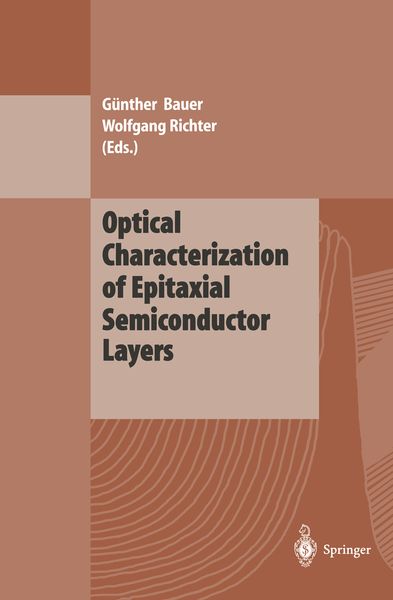
Produktbild: Optical Characterization of Epitaxial Semiconductor Layers

Optical Characterization of Epitaxial Semiconductor Layers

51,99 €

inkl. gesetzl. MwSt., Versandkostenfrei


Beschreibung

Produktdetails

Einband

Taschenbuch

Erscheinungsdatum

14.12.2011

Herausgeber

Günther Bauer + weitere

Verlag

Springer Berlin

Seitenzahl

429

Maße (L/B/H)

23,5/15,5/2,5 cm

Gewicht

680 g

Auflage

Softcover reprint of the original 1st ed. 1996

Sprache

Englisch

ISBN

978-3-642-79680-7

Beschreibung

Produktdetails

Einband

Taschenbuch

Erscheinungsdatum

14.12.2011

Herausgeber

Verlag

Springer Berlin

Seitenzahl

429

Maße (L/B/H)

23,5/15,5/2,5 cm

Gewicht

680 g

Auflage

Softcover reprint of the original 1st ed. 1996

Sprache

Englisch

ISBN

978-3-642-79680-7

Herstelleradresse

Springer-Verlag GmbH
Tiergartenstr. 17
69121 Heidelberg
DE

Email: ProductSafety@springernature.com

Kundinnen und Kunden meinen

0 Bewertungen

Informationen zu Bewertungen

Zur Abgabe einer Bewertung ist eine Anmeldung im Konto notwendig. Die Authentizität der Bewertungen wird von uns nicht überprüft. Wir behalten uns vor, Bewertungstexte, die unseren Richtlinien widersprechen, entsprechend zu kürzen oder zu löschen.

Die Bewertungen sind nach Format, Anzahl Sterne und Datum sortiert.

Verfassen Sie die erste Bewertung zu diesem Artikel

Helfen Sie anderen Kund*innen durch Ihre Meinung

Kundinnen und Kunden meinen

0 Bewertungen filtern

  • Produktbild: Optical Characterization of Epitaxial Semiconductor Layers
  • 1 Introduction.- 2 Analysis of Epitaxial Growth.- 2.1 Vapour Phase Epitaxy: Basics.- 2.2 Gas Phase Diagnostics: Transport.- 2.2.1 Theoretical Considerations.- 2.2.2 Experimental Determination of v and T.- 2.2.2.1 Measurement of Velocities.- 2.2.2.2 Measurement of Temperature.- 2.3 Gas Phase Diagnostics: Reaction Kinetics.- 2.3.1 Optical Techniques.- 2.3.1.1 Absorption Spectroscopy.- 2.3.1.2 Laser Induced Fluorescence.- 2.3.1.3 Spontaneous Raman Scattering.- 2.3.1.4 Coherent Anti-Stokes Raman Scattering.- 2.3.1.5 Other Methods.- 2.3.2 Experimental Results.- 2.3.2.1 Thermal Decomposition of Precursors.- 2.3.2.2 Decomposition Products.- 2.4 Surface Diagnostics.- 2.4.1 Reflectance Anisotropy Spectroscopy (RAS).- 2.4.1.1 Surfaces Under Pregrowth Conditions.- 2.4.1.2 Surfaces During Growth.- 2.4.2 Surface Photo Absorption (SPA).- 2.4.3 Infrared Reflection Absorption Spectroscopy (IRRAS).- 2.4.4 Second Harmonic Generation (SHG).- 2.4.5 Laser Light Scattering (LLS).- 2.5 Conclusions.- 3 Spectroscopic Ellipsometry.- 3.1 Principle of Measurement.- 3.1.1 Null-Ellipsometry.- 3.1.2 Photometric Ellipsometers.- 3.1.3 Description of Light Polarisation.- 3.1.3.1 The Jones Formalism.- 3.1.3.2 Stokes Vectors and Mueller Matrices.- 3.1.4 Rotating Analyser Ellipsometer in the Jones Formalism.- 3.1.5 The Effective Dielectric Function .- 3.2 Experimental Details.- 3.2.1 Rotating Analyser Ellipsometer.- 3.2.2 Photoelastic Modulator Ellipsometer.- 3.2.3 Polarisers.- 3.2.4 Calibration Procedures.- 3.2.5 Experimental Limits.- 3.2.5.1 Angle of Incidence.- 3.2.5.2 Influence of the Windows.- 3.2.6 Trends and New Developments.- 3.3 Interpretation of the Effective Dielectric Function.- 3.3.1 Examples of Dielectric Functions.- 3.3.2 Lineshape Analysis of Optical Gaps.- 3.3.3 Direct Inspection of .- 3.3.4 Single Layers on a Substrate.- 3.3.4.1 The 3-Phase Model.- 3.3.4.2 Determination of Layer Properties.- 3.3.4.3 Ultrathin Layers.- 3.3.5 Inhomogeneous Layers.- 3.4 Characteristic Experimental Examples.- 3.4.1 Interband Critical Points.- 3.4.1.1 Influence of Temperature.- 3.4.1.2 Influence of Defects: Si Implanted GaAs.- 3.4.1.3 Oxide Overlayers.- 3.4.1.4 Size Effects: Microcrystalline Si.- 3.4.2 Semiconductor Heterostructures.- 3.4.2.1 AlGaAs, GaAsP.- 3.4.2.2 InP on InGaAs.- 3.4.2.3 CdS on InP.- 3.4.3 Strained Layers of InGaAs.- 3.4.4 Inhomogeneous Systems: Porous Silicon Layers.- 3.4.5 In-Situ Studies.- 3.4.5.1 Study of GaAs/AlxGa1-xAs Interfaces.- 3.4.5.2 Control of Composition.- 3.4.5.3 Arsenic Layers on Silicon.- 3.4.6 Multilayer Analysis.- 3.5 Sample Related Problems.- 3.5.1 Sample Preparation.- 3.5.2 Multilayer Structures.- 3.5.3 Gradually Varying Composition.- 3.5.4 Anisotropies.- 3.5.5 Quantification of Defects and Strain.- 3.5.6 Depolarisation.- 3.6 Summary.- 4 Raman Spectroscopy.- 4.1 Theory of Raman Spectroscopy.- 4.1.1 Principles of Raman Spectroscopy.- 4.1.2 Electron-Phonon Interaction.- 4.1.3 Resonance Effects.- 4.1.4 Selection Rules.- 4.2 Experimental Setup for Raman Scattering.- 4.2.1 Light Source.- 4.2.2 Raman Spectrometer.- 4.2.3 Multichannel Detector.- 4.2.4 Micro-Raman Spectroscopy.- 4.2.5 In-Situ Experiments.- 4.3 Analysis of Lattice Dynamical Properties.- 4.3.1 Crystalline Order.- 4.3.1.1 Vibrational Modes of Monolayers.- 4.3.1.2 Structure of Thin Overlayers.- 4.3.2 Strain.- 4.3.3 Orientation.- 4.3.4 Composition and Ordering of Mixed Compounds.- 4.3.5 Detection of Reacted Phases.- 4.3.6 Monitoring of Growth.- 4.3.7 Low-Dimensional Effects.- 4.3.7.1 Folded Acoustical Phonons.- 4.3.7.2 Confined Optical Phonons.- 4.3.7.3 Interface Phonons.- 4.4 Analysis of Electronic Properties.- 4.4.1 Electronic Band Structure.- 4.4.2 Impurities.- 4.4.3 Free Carriers.- 4.4.4 Low Dimensional Effects.- 4.5 Band Bending at Interfaces.- 4.5.1 Band Bending Determination by Plasmon-LO-Phonon Modes.- 4.5.2 Band Bending Determination by Electric-Field Induced Raman Scattering.- 4.6 Summary.- 5 Far-Infrared Spectroscopy.- 5.1 Theoretical Foundations.- 5.1.1 Maxwell’s Equations.- 5.1.2 Constitutive Equations and Dispersion Relations.- 5.1.3 Plane Waves in an Isotropic and Homogeneous Medium.- 5.1.4 The Energy Balance.- 5.1.5 Boundary Conditions.- 5.1.6 Coherent and Incoherent Reflection and Transmission of Layered Structures.- 5.1.7 The Dielectric Function ?(?).- 5.1.7.1 The Susceptibility ?PM of Lattice Vibrations.- 5.1.7.2 The Susceptibility ?FC(?) of Free Carriers.- 5.1.8 The Berreman Effect.- 5.1.8.1 The Free Standing Film (?s = 1).- 5.1.8.2 Metal Substrate (??s? ?1).- 5.1.9 Surface Waves.- 5.1.10 Interpretation of Measured Spectra.- 5.2 Fourier Transform Spectroscopy.- 5.2.1 Principle.- 5.2.2 Instrumentation.- 5.3 Determination of Layer Thicknesses.- 5.3.1 Simple Evaluation of Fabry-Perot Interferences.- 5.3.2 Thickness Determination by Fourier Transforms.- 5.3.3 Direct Interferogram Analysis.- 5.3.4 Full Numerical Simulation of Reflectance Spectra.- 5.4 Determination of Carrier Concentrations.- 5.4.1 Semi-Infinite Samples.- 5.4.2 Multilayers.- 5.4.3 Carrier Concentration Profiles.- 5.4.3.1 A Fast Evaluation Scheme for Diffusion Profiles.- 5.5 Confined Electron Systems.- 5.5.1 Properties of Confined Electrons.- 5.5.2 Spectroscopic Techniques.- 5.5.3 Results.- 5.6 Determination of Impurity Concentrations.- 5.6.1 Experimental.- 5.6.2 Impurities in Substrates.- 5.6.2.1 Substitutional Carbon in Silicon.- 5.6.2.2 Interstitial Oxygen in Silicon.- 5.6.2.3 Oxygen Precipitates.- 5.6.3 Impurities in Thin Layers.- 5.7 Shallow Donors and Acceptors.- 5.7.1 Donors and Acceptors in Bulk Materials.- 5.7.2 Donors and Acceptors in Quantum Wells.- 5.8 IR Characterisation of Porous Silicon Layers.- 5.8.1 Effective Medium Theories.- 5.8.2 Examples.- 5.9 Summary.- 6 High Resolution X-Ray Diffraction.- 6.1 Principal Scattering Geometries.- 6.1.1 ? — 2?9-Scan and ?;-Scan (Rocking-curve).- 6.1.2 Double-Crystal Diffraction.- 6.1.3 The 4+1 Crystal Diffractometer.- 6.1.4 Triple-Axis Spectrometer.- 6.1.5 Renninger Scans.- 6.1.6 High-Resolution Multiple-Crystal Multiple-Reflection Diffractometer (HRMCMRD).- 6.2 Kinematical and Dynamical Theory.- 6.3 Thickness Dependence of Bragg Reflections.- 6.4 Strain Phenomena.- 6.4.1 Strains in Epitaxial Layers.- 6.4.2 Partial Relaxation of Strain.- 6.5 Rocking-Curves from Heterostructures.- 6.5.1 Single Heterostructures.- 6.5.2 Composition Gradients.- 6.5.3 Characterisation of Epitaxial Layers Grown Tilted Relative to the Substrates.- 6.6 Multilayer Structures.- 6.6.1 Superlattices.- 6.6.2 Ewald Sphere Construction of SL-Diffraction Diagrams.- 6.6.3 Interpretation of the Fine Structure in X-Ray Diffraction Profiles of SL’s.- 6.6.4 Imperfect MQW’s and Superlattices.- 6.6.4.1 Interdiffusion in MQW’s and SL-Systems.- 6.6.4.2 Imperfect Superlattices: Period, Thickness, Composition Fluctuations.- 6.6.5 Strained-Layer Superlattices: Tilt, Terracing and Mosaic Spread.- 6.7 Scans in the Reciprocal Lattice.- 6.8 New Developments.- 6.8.1 Analysis of Quantum Wire Structures Using HRXRD..- 6.8.2 Real Time X-Ray Diffraction.- 6.9 Grazing-Incidence X-Ray Techniques.- 6.10 Reflection of X-Rays at Grazing Incidence.- 6.11 Specular and Non-Specular Scattering.- 6.12 Grazing-Incidence X-Ray Diffraction.- 6.13 Summary.- 6.14 Concluding Remarks.- References.