
Gutscheinbedingungen

**Gültig von 22.06.2026 ab 19 Uhr bis 23.06.2026 24 Uhr auf Spielzeug, Schreibwaren, Filme, Geschenke & Trends, Musik, tolino eReader & Zubehör, Hörbücher und Hörbuch-Downloads (außer Abo), nicht preisgebundene Bücher und Kalender online auf thalia.at und in der Thalia App. Einzelne Artikel können ausgeschlossen sein. Aufgrund der Buchpreisbindung sind deutschsprachige Bücher und eBooks ausgenommen. Zusätzlich ausgenommen sind preisgebundene Artikel, Abos & Flatrates, eBooks, Games, Geschenkkarten/-boxen, Shelfies, Software, Zeitschriften sowie einzelne Artikel von tonies®. Pro Einkauf einmal einlösbar. Click & Collect nur bei Onlinevorabzahlung möglich. Keine Barauszahlung. Nicht kombinierbar mit anderen Aktionen und Gutscheinen. Gutschein wird auf max. 500€ Bestellwert angerechnet. Nicht gültig für Versandkosten und Services.

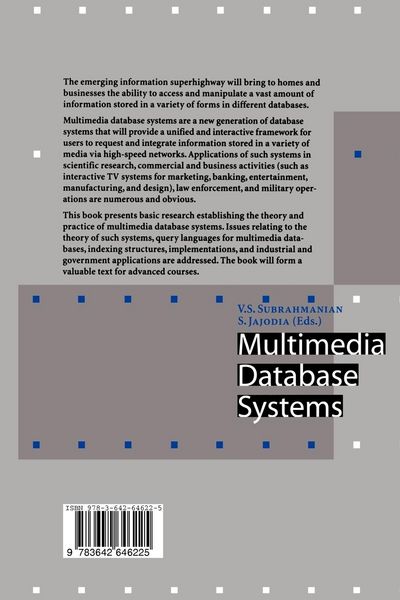
  • Produktbild: Multimedia Database Systems
  • Produktbild: Multimedia Database Systems

Multimedia Database Systems Issues and Research Directions

Aus der Reihe Artificial Intelligence

99,99 €

inkl. gesetzl. MwSt., Versandkostenfrei


Beschreibung

Produktdetails

Einband

Taschenbuch

Erscheinungsdatum

27.09.2011

Herausgeber

V.S. Subrahmanian + weitere

Verlag

Springer Berlin

Seitenzahl

323

Maße (L/B/H)

23,5/15,5/1,9 cm

Gewicht

522 g

Auflage

Softcover reprint of the original 1st ed. 1996

Sprache

Englisch

ISBN

978-3-642-64622-5

Beschreibung

Portrait

The information superhighway will bring vast amounts of information to everyone. Multimedia database systems will provide a unified and interactive framework for users to access and manipulate such information. This book presents basic research on such systems and is a valuable text for advanced courses.

Produktdetails

Einband

Taschenbuch

Erscheinungsdatum

27.09.2011

Herausgeber

Verlag

Springer Berlin

Seitenzahl

323

Maße (L/B/H)

23,5/15,5/1,9 cm

Gewicht

522 g

Auflage

Softcover reprint of the original 1st ed. 1996

Sprache

Englisch

ISBN

978-3-642-64622-5

Herstelleradresse

Springer-Verlag KG
Sachsenplatz 4-6
1201 Wien
AT

Email: ProductSafety@springernature.com

Kundinnen und Kunden meinen

0 Bewertungen

Informationen zu Bewertungen

Zur Abgabe einer Bewertung ist eine Anmeldung im Konto notwendig. Die Authentizität der Bewertungen wird von uns nicht überprüft. Wir behalten uns vor, Bewertungstexte, die unseren Richtlinien widersprechen, entsprechend zu kürzen oder zu löschen.

Die Bewertungen sind nach Format, Anzahl Sterne und Datum sortiert.

Verfassen Sie die erste Bewertung zu diesem Artikel

Helfen Sie anderen Kund*innen durch Ihre Meinung

Kundinnen und Kunden meinen

0 Bewertungen filtern

  • Produktbild: Multimedia Database Systems
  • Produktbild: Multimedia Database Systems
  • Towards a Theory of Multimedia Database Systems.- 1. Introduction.- 2. Basic Ideas Underlying the Framework.- 3. Media Instances.- 3.1 The Clinton Example.- 3.2 Examples of Media-Instances.- 4. Indexing Structures and a Query Language for Multimedia Systems.- 4.1 Frame-Based Query Language.- 4.2 The Frame Data Structure.- 4.3 Query Processing Algorithms.- 4.4 Updates in Multimedia Databases.- 5. Multimedia Presentations.- 5.1 Generation of Media Events = Query Processing.- 5.2 Synchronization = Constraint Solving.- 5.3 Internal Synchronization.- 5.4 Media Buffers.- 6. Related Work.- 7. Conclusions.- A Unified Approach to Data Modelling and Retrieval for a Class of Image Database Applications.- 1. Introduction.- 2. Approaches to Image Data Modeling.- 2.1 Terminology.- 2.2 Conventional Data Models.- 2.3 Image Processing/Graphics Systems with Database Functionality.- 2.4 Extended Conventional Data Models.- 2.5 Extensible Data Models.- 2.6 Other Data Models.- 3. Requirements Analysis of Application Areas.- 3.1 A Taxonomy for Image Attributes.- 3.2 A Taxonomy for Retrieval Types.- 3.3 Art Galleries and Museums.- 3.4 Interior Design.- 3.5 Architectural Design.- 3.6 Real Estate Marketing.- 3.7 Face Information Retrieval.- 4. Logical Representations.- 5. Motivations for the Proposed Data Model.- 6. An Overview of AIR Framework.- 6.1 Data Model.- 6.2 The Proposed DBMS Architecture.- 7. Image Database Systems Based on AIR Model.- 8. Image Retrieval Applications Based on the Prototype Implementation of AIR Framework.- 8.1 Realtors Information System.- 8.2 Face Information Retrieval System.- 9. Research Issues in AIR Framework.- 9.1 Query Interface.- 9.2 Algorithms for RSC and RSS Queries.- 9.3 Relevance Feedback Modeling and Improving Retrieval Effectiveness.- 9.4 Elicitation of Semantic Attributes.- 10. Conclusions and Future Direction.- A. Image Logical Structures.- The QBISM Medical Image DBMS.- 1. Introduction.- 2. The Medical Application.- 2.1 Problem Definition.- 2.2 Data Characteristics.- 3. Logical Design.- 3.1 Data Types.- 3.2 Spatial Operations.- 3.3 Schema.- 3.4 Queries.- 4. Physical Database Design.- 4.1 Representation of a VOLUME.- 4.2 Representation of a REGION.- 4.3 Conclusions.- 5. System Issues.- 5.1 Starburst Extensions.- 5.2 System Architecture.- 6. Performance Experiments.- 6.1 Experimental Environment.- 6.2 Single-study Queries.- 6.3 Multi-study Queries.- 6.4 Results from the Performance Experiments.- 7. Conclusions and Future Work.- Retrieval of Pictures Using Approximate Matching.- 1. Introduction.- 2. Picture Representation.- 3. User Interface.- 4. Computation of Similarity Values.- 4.1 Similarity Functions.- 4.2 Object Similarities.- 4.3 Similarities of Non-spatial Relationships.- 4.4 Spatial Similarity Functions.- 5. Conclusion.- Ink as a First-Class Datatype in Multimedia Databases.- 1. Introduction.- 2. Ink as First-Class Data.- 2.1 Expressiveness of Ink.- 2.2 Approximate Ink Matching.- 3. Pictographic Naming.- 3.1 Motivation.- 3.2 A Pictographic Browser.- 3.3 The Window Algorithm.- 3.4 Hidden Markov Models.- 4. The ScriptSearch Algorithm.- 4.1 Definitions.- 4.2 Approaches to Searching Ink.- 4.3 Searching for Patterns in Noisy Text.- 4.4 The ScriptSearch Algorithm.- 4.5 Evaluation of ScriptSearch.- 4.6 Experimental Results.- 4.7 Discussion.- 5. Searching Large Databases.- 5.1 The HMM-Tree.- 5.2 The Handwritten Trie.- 5.3 Inter-character Strokes.- 5.4 Performance.- 6. Conclusions.- Indexing for Retrieval by Similarity.- 1. Introduction.- 2. Shape Matching.- 2.1 Rectangular Shape Covers.- 2.2 Storage Structure.- 2.3 Queries.- 2.4 Approximate Match.- 2.5 An Example.- 2.6 Experiment.- 3. Word Matching.- 4. Discussion.- Filtering Distance Queries in Image Retrieval.- 1. Introduction.- 2. Spatial Access Methods and Image Retrieval.- 2.1 Query Processor.- 2.2 Image Objects and Spatial Predicates.- 3. Snapshot.- 3.1 Regular Grid with Locational Keys.- 3.2 Clustering Technique.- 3.3 Extensible Hashing.- 3.4 Organization of Snapshot.- 4. Filtering Metric Queries with Snapshot.- 4.1 Search Algorithm.- 4.2 Min Algorithm.- 5. Optimization of Spatial Queries.- 6. Conclusions and Future Work.- Stream-based Versus Structured Video Objects: Issues, Solutions, and Challenges.- 1. Introduction.- 2. Stream-based Presentation.- 2.1 Continuous Display.- 2.2 Pipelining to Minimize Latency Time.- 2.3 High Bandwidth Objects and Scalable Servers.- 2.4 Challenges.- 3. Structured Presentation.- 3.1 Atomic Object Layer.- 3.2 Composed Object Layer.- 3.3 Challenges.- 4. Conclusion.- The Storage and Retrieval of Continuous Media Data.- 1. Introduction.- 2. Retrieving Continuous Media Data.- 3. Matrix-Based Allocation.- 3.1 Storage Allocation.- 3.2 Buffering.- 3.3 Repositioning.- 3.4 Implementation of VCR Operations.- 4. Variable Disk Transfer Rates.- 5. Horizontal Partitioning.- 5.1 Storage Allocation.- 5.2 Retrieval.- 6. Vertical Partitioning.- 6.1 Size of Buffers.- 6.2 Data Retrieval.- 7. Related Work.- 8. Research Issues.- 8.1 Load Balancing and Fault Tolerance Issues.- 8.2 Storage Issues.- 8.3 Data Retrieval Issues.- 9. Concluding Remarks.- Querying Multimedia Databases in SQL.- 1. Introduction.- 2. Automobile Multimedia Database Example.- 3. Logical Query Language.- 4. Querying Multimedia Databases in SQL.- 5. Expressing User Requests in SQL.- 6. Conclusions.- Multimedia Authoring Systems.- 1. Introduction.- 2. Underlying Technology.- 2.1 ODBC.- 2.2 OLE.- 2.3 DDE.- 2.4 DLL.- 2.5 MCI.- 3. Sample Application - “Find-Movie”.- 4. Multimedia Toolbook 3.0.- 5. IconAuthor 6.0.- 6. Director 4.0.- 7. MAS’s and Current Technology.- 7.1 How to improve MAS’s?.- 7.2 How to Benefit from MAS’s in Multimedia Research.- 8. Conclusion.- Metadata for Building the Multimedia Patch Quilt.- 1. Introduction.- 2. Characterization of the Ontology.- 2.1 Terminological Commitments: Constructing an Ontology.- 2.2 Controlled Vocabulary for Digital Media.- 2.3 Better understanding of the query.- 2.4 Ontology Guided Extraction of Metadata.- 3. Construction and Design of Metadata.- 3.1 Classification of Metadata.- 3.2 Meta-correlation: The Key to Media-Independent Semantic Correlation.- 3.3 Extractors for Metadata.- 3.4 Storage of Metadata.- 4. Association of Digital Media Data with Metadata.- 4.1 Association of Metadata with Image Data.- 4.2 Association of Symbolic Descriptions with Image Data.- 4.3 Metadata for Multimedia Objects.- 5. Conclusion.- Contributors.