
KI-Beratung Beta

Gutscheinbedingungen

**Gültig bis 11.11.2026 auf Spielzeug, Schreibwaren, Filme, Geschenke & Trends, Musik, tolino eReader & Zubehör, Hörbücher und Hörbuch-Downloads, nicht preisgebundene Bücher und Kalender online auf thalia.at und in der Thalia App. Einzelne Artikel können ausgeschlossen sein. Aufgrund der Buchpreisbindung sind deutschsprachige Bücher und eBooks ausgenommen. Zusätzlich ausgenommen sind Abos & Flatrates, Games, Geschenkkarten/-boxen, Shelfies, Software, Zeitschriften sowie einzelne Artikel von tonies®. Pro Einkauf einmal einlösbar. Click & Collect nur bei Onlinevorabzahlung möglich. Keine Barauszahlung. Nicht kombinierbar mit anderen Aktionen und Gutscheinen. Gutschein wird auf max. 500€ Bestellwert angerechnet. Nicht gültig für Versandkosten und Services.

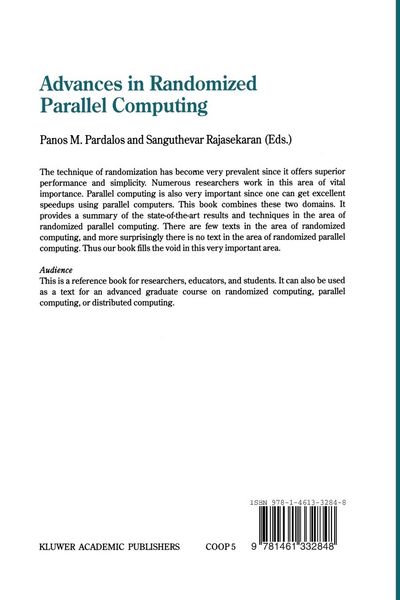
  • Produktbild: Advances in Randomized Parallel Computing
  • Produktbild: Advances in Randomized Parallel Computing
Band 5 - 12%

Advances in Randomized Parallel Computing

12% sparen

144,99 € UVP 164,99 €

inkl. gesetzl. MwSt., Versandkostenfrei


Beschreibung

Produktdetails

Einband

Taschenbuch

Erscheinungsdatum

12.10.2011

Abbildungen

XXVI, 287 p.

Herausgeber

Panos M. Pardalos + weitere

Verlag

Springer Us

Seitenzahl

287

Maße (L/B/H)

24/16/1,8 cm

Gewicht

508 g

Auflage

1999

Sprache

Englisch

ISBN

978-1-4613-3284-8

Beschreibung

Produktdetails

Einband

Taschenbuch

Erscheinungsdatum

12.10.2011

Abbildungen

XXVI, 287 p.

Herausgeber

Verlag

Springer Us

Seitenzahl

287

Maße (L/B/H)

24/16/1,8 cm

Gewicht

508 g

Auflage

1999

Sprache

Englisch

ISBN

978-1-4613-3284-8

Herstelleradresse

Springer-Verlag KG
Sachsenplatz 4-6
1201 Wien
AT

Email: ProductSafety@springernature.com

Noch keine Bewertungen vorhanden

Verfassen Sie die erste Bewertung zu diesem Artikel

Helfen Sie anderen Kundinnen und Kunden durch Ihre Meinung.

Kundinnen und Kunden meinen

Bewertungen (0)

  • Produktbild: Advances in Randomized Parallel Computing
  • Produktbild: Advances in Randomized Parallel Computing
  • 1 Optimal Bounds on Tail Probabilities: A Study of an Approach.- 1.1 Introduction.- 1.2 Bounding Tail Probabilities with the Laplace Transform.- 1.3 When only the Mean is given: The Hoeffding Bound.- 1.4 When the Mean and the Variance are given: A Simple Proof of the Bennett Bound.- 1.5 When the First n Moments are Given: A Glimpse of the General Theory.- 1.6 An Application: Improved Bounds for the List Update Problem.- References.- 2 Parallelism in Comparison Problems.- 2.1 Introduction.- 2.2 Selection.- 2.3 Merging.- 2.4 Sorting.- 2.5 Conclusions.- References.- 3 Random Sampling.- 3.1 Introduction.- 3.2 Preliminaries.- 3.3 Partitioning I: Sorting.- 3.4 Partitioning II: List Ranking.- 3.5 Pruning I: Selection.- 3.6 Pruning II: Row maxima of monotone matrices.- 3.7 Pruning III: Graph Connected Components.- 3.8 Other examples.- 3.5 Bibliographic Notes.- References.- 4 Randomized Algorithms on the Mesh.- 4.1 Introduction.- 4.2 Preliminaries.- 4.3 Routing on the mesh.- 4.4 Sorting on the mesh.- 4.5 Selection on the mesh.- References.- 5 Efficient Randomized Algorithms.- 5.1 Introduction.- 5.2 Preliminaries.- 5.3 Randomized Routing.- 5.4 Randomized Selection.- 5.5 Randomized Sorting.- 5.6 Randomized PRAM Emulation.- 5.7 Selection and Sorting Schemes for Processing Large Distributed Files.- 5.8 Conclusions.- References.- 6 Ultrafast Randomized Parallel Algorithms for Spanning Forests.- 6.1 Introduction.- 6.2 Uitrafast Parallel Algorithms.- 6.3 Dense Instances.- 6.4 Ultrafast Algorithms for Spanning Forests.- 6.5 Open Problems and Further Research.- References.- 7 Parallel Randomized Techniques for Some Fundamental Geometric Problems.- 7.1 Introduction.- 7.2 Preliminaries and Definitions.- 7.3 The Use of Randomization in Computational Geometry.- 7.4 Applications to Fundamental Geometric Problems.- 7.5 Summary.- References.- 8 Capturing the Connectivity of High-Dimensional Geometric Spaces.- 8.1 Introduction.- 8.2 Basic Probabilistic Roadmap Planner.- 8.3 Other Sampling Strategies.- 8.4 Roadmap Coverage.- 8.5 Roadmap Connectedness.- 8.6 Current and Future Work.- Appendix: A. Proof of Theorem 1.- Appendix: B. Proof of Theorem 2.- Appendix: C. Proof of Theorem 3.- Appendix: D. Proof of Theorem 4.- References.- 9 Randomized Parallel Prefetching and Buffer Management.- 9.1 Introduction.- 9.2 Definitions.- 9.3 Read-Once Reference Strings.- 9.4 Read-Many Reference Strings.- 9.5 Concluding Remarks.- References.- 10 DFA Problems.- 10.1 Introduction.- 10.2 Membership Problem.- 10.3 Containment and Equivalence Problems.- 10.4 Ranking and Related Problems.- 10.5 Coarsest Partition Problems.- 10.6 Automata Testing Problems.- 10.7 Conversion from Regular Expression to NFA.- 10.8 Applications.- 10.9 Open Problems.- References.- 11 LAPACK90.- 11.1 Introduction.- 11.2 Interface Blocks for LAPACK 77.- 11.3 Interface Blocks for LAPACK 90.- 11.4 Code of LAPACK90 Routines.- 11.5 LAPACK90 Documentation.- 11.6 LAPACK90 Test Programs.- 11.7 LAPACK90 User Callable Routines.- References.- Appendix: A, Generic Interfaces.- A.1 LAPACK77 Generic Interface Blocks.- A.2 LAPACK90 Generic Interface Blocks.- Appendix: B, Interface Subroutines.- B.1 LA_GESV and LA_GETRI subroutines.- B.2 Auxiliary Routines.- Appendix: C.- C.1 Documentation of LA_GESV.- Appendix: D.- D.1 The LA_GESV test results.- Appendix: E.- E.1 LAPACK90 User Callable Routines.