
Gutscheinbedingungen

**Gültig bis 06.07.2026 auf fremdsprachige Bücher online auf thalia.at, in der Thalia App ab einem Mindestbestellwert von 30€ und in allen Thalia Buchhandlungen in Österreich. In den Buchhandlungen nur gültig auf lagernde Ware. Einzelne Artikel können ausgeschlossen sein. Ausgenommen sind preisgebundene Artikel & eBooks. Pro Einkauf einmal einlösbar. Nur gültig gegen Vorlage oder im Onlineshop hinterlegter Bonuscard. Infos zur Einlösung in der Buchhandlung sind auf der Bonuscard-Vorteilspreisseite zu finden. Click & Collect nur bei Onlinevorabzahlung möglich. Keine Einlösung bei Scan & Go-Bezahlung. Keine Barauszahlung. Nicht kombinierbar mit anderen Aktionen und Gutscheinen. Gutschein wird auf max. 500€ Bestellwert angerechnet. Nicht gültig für Versandkosten und Services.

  • Produktbild: Bioelectrochemistry of Cells and Tissues
  • Produktbild: Bioelectrochemistry of Cells and Tissues
Band 2

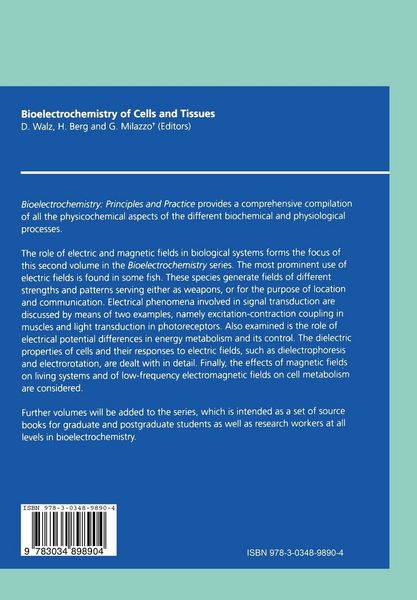
Bioelectrochemistry of Cells and Tissues

99,99 €

inkl. gesetzl. MwSt., Versandkostenfrei


Beschreibung

Produktdetails

Einband

Taschenbuch

Erscheinungsdatum

30.09.2011

Herausgeber

Dieter Walz + weitere

Verlag

Springer Basel

Seitenzahl

305

Maße (L/B/H)

24,4/17/1,8 cm

Gewicht

568 g

Auflage

Softcover reprint of the original 1st ed. 1995

Sprache

Englisch

ISBN

978-3-0348-9890-4

Beschreibung

Produktdetails

Einband

Taschenbuch

Erscheinungsdatum

30.09.2011

Herausgeber

Verlag

Springer Basel

Seitenzahl

305

Maße (L/B/H)

24,4/17/1,8 cm

Gewicht

568 g

Auflage

Softcover reprint of the original 1st ed. 1995

Sprache

Englisch

ISBN

978-3-0348-9890-4

Herstelleradresse

Springer Nature c/o IBS
Benzstrasse 21
48619 Heek
DE

Email: Tanja.Keller@springer.com

Noch keine Bewertungen vorhanden

Verfassen Sie die erste Bewertung zu diesem Artikel

Helfen Sie anderen Kundinnen und Kunden durch Ihre Meinung.

Kundinnen und Kunden meinen

Bewertungen (0)

  • Produktbild: Bioelectrochemistry of Cells and Tissues
  • Produktbild: Bioelectrochemistry of Cells and Tissues
  • 1. Electric organs and their innervation: A model system for the study of cholinergic function.- • Introduction.- • Anatomy and embryology of the electromotor system.- • Electrophysiology of the electromotor system.- • Electrolocation and electrocommunication.- • The cellular and molecular biology of cholinergic synapses as deduced from work on the electromotor system.- • Summary.- 2. Contractility and motility of muscle and non-muscle cells.- • Introduction.- • Histology of striated muscle cells.- • Muscle physiology.- • The sliding filament model.- • Actin and myosin are proteins organized in filaments.- • Actin and myosin exist in a number of variants.- • The atomic structures of actin and myosin subfragment 1 have been solved.- • The cross-bridge cycle.- • The mechanism of ATP-hydrolysis by myosin and acto-myosin.- • Where in the myosin molecule is the force produced?.- • The regulation of muscle activity.- • Electrochemical coupling in muscle cells.- • Muscle diseases (Myopathies).- • Motor systems in non-muscle cells.- • Summary.- 3. Light-transduction in photoreceptors.- • Introduction.- • Structure and function of photoreceptors.- • Molecular basis of phototransduction.- • Light-induced currents.- • Function of calcium ions in photoreception.- • Voltage-gated currents and their physiological significance.- • Ion transport.- • Summary and conclusions.- 4. An electrochemical description of metabolism.- • Introduction.- • Cellular structure and enzyme organisation.- • Cellular energy transduction.- • Proton and electron flow in intracellular structures.- • Importance of electrical processes in the control of metabolism.- • Significance of cellular potentials.- • Theoretical considerations.- • Relevant experimental studies.- • Electrochemical regulation of metabolism.- 5. The low-frequency dielectric properties of biological cells.- • Introduction.- • Theory of the dielectric experiment.- • Mechanisms of dielectric dispersion in biological systems.- • Mechanisms of dielectric relaxation in cell suspensions and tissues.- • Nonlinear interactions of cells with electrical fields.- • A four state enzyme capable of harvesting electrical energy for the performance of useful (bio)chemical work.- 6. Dielectrophoretic and electrorotation behaviour of cells: Theory and experiment.- • Introduction.- • Theoretical background.- • Cell dielectrophoresis.- • Cell electrorotation.- • Relationship between dielectrophoresis and electrorotation.- 7. Effects of magnetic fields on living systems.- • Introduction.- • Field types and modes of action.- • Experimental in vitro results.- • Experimental in vivo results.- 8. Low-frequency electromagnetic field effects on cell metabolism.- • Introduction.- • Experimental techniques.- • Biochemical and biological response of biological systems.- • Current models for mechanisms of electrostimulation.