Gutscheinbedingungen

**Gültig von 22.06.2026 ab 19 Uhr bis 23.06.2026 24 Uhr auf Spielzeug, Schreibwaren, Filme, Geschenke & Trends, Musik, tolino eReader & Zubehör, Hörbücher und Hörbuch-Downloads (außer Abo), nicht preisgebundene Bücher und Kalender online auf thalia.at und in der Thalia App. Einzelne Artikel können ausgeschlossen sein. Aufgrund der Buchpreisbindung sind deutschsprachige Bücher und eBooks ausgenommen. Zusätzlich ausgenommen sind preisgebundene Artikel, Abos & Flatrates, eBooks, Games, Geschenkkarten/-boxen, Shelfies, Software, Zeitschriften sowie einzelne Artikel von tonies®. Pro Einkauf einmal einlösbar. Click & Collect nur bei Onlinevorabzahlung möglich. Keine Barauszahlung. Nicht kombinierbar mit anderen Aktionen und Gutscheinen. Gutschein wird auf max. 500€ Bestellwert angerechnet. Nicht gültig für Versandkosten und Services.

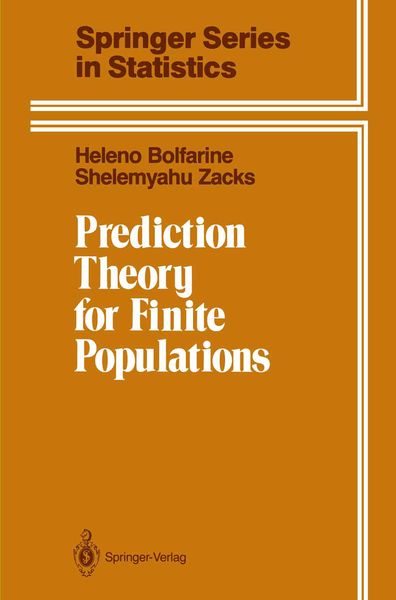
  • Produktbild: Prediction Theory for Finite Populations
  • Produktbild: Prediction Theory for Finite Populations

Prediction Theory for Finite Populations

51,99 €

inkl. gesetzl. MwSt., Versandkostenfrei


Beschreibung

Produktdetails

Einband

Taschenbuch

Erscheinungsdatum

26.09.2011

Verlag

Springer Us

Seitenzahl

207

Maße (L/B/H)

23,5/15,5/1,3 cm

Gewicht

347 g

Auflage

Softcover reprint of the original 1st ed. 1992

Sprache

Englisch

ISBN

978-1-4612-7713-2

Beschreibung

Produktdetails

Einband

Taschenbuch

Erscheinungsdatum

26.09.2011

Verlag

Springer Us

Seitenzahl

207

Maße (L/B/H)

23,5/15,5/1,3 cm

Gewicht

347 g

Auflage

Softcover reprint of the original 1st ed. 1992

Sprache

Englisch

ISBN

978-1-4612-7713-2

Herstelleradresse

Springer-Verlag GmbH
Tiergartenstr. 17
69121 Heidelberg
DE

Email: ProductSafety@springernature.com

Kundinnen und Kunden meinen

0 Bewertungen

Informationen zu Bewertungen

Zur Abgabe einer Bewertung ist eine Anmeldung im Konto notwendig. Die Authentizität der Bewertungen wird von uns nicht überprüft. Wir behalten uns vor, Bewertungstexte, die unseren Richtlinien widersprechen, entsprechend zu kürzen oder zu löschen.

Die Bewertungen sind nach Format, Anzahl Sterne und Datum sortiert.

Verfassen Sie die erste Bewertung zu diesem Artikel

Helfen Sie anderen Kund*innen durch Ihre Meinung

Kundinnen und Kunden meinen

0 Bewertungen filtern

  • Produktbild: Prediction Theory for Finite Populations
  • Produktbild: Prediction Theory for Finite Populations
  • Synopsis.- 1. Basic Ideas and Principles.- 1.1. The Fixed Finite Population Model.- 1.2. The Superpopulation Model.- 1.2.1. The Regression Model.- 1.3. Predictors of Population Quantities.- 1.4. The Model—Based Design—Based Approach.- 1.5. Exercises.- 2. Optimal Predictors of Population Quantities.- 2.1. Best Linear Unbiased Predictors.- 2.2. Best Unbiased Predictors.- 2.3. Equivariant Predictors.- 2.3.1. A General Formulation.- 2.3.2. Location Equivariant Predictors of T Under Model SM1.- 2.3.3. Location Equivariant Predictors of T Under the Regression Model.- 2.3.4. Scale Equivariant Predictors of T.- 2.3.5. Location—Scale Equivariant Predictors of T.- 2.3.6. Location—Scale Equivariant Predictors of Sy2.- 2.4. Stein—Type Shrinkage Predictors.- 2.5. Exercises.- 3. Bayes and Minimax Predictors.- 3.1. The Multivariate Normal Model.- 3.1.1. Bayes Predictors of T.- 3.1.2. Bayes Predictors of ?N.- 3.1.3. Bayes Predictors of Sy2.- 3.2. Bayes Linear Predictors.- 3.3. Minimax and Admissible Predictors.- 3.4. Dynamic Bayesian Prediction.- 3.4.1. The Multinormal Dynamic Model.- 3.4.1.1. Dynamic Prediction of Tt.- 3.4.1.2. Dynamic Prediction of Sty2.- 3.5. Empirical Bayes Predictors.- 3.6. Exercises.- 4. Maximum—Likelihood Predictors.- 4.1. Predictive Likelihoods.- 4.1.1. Estimative Predictive Likelihoods.- 4.1.2. Profile Predictive Likelihoods.- 4.1.3. The Lauritzen—Hinkley Predictive Likelihoods.- 4.1.4. The Royall Predictive Likelihoods.- 4.2. Maximum Likelihood Predictors of T Under the Normal Superpopulation Model.- 4.2.1. Estimative Likelihood Predictors.- 4.2.2. Profile Likelihood Predictors.- 4.2.3. The LH Likelihood Predictors.- 4.2.4. The Royall Maximum—Likelihood Predictors.- 4.3. Maximum—Likelihood Predictors of the Population Variance Sy2 Under the Normal Regression Model.- 4.3.1. Estimative Likelihood Predictors.- 4.3.2. Profile Likelihood Predictors.- 4.3.3. LH Likelihood Predictors.- 4.4. Exercises.- 5. Classical and Bayesian Prediction Intervals.- 5.1. Confidence Prediction Intervals.- 5.2. Tolerance Prediction Intervals for T.- 5.3. Bayesian Prediction Intervals.- 5.4. Exercises.- 6. The Effects of Model Misspecification, Conditions For Robustness, and Bayesian Modeling.- 6.1. Robust Linear Prediction of T.- 6.2. Estimation of the Prediction Variance.- 6.3. Simulation Estimates of the ?* MSE of $${\hat T_R}$$.- 6.4. Bayesian Robustness.- 6.5. Bayesian Modeling.- 6.5.1. The Framework.- 6.5.2. The Normal Linear Model.- 6.6. Exercises.- 7. Models with Measurement Errors.- 7.1. The Location and Simple Regression Models.- 7.1.1. Model SM1.- 7.1.2. Simple Regression Model.- 7.1.3. Regression Type Predictors.- 7.2. Bayesian Models with Measurement Errors.- 7.2.1. Model SM1.- 7.2.2. Model SM6.- 7.2.3. Simple Regression Model.- 7.2.4. Orthogonal Transformations.- 7.3. Exercises.- 8. Asymptotic Properties in Finite Populations.- 8.1. Predictors of T.- 8.2. The Asymptotic Distribution of $${\hat \beta _{{s_k}}}$$.- 8.3. The Linear Regression Model with Measurement Errors.- 8.4. Exercises.- 9. Design Characteristics of Predictors.- 9.1. The QR Class of Predictors.- 9.2. ADU Predictors.- 9.3. Optimal ADU Predictors.- 9.4. Exercises.- Glossary of Predictors.- Author Index.