Gutscheinbedingungen

**Gültig bis 14.09.2026 auf Spielzeug, Schreibwaren, Filme, Geschenke & Trends, Musik, tolino eReader & Zubehör, Hörbücher, nicht preisgebundene Bücher und Kalender in der Thalia App. Einzelne Artikel können ausgeschlossen sein. Aufgrund der Buchpreisbindung sind deutschsprachige Bücher und eBooks ausgenommen. Zusätzlich ausgenommen sind Abos & Flatrates, Games, Geschenkkarten/-boxen, Shelfies, Software, Zeitschriften sowie einzelne Artikel von tonies®. Pro Einkauf einmal einlösbar. Nur gültig mit im Onlineshop hinterlegter Bonuscard. Click & Collect nur bei Onlinevorabzahlung möglich. Keine Barauszahlung. Nicht kombinierbar mit anderen Aktionen und Gutscheinen. Gutschein wird auf max. 500€ Bestellwert angerechnet. Nicht gültig für Versandkosten und Services.

  • Produktbild: Species Survival in Fragmented Landscapes
  • Produktbild: Species Survival in Fragmented Landscapes
Band 35

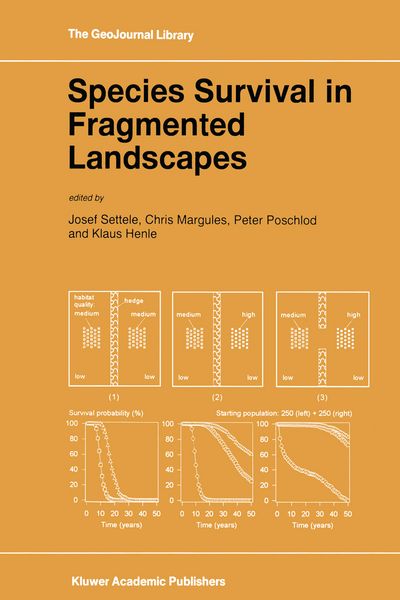
Species Survival in Fragmented Landscapes

Aus der Reihe GeoJournal Library

198,99 €

inkl. gesetzl. MwSt., Versandkostenfrei


Beschreibung

Produktdetails

Einband

Taschenbuch

Erscheinungsdatum

01.10.2011

Abbildungen

XVI, 384 p.

Herausgeber

J. Settele + weitere

Verlag

Springer Netherland

Seitenzahl

384

Maße (L/B/H)

24/16/2,2 cm

Gewicht

643 g

Auflage

Softcover reprint of the original 1st edition 1996

Sprache

Englisch

ISBN

978-94-010-6640-2

Beschreibung

Portrait

Prof. Dr. Peter Poschlod studierte Biologie in Ulm. Er promovierte an der TUM-Weihenstephan und habilitierte an der Universität Hohenheim. Von 1994 bis 2001 war er Professor für Wissenschaftlichen Naturschutz der Philipps-Universität Marburg, seit 2001 ist er Inhaber des Lehrstuhls für Botanik der Universität Regensburg.

Produktdetails

Einband

Taschenbuch

Erscheinungsdatum

01.10.2011

Abbildungen

XVI, 384 p.

Herausgeber

Verlag

Springer Netherland

Seitenzahl

384

Maße (L/B/H)

24/16/2,2 cm

Gewicht

643 g

Auflage

Softcover reprint of the original 1st edition 1996

Sprache

Englisch

ISBN

978-94-010-6640-2

Herstelleradresse

Springer-Verlag KG
Sachsenplatz 4-6
1201 Wien
AT

Email: ProductSafety@springernature.com

Noch keine Bewertungen vorhanden

Verfassen Sie die erste Bewertung zu diesem Artikel

Helfen Sie anderen Kundinnen und Kunden durch Ihre Meinung.

Kundinnen und Kunden meinen

Bewertungen (0)

  • Produktbild: Species Survival in Fragmented Landscapes
  • Produktbild: Species Survival in Fragmented Landscapes
  • I Case Studies on Species Survival in Fragmented Landscapes.- The case for a science-based strategy of conserving threatened butterfly populations in the UK and north Europe.- Decline and rehabilitation of the Apollo butterfly Parnassius apollo (LINNAEUS, 1758) in the Pieniny National Park (Polish Carpathians).- Effects of habitat fragmentation on the butterfly Maculinea alcon in the Netherlands.- Forest resource management and the conservation of arboreal marsupials in Central Victoria, South-Eastern Australia.- The conservation biology of a specialist and generalist gecko in the fragmented landscape of the Western Australian wheatbelt.- Bird population dynamics in relation to habitat quality.- Population size, genetic variation, and related parameters in small, isolated plant populations: a case study.- Habitat networks in the fragmented landscape of the Western Australian wheatbelt: Preliminary results, involvement with landcare groups, and experience in implementation.- II A Reviewof Species Survival in Fragmented Habitats: Theory and Approaches.- Species survival and metapopulations: Conservation implications from ecological theory.- Genetical aspects of fragmented plant populations.- Applications of population viability analysis in conservation biology in Australia.- Area requirements and isolation: Conservation concepts and application in Central Europe.- Dispersal of plants in fragmented landscapes - Changes of dispersal processes in the actual and historical man-made landscape.- Experimental fragmentation.- Landscape fragmentation and landscape planning, with a focus on Germany.- III The FIFB Project.- FIFB: Conceptual frame.- Studying species survival in fragmented landscapes: the approach of the FIFB.- FIFB: the hilly landscape of Halle - main study area.- The Hilly landscape of Halle - main study area of the FIFB: Natural history and the selection of target species for conservation biological research.- Vegetation Cover of porphyry Outcrops.- Vegetationstructure of the porphyry Landscape of Halle.- Relations of invertebrate species to habitat Quality in the fragmented Porphyry Landscape near Halle (Sachsen-Anhalt, Germany).- Invertebrates and area size in the porphyry Landscape of Halle.- Invertebrates and Isolation in the porphyry Landscape of Halle.- FIFB: Survival of plants in fragmented landscapes.- Why are some plant species of fragmented continental dry grasslands frequent and some rare? - The role of germination and establishment.- Survival of small isolated populations of Muscari tenuifolium TAUSCH in dry continental Grasslands - The role of reproduction.- Restoration of fallow or afforested calcareous grasslands by clear-cutting.- A coenotical approach of plant population viability analysis on successional and afforested calcareous grassland sites - Towards an ecological flora data base.- FIFB: Survival of vertebrates in fragmented landscapes.- Survival of birds in fragmented landscapes.- Survival of lizards in habitat islands in Central Europe - Introduction and summary conclusions.- Survival of the sand lizard Lacerta agilis LINNAEUS, 1758 (Sauria, Lacertidae) in relation to habitat quality and heterogeneity.- Consolidation of vineyards, mitigations, and survival of the common wall lizard (Podarcis muralis) in isolated habitat fragments.- FIFB: Survival of butterflies in fragmented landscapes.- Research on population viability of Melitaea didyma (Lepidoptera, Nymphalidae).- A population ecological study of Chazara briseis (Lepidoptera, Satyrinae).- Aspects of the population vulnerability of the large blue butterfly, Glaucopsyche (Maculinea) arion, in South-West Germany.- Towards demographic population vulnerability categories of butterflies: Requirements of and species selection for future population ecological research.- FIFB: Survival of grasshoppers and bush crickets in fragmented landscapes.- The ecological background of population vulnerability in central European grasshoppers and bush crickets: Abrief review.- A population vulnerability analysis of the stripe-winged grasshopper, Stenobothrus lineatus (Caelifera: Acrididae).- A population vulnerability analysis of the red-winged grasshopper, Oedipoda germanica (Caelifera: Acrididae).- Elements of population vulnerability of the blue-winged grasshopper, Oedipoda caerulescens (Caelifera: Acrididae).- Population vulnerability of the grey bush cricket Platycleis albopunctata (GOEZE, 1778) (Ensifera: Tettigoniidae).- FIFB: Survival of snails in fragmented landscapes.- Survival of snails in fragmented landscapes.- FIFB: Genetics, habitat models, and implementation.- Genetics of insect populations in fragmented landscapes - A comparison of species and habitats.- Mapping and assessing habitat models on the landscape level.- Implementation of FIFB results in environmental planning.- IV Summary Conclusions.- Species survival in relation to habitat quality, size, and isolation: Summary conclusions and future directions.