Gutscheinbedingungen

**Gültig bis 06.07.2026 auf fremdsprachige Bücher online auf thalia.at, in der Thalia App ab einem Mindestbestellwert von 30€ und in allen Thalia Buchhandlungen in Österreich. In den Buchhandlungen nur gültig auf lagernde Ware. Einzelne Artikel können ausgeschlossen sein. Ausgenommen sind preisgebundene Artikel & eBooks. Pro Einkauf einmal einlösbar. Nur gültig gegen Vorlage oder im Onlineshop hinterlegter Bonuscard. Infos zur Einlösung in der Buchhandlung sind auf der Bonuscard-Vorteilspreisseite zu finden. Click & Collect nur bei Onlinevorabzahlung möglich. Keine Einlösung bei Scan & Go-Bezahlung. Keine Barauszahlung. Nicht kombinierbar mit anderen Aktionen und Gutscheinen. Gutschein wird auf max. 500€ Bestellwert angerechnet. Nicht gültig für Versandkosten und Services.

  • Produktbild: Factorization and Primality Testing
  • Produktbild: Factorization and Primality Testing

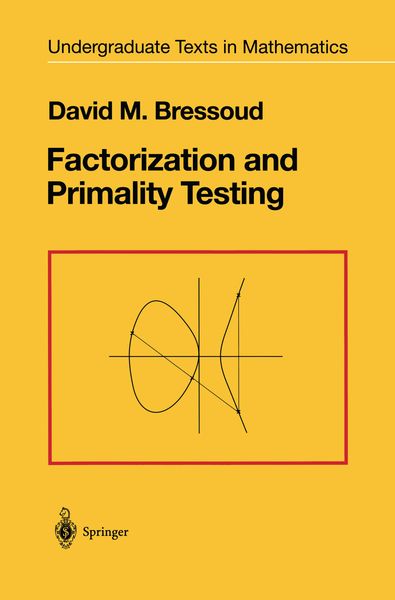
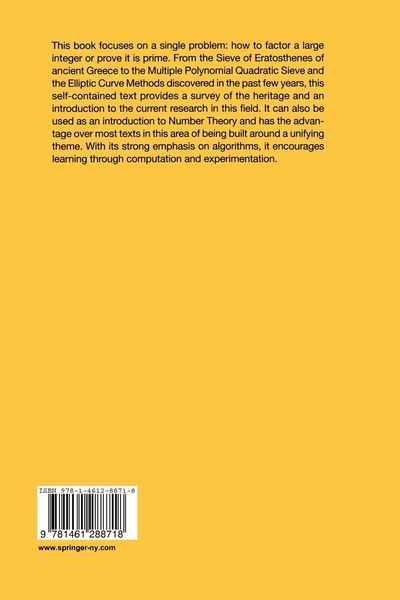
Factorization and Primality Testing

52,99 €

inkl. gesetzl. MwSt., Versandkostenfrei


Beschreibung

Produktdetails

Einband

Taschenbuch

Erscheinungsdatum

26.09.2011

Verlag

Springer Us

Seitenzahl

240

Maße (L/B/H)

23,5/15,5/1,5 cm

Gewicht

392 g

Auflage

Softcover reprint of the original 1st ed. 1989

Sprache

Englisch

ISBN

978-1-4612-8871-8

Beschreibung

Produktdetails

Einband

Taschenbuch

Erscheinungsdatum

26.09.2011

Verlag

Springer Us

Seitenzahl

240

Maße (L/B/H)

23,5/15,5/1,5 cm

Gewicht

392 g

Auflage

Softcover reprint of the original 1st ed. 1989

Sprache

Englisch

ISBN

978-1-4612-8871-8

Herstelleradresse

Springer-Verlag KG
Sachsenplatz 4-6
1201 Wien
AT

Email: GPSR Kontakt

Noch keine Bewertungen vorhanden

Verfassen Sie die erste Bewertung zu diesem Artikel

Helfen Sie anderen Kundinnen und Kunden durch Ihre Meinung.

Kundinnen und Kunden meinen

Bewertungen (0)

  • Produktbild: Factorization and Primality Testing
  • Produktbild: Factorization and Primality Testing
  • 1 Unique Factorization and the Euclidean Algorithm.- 1.1 A theorem of Euclid and some of its consequences.- 1.2 The Fundamental Theorem of Arithmetic.- 1.3 The Euclidean Algorithm.- 1.4 The Euclidean Algorithm in practice.- 1.5 Continued fractions, a first glance.- 1.6 Exercises.- 2 Primes and Perfect Numbers.- 2.1 The Number of Primes.- 2.2 The Sieve of Eratosthenes.- 2.3 Trial Division.- 2.4 Perfect Numbers.- 2.5 Mersenne Primes.- 2.6 Exercises.- 3 Fermat, Euler, and Pseudoprimes.- 3.1 Fermat’s Observation.- 3.2 Pseudoprimes.- 3.3 Fast Exponentiation.- 3.4 A Theorem of Euler.- 3.5 Proof of Fermat’s Observation.- 3.6 Implications for Perfect Numbers.- 3.7 Exercises.- 4 The RSA Public Key Crypto-System.- 4.1 The Basic Idea.- 4.2 An Example.- 4.3 The Chinese Remainder Theorem.- 4.4 What if the Moduli are not Relatively Prime?.- 4.5 Properties of Euler’s ø Function.- Exercises.- 5 Factorization Techniques from Fermat to Today.- 5.1 Fermat’s Algorithm.- 5.2 Kraitchik’s Improvement.- 5.3 Pollard Rho.- 5.4 Pollard p — 1.- 5.5 Some Musings.- 5.6 Exercises.- 6 Strong Pseudoprimes and Quadratic Residues.- 6.1 The Strong Pseudoprime Test.- 6.2 Refining Fermat’s Observation.- 6.3 No “Strong” Carmichael Numbers.- 6.4 Exercises.- 7 Quadratic Reciprocity.- 7.1 The Legendre Symbol.- 7.2 The Legendre symbol for small bases.- 7.3 Quadratic Reciprocity.- 7.4 The Jacobi Symbol.- 7.5 Computing the Legendre Symbol.- 7.6 Exercises.- 8 The Quadratic Sieve.- 8.1 Dixon’s Algorithm.- 8.2 Pomerance’s Improvement.- 8.3 Solving Quadratic Congruences.- 8.4 Sieving.- 8.5 Gaussian Elimination.- 8.6 Large Primes and Multiple Polynomials.- 8.7 Exercises.- 9 Primitive Roots and a Test for Primality.- 9.1 Orders and Primitive Roots.- 9.2 Properties of Primitive Roots.- 9.3 Primitive Roots for Prime Moduli.- 9.4 A Test for Primality.- 9.5 More on Primality Testing.- 9.6 The Rest of Gauss’ Theorem.- 9.7 Exercises.- 10 Continued Fractions.- 10.1 Approximating the Square Root of 2.- 10.2 The Bháscara-Brouncker Algorithm.- 10.3 The Bháscara-Brouncker Algorithm Explained.- 10.4 Solutions Really Exist.- 10.5 Exercises.- 11 Continued Fractions Continued, Applications.- 11.1 CFRAC.- 11.2 Some Observations on the Bháscara-Brouncker Algorithm.- 11.3 Proofs of the Observations.- 11.4 Primality Testing with Continued Fractions.- 11.5 The Lucas-Lehmer Algorithm Explained.- 11.6 Exercises.- 12 Lucas Sequences.- 12.1 Basic Definitions.- 12.2 Divisibility Properties.- 12.3 Lucas’ Primality Test.- 12.4 Computing the V’s.- 12.5 Exercises.- 13 Groups and Elliptic Curves.- 13.1 Groups.- 13.2 A General Approach to Primality Tests.- 13.3 A General Approach to Factorization.- 13.4 Elliptic Curves.- 13.5 Elliptic Curves Modulo p.- 13.6 Exercises.- 14 Applications of Elliptic Curves.- 14.1 Computation on Elliptic Curves.- 14.2 Factorization with Elliptic Curves.- 14.3 Primality Testing.- 14.4 Quadratic Forms.- 14.5 The Power Residue Symbol.- 14.6 Exercises.- The Primes Below 5000.