
Gutscheinbedingungen

**Gültig nur für Bestellungen an die Wunsch-Poststation bis 10.06.2026 auf Spielzeug, Schreibwaren, Filme, Geschenke & Trends, Musik, tolino eReader & Zubehör, Hörbücher und Hörbuch-Downloads (außer Abo), nicht preisgebundene Bücher und Kalender online auf thalia.at und in der Thalia App. Einzelne Artikel können ausgeschlossen sein. Aufgrund der Buchpreisbindung sind deutschsprachige Bücher und eBooks ausgenommen. Zusätzlich ausgenommen sind preisgebundene Artikel, Abos & Flatrates, eBooks, Games, Geschenkkarten/-boxen, Shelfies, Software, Zeitschriften sowie einzelne Artikel von tonies®. Pro Einkauf einmal einlösbar. Kein Click & Collect möglich. Keine Barauszahlung. Nicht kombinierbar mit anderen Aktionen und Gutscheinen. Gutschein wird auf max. 500€ Bestellwert angerechnet. Nicht gültig für Versandkosten und Services.

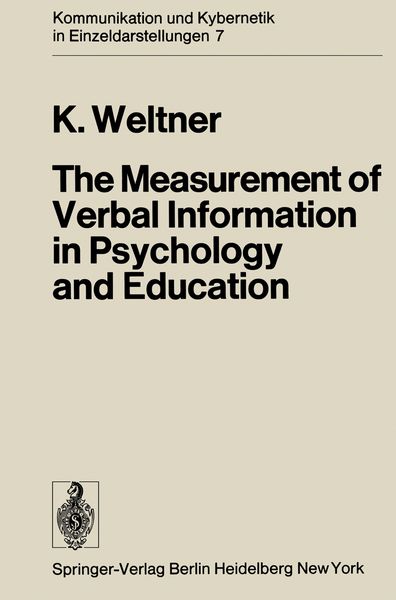
  • Produktbild: The Measurement of Verbal Information in Psychology and Education
  • Produktbild: The Measurement of Verbal Information in Psychology and Education
Band 7

The Measurement of Verbal Information in Psychology and Education

51,99 €

inkl. gesetzl. MwSt., Versandkostenfrei


Beschreibung

Produktdetails

Einband

Taschenbuch

Erscheinungsdatum

12.11.2011

Verlag

Springer Berlin

Seitenzahl

188

Maße (L/B/H)

23,5/15,5/1,3 cm

Gewicht

341 g

Auflage

Softcover reprint of the original 1st ed. 1973

Übersetzt von

Barbara M. Crook

Sprache

Englisch

ISBN

978-3-642-65639-2

Beschreibung

Produktdetails

Einband

Taschenbuch

Erscheinungsdatum

12.11.2011

Verlag

Springer Berlin

Seitenzahl

188

Maße (L/B/H)

23,5/15,5/1,3 cm

Gewicht

341 g

Auflage

Softcover reprint of the original 1st ed. 1973

Übersetzt von

Barbara M. Crook

Sprache

Englisch

ISBN

978-3-642-65639-2

Herstelleradresse

Springer-Verlag KG
Sachsenplatz 4-6
1201 Wien
AT

Email: ProductSafety@springernature.com

Kundinnen und Kunden meinen

0 Bewertungen

Informationen zu Bewertungen

Zur Abgabe einer Bewertung ist eine Anmeldung im Konto notwendig. Die Authentizität der Bewertungen wird von uns nicht überprüft. Wir behalten uns vor, Bewertungstexte, die unseren Richtlinien widersprechen, entsprechend zu kürzen oder zu löschen.

Die Bewertungen sind nach Format, Anzahl Sterne und Datum sortiert.

Verfassen Sie die erste Bewertung zu diesem Artikel

Helfen Sie anderen Kund*innen durch Ihre Meinung

Kundinnen und Kunden meinen

0 Bewertungen filtern

  • Produktbild: The Measurement of Verbal Information in Psychology and Education
  • Produktbild: The Measurement of Verbal Information in Psychology and Education
  • 1 Foundations of Information Theory.- 1.1 The Communication System.- 1.1.1 Introduction.- 1.1.2 The Basic Problems of Information Theory.- 1.1.3 The Simple Communication System.- 1.2 Concepts of Information Theory.- 1.2.1 Information.- 1.2.1.1 Signs, Repertory, Alphabet.- 1.2.1.2 Frequency, Probability, Field.- 1.2.1.3 Information and Probability of Expectation.- 1.2.2 Coding, Binary Coding, Supersigns.- 1.2.3 The Product Field.- 1.2.4 Conditional Probability.- 1.2.5 Transinformation.- 1.2.6 Redundancy.- 1.2.6.1 Information Flow Rate, Channel Capacity.- 1.2.6.2 Noise, Interfering Source.- 1.2.7 Surprise Value.- 2 Measurement of the Information of Written Language and the Concept of Subjective Information.- 2.1 Introduction.- 2.2 Statistically Based Procedures.- 2.2.1 Statistics of Letters and Combinations of Letters.- 2.2.2 The Method of Newman and Gerstman.- 2.2.3 Word-Frequency Statistics.- 2.3 Shannon’s Guessing-Game Method.- 2.4 The Concept of Subjective Information.- 2.5 Digitizing Prediction by Means of Branching Diagrams.- 2.5.1 Derivation of Limits for Subjective Information by Means of Digitized Prediction.- 2.5.2 Procedure for a More Exact Determination of Subjective Information.- 2.5.3 Subjective Information of Different Texts; Age Dependence; Intelligence Dependence.- 2.5.3.1 Hsub as a Function of the Text.- 2.5.3.2 Hsub as a Function of Age.- 2.5.3.3 Hsub as a Function of the Recipient’s Intelligence.- 2.6 Extension of the Procedure.- 2.7 Simplified Procedures for Determining Subjective Information.- 2.7.1 Simplified Procedure (1); Prediction by Letters.- 2.7.2 Simplified Procedure (2); Prediction by Syllables Simplified Procedure (3); Prediction by Words.- 2.7.3 Combined Procedures: Measurement of the Subjective Information of Upper and Lower Case Letters.- 3 Transinformation Analysis.- 3.1 The Basic Concept of Transinformation Analysis.- 3.2 Didactic Transinformation.- 3.2.1 Correlation between the Subjective Information of the Basic Text and Achievement Tests Related to the Teaching Program.- 3.2.2 Iteration Procedure for Complete Determination of the Didactic Information.- 3.3 Semantic Transinformation.- 3.3.1 Synonyms; Semantic Potential.- 3.3.2 Semantic Transinformation for Antonyms; Semantic Differential.- 3.4 Transinformation in Reading Processes.- 3.5 The Semantic Information of Graphic Representations.- 3.5.1 Efficiency in Terms of Information Theory.- 3.6 Memory Experiments.- 3.7 Cognitive-Process Curve.- 4 Learning and Teaching in the Light of Information Theory.- 4.1 The Model of Information Reception and Processing in Man.- 4.1.1 Inflow Capacity of the Short-Term Store.- 4.1.2 Present Duration.- 4.1.3 Memory.- 4.2 Learning Viewed in the Light of Information Theory.- 4.2.1 Transinformation, Redundancy, “Informedness”.- 4.3 Elements of a Theory of Teaching.- 4.3.1 Limits of Perception Capacity.- 4.3.2 Limits of Memory Inflow Capacity.- 4.3.3 Limits of Capacity of Short-Term Store.- 4.3.4 Readability Diagrams.- 4.4 Elements of a Theory Relating to Basic Texts.- 4.4.1 Coherence Structure Diagram.- 4.4.2 Teaching Success as a Function of Coherence of Subject Matter.- 4.5 Insight and Transfer.- 4.5.1 Insight.- 4.5.2 Problem-Oriented Instruction.- 4.5.3 Transfer and Transinformation.- 5 Use of the Guessing Game to Determine Subjective Information: A Practical Guide.- 5.1 Selection of Text Sample and Preparation of Experimental Material.- 5.1.1 Length of Text Samples.- 5.1.2 Selecting the Sample from the Whole Text.- 5.1.3 Technical Preparation of the Experimental Material.- 5.1.4 Experimental Design.- 5.2 How to Carry out the Experiment: Some Examples.- 5.2.1 Use of the Branching Diagram.- 5.2.2 Simplified Procedure (1): Prediction by Letters.- 5.2.3 Simplified Procedure (2): Prediction by Syllables.- 5.2.4 Simplified Procedure (3): Prediction by Words.- 5.3 Special Problems in Conducting the Experiments.- 5.4 Guessing Games Using Computers with Typewriters as Input and Output Units.- 5.5 Tables and Graphs.- 5.5.1 How to Use the Tables.- 5.5.2 How to Use the Graphs.- Appendix. Notes.- Literature.- Author Index.