KI-Beratung Beta

Gutscheinbedingungen

**Gültig bis 18.11.2026 auf englischsprachige Klassiker (klassiker-32728) online auf thalia.at und in der Thalia App. Einzelne Artikel können ausgeschlossen sein. Ausgenommen sind preisgebundene Artikel & eBooks. Pro Einkauf einmal einlösbar. Click & Collect nur bei Onlinevorabzahlung möglich. Keine Barauszahlung. Nicht kombinierbar mit anderen Aktionen und Gutscheinen. Gutschein wird auf max. 500€ Bestellwert angerechnet. Nicht gültig für Geschenkkarten, Versandkosten und Services.

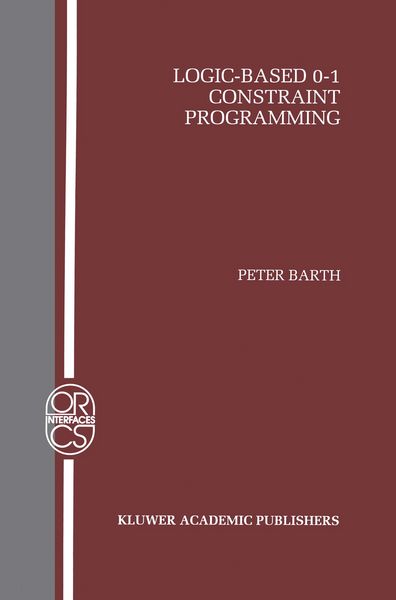
  • Produktbild: Logic-Based 0–1 Constraint Programming
  • Produktbild: Logic-Based 0–1 Constraint Programming
Band 5

Logic-Based 0–1 Constraint Programming

99,99 €

inkl. gesetzl. MwSt., Versandkostenfrei


Beschreibung

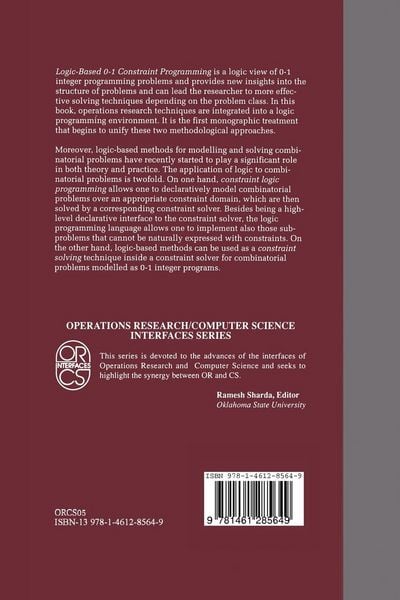
A logic view of 0-1 integer programming problems, providing new insights into the structure of problems that can lead the researcher to more effective solution techniques depending on the problem class. Operations research techniques are integrated into a logic programming environment. The first monographic...

Beschreibung

A logic view of 0-1 integer programming problems, providing new insights into the structure of problems that can lead the researcher to more effective solution techniques depending on the problem class. Operations research techniques are integrated into a logic programming environment. The first monographic treatment that begins to unify these two methodological approaches.
Logic-based methods for modelling and solving combinatorial problems have recently started to play a significant role in both theory and practice. The application of logic to combinatorial problems has a dual aspect. On one hand, constraint logic programming allows one to declaratively model combinatorial problems over an appropriate constraint domain, the problems then being solved by a corresponding constraint solver. Besides being a high-level declarative interface to the constraint solver, the logic programming language allows one also to implement those subproblems that cannot be naturally expressed with constraints. On the other hand, logic-based methods can be used as a constraint solving technique within a constraint solver for combinatorial problems modelled as 0-1 integer programs.

Produktdetails

Einband

Taschenbuch

Erscheinungsdatum

30.09.2011

Abbildungen

XIV, 254 p.

Verlag Springer Us

Produktdetails

Einband

Taschenbuch

Erscheinungsdatum

30.09.2011

Abbildungen

XIV, 254 p.

Verlag Springer Us
Seitenzahl

254

Maße (L/B/H)

23,5/15,5/1,5 cm

Gewicht

417 g

Auflage

Softcover reprint of the original 1st edition 1996

Sprache

Englisch

ISBN

978-1-4612-8564-9

Herstelleradresse

Springer-Verlag KG
Sachsenplatz 4-6
1201 Wien
AT

Email: ProductSafety@springernature.com

Noch keine Bewertungen vorhanden

Verfassen Sie die erste Bewertung zu diesem Artikel

Helfen Sie anderen Kundinnen und Kunden durch Ihre Meinung.

Kundinnen und Kunden meinen

Bewertungen (0)

  • Produktbild: Logic-Based 0–1 Constraint Programming
  • Produktbild: Logic-Based 0–1 Constraint Programming
  • 1 Introduction.- 1.1 CLP and Combinatorial Optimization.- 1.2 Logic-based Pseudo-Boolean Constraint Solving.- 2 Constraint Logic Programming.- 2.1 CLP by Example.- 2.2 Semantics.- 2.3 Constraint Solving.- 2.4 Local Consistency and CLP.- 2.5 Logic Programming with Pseudo-Boolean Constraints.- 2.6 Existing CLP-systems for combinatorial optimization.- 3 Pseudo-Boolean Constraints.- 3.1 Preliminaries.- 3.2 Previous Work.- 3.3 Generalized Resolution.- 4 A Logic Cut Based Constraint Solver.- 4.1 The Solved Form.- 4.2 Reaching the Solved Form.- 5 Pseudo-Boolean Unit Resolution.- 5.1 The Classical Davis-Putnam Procedure.- 5.2 Davis-Putnam for Linear Pseudo-Boolean Inequalities.- 5.3 Optimizing with Pseudo-Boolean Davis-Putnam.- 5.4 Implementation.- 5.5 Heuristics.- 5.6 Computational Results.- 5.7 Pseudo-Boolean Davis-Putnam for CLP.- 6 Logic Cuts and Enumeration.- 6.1 Valid Extended Clauses by Enumeration.- 6.2 A Pure Logic Cut Algorithm.- 6.3 Entailment and Logic Cuts.- 7 Linear Pseudo-Boolean Inequalities and Extended Clauses.- 7.1 Generating Valid Extended Clauses.- 7.2 Identifying Redundant Extended Clauses.- 7.3 Implementation.- 7.4 Symmetries.- 7.5 Detection of Fixed Literals.- 7.6 Constrained Simplification.- 7.7 Cut Generation for 0–1 Integer Programming.- 7.8 Implementing Resolution.- 8 Simplification.- 8.1 An Order for Extended Clauses.- 8.2 Simplifying Diagonal Sums.- 8.3 Simplifying Resolvents.- 8.4 Equations between Literals.- 9 Linearization.- 9.1 Previous Work.- 9.2 A Linearization Method.- 9.3 Deriving Lower Bounds.- 9.4 Further Improvements.- 10 Projection.- 10.1 Projection for Prime Extended Clauses.- 10.2 Projection for Extended Clauses.- 10.3 Improvements.- 11 Conclusion.- 11.1 Summary of Results.- 11.2 Related and Future Research.- References.