
KI-Beratung Beta

Gutscheinbedingungen

**Gültig bis 09.11.2026 auf tolino shine color (4016621130473), tolino vision color (4016621130183) und tolino vision color weiß (4016621131456) online auf thalia.at, in der Thalia App und in allen Thalia Buchhandlungen in Österreich. In den Buchhandlungen nur gültig auf lagernde Ware. Pro Einkauf einmal einlösbar. Nur gültig gegen Vorlage oder im Onlineshop hinterlegter Bonuscard. Infos zur Einlösung in der Buchhandlung sind auf der Bonuscard-Vorteilspreisseite zu finden. Click & Collect nur bei Onlinevorabzahlung möglich. Keine Einlösung bei Scan & Go-Bezahlung. Keine Barauszahlung. Nicht kombinierbar mit anderen Aktionen und Gutscheinen. Nicht gültig für Geschenkkarten, Versandkosten und Services. Nur solange der Vorrat reicht.

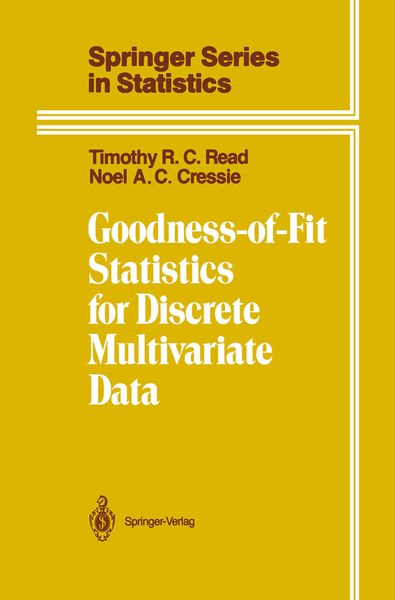
  • Produktbild: Goodness-of-Fit Statistics for Discrete Multivariate Data
  • Produktbild: Goodness-of-Fit Statistics for Discrete Multivariate Data

Goodness-of-Fit Statistics for Discrete Multivariate Data

49,99 €

inkl. gesetzl. MwSt., Versandkostenfrei


Beschreibung

Produktdetails

Einband

Taschenbuch

Erscheinungsdatum

14.10.2011

Abbildungen

XII, 212 p.

Verlag

Springer Us

Seitenzahl

212

Maße (L/B/H)

23,5/15,5/1,3 cm

Gewicht

353 g

Auflage

Softcover reprint of the original 1st ed. 1988

Sprache

Englisch

ISBN

978-1-4612-8931-9

Beschreibung

Produktdetails

Einband

Taschenbuch

Erscheinungsdatum

14.10.2011

Abbildungen

XII, 212 p.

Verlag

Springer Us

Seitenzahl

212

Maße (L/B/H)

23,5/15,5/1,3 cm

Gewicht

353 g

Auflage

Softcover reprint of the original 1st ed. 1988

Sprache

Englisch

ISBN

978-1-4612-8931-9

Herstelleradresse

Springer-Verlag KG
Sachsenplatz 4-6
1201 Wien
AT

Email: ProductSafety@springernature.com

Noch keine Bewertungen vorhanden

Verfassen Sie die erste Bewertung zu diesem Artikel

Helfen Sie anderen Kundinnen und Kunden durch Ihre Meinung.

Kundinnen und Kunden meinen

Bewertungen (0)

  • Produktbild: Goodness-of-Fit Statistics for Discrete Multivariate Data
  • Produktbild: Goodness-of-Fit Statistics for Discrete Multivariate Data
  • 1 Introduction to the Power-Divergence Statistic.- 1.1 A Unified Approach to Model Testing.- 1.2 The Power-Divergence Statistic.- 1.3 Outline of the Chapters.- 2 Defining and Testing Models: Concepts and Examples.- 2.1 Modeling Discrete Multivariate Data.- 2.2 Testing the Fit of a Model.- 2.3 An Example: Time Passage and Memory Recall.- 2.4 Applying the Power-Divergence Statistic.- 2.5 Power-Divergence Measures in Visual Perception.- 3 Modeling Cross-Classified Categorical Data.- 3.1 Association Models and Contingency Tables.- 3.2 Two-Dimensional Tables: Independence and Homogeneity.- 3.3 Loglinear Models for Two and Three Dimensions.- 3.4 Parameter Estimation Methods: Minimum Distance Estimation.- 3.5 Model Generation: A Characterization of the Loglinear, Linear, and Other Models through Minimum Distance Estimation.- 3.6 Model Selection and Testing Strategy for Loglinear Models.- 4 Testing the Models: Large-Sample Results.- 4.1 Significance Levels under the Classical (Fixed-Cells) Assumptions.- 4.2 Efficiency under the Classical (Fixed-Cells) Assumptions.- 4.3 Significance Levels and Efficiency under Sparseness Assumptions.- 4.4 A Summary Comparison of the Power-Divergence Family Members.- 4.5 Which Test Statistic?.- 5 Improving the Accuracy of Tests with Small Sample Size.- 5.1 Improved Accuracy through More Accurate Moments.- 5.2 A Second-Order Correction Term Applied Directly to the Asymptotic Distribution.- 5.3 Four Approximations to the Exact Significance Level: How Do They Compare?.- 5.4 Exact Power Comparisons.- 5.5 Which Test Statistic?.- 6 Comparing the Sensitivity of the Test Statistics.- 6.1 Relative Deviations between Observed and Expected Cell Frequencies.- 6.2 Minimum Magnitude of the Power-Divergence Test Statistic.- 6.3 Further Insights into the Accuracy of Large-Sample Approximations.- 6.4 Three Illustrations.- 6.5 Transforming for Closer Asymptotic Approximations in Contingency Tables with Some Small Expected Cell Frequencies.- 6.6 A Geometric Interpretation of the Power-Divergence Statistic.- 6.7 Which Test Statistic?.- 7 Links with Other Test Statistics and Measures of Divergence.- 7.1 Test Statistics Based on Quantiles and Spacings.- 7.2 A Continuous Analogue to the Discrete Test Statistic.- 7.3 Comparisons of Discrete and Continuous Test Statistics.- 7.4 Diversity and Divergence Measures from Information Theory.- 8 Future Directions.- 8.1 Hypothesis Testing and Parameter Estimation under Sparseness Assumptions.- 8.2 The Parameter ? as a Transformation.- 8.3 A Generalization of Akaike’s Information Criterion.- 8.4 The Power-Divergence Statistic as a Measure of Loss and a Criterion for General Parameter Estimation.- 8.5 Generalizing the Multinomial Distribution.- Historical Perspective: Pearson’s X2 and the Loglikelihood Ratio Statistic G2.- 1. Small-Sample Comparisons of X2 and G2 under the Classical (Fixed-Cells) Assumptions.- 2. Comparing X2 and G2 under Sparseness Assumptions.- 3. Efficiency Comparisons.- 4. Modified Assumptions and Their Impact.- Appendix: Proofs of Important Results.- A1. Some Results on Rao Second-Order Efficiency and Hodges-Lehmann Deficiency (Section 3.4).- A2. Characterization of the Generalized Minimum Power-Divergence Estimate (Section 3.5).- A3. Characterization of the Lancaster-Additive Model (Section 3.5).- A4. Proof of Results (i), (ii), and (iii) (Section 4.1).- A5. Statement of Birch’s Regularity Conditions and Proof that the Minimum Power-Divergence Estimator Is BAN (Section 4.1).- A6. Proof of Results (i*), (ii*), and (iii*) (Section 4.1).- A7. The Power-DivergenceGeneralization of the Chernoff-Lehmann Statistic: An Outline (Section 4.1).- A8. Derivation of the Asymptotic Noncentral Chi-Squared Distribution for the Power-Divergence Statistic under Local Alternative Models (Section 4.2).- A9. Derivation of the Mean and Variance of the Power-Divergence Statistic for ? > -1 under a Nonlocal Alternative Model (Section 4.2).- A10. Proof of the Asymptotic Normality of the Power-Divergence Statistic under Sparseness Assumptions (Section 4.3).- A12. Derivation of the Second-Order Terms for the Distribution Function of the Power-Divergence Statistic under the Classical (Fixed-Cells) Assumptions (Section 5.2).- A13. Derivation of the Minimum Asymptotic Value of the Power-Divergence Statistic (Section 6.2).- A14. Limiting Form of the Power-Divergence Statistic as the Parameter ? ? ± ? (Section 6.2).- Author Index.