
KI-Beratung Beta

Gutscheinbedingungen

**Gültig bis 18.11.2026 auf englischsprachige Klassiker (klassiker-32728) online auf thalia.at und in der Thalia App. Einzelne Artikel können ausgeschlossen sein. Ausgenommen sind preisgebundene Artikel & eBooks. Pro Einkauf einmal einlösbar. Click & Collect nur bei Onlinevorabzahlung möglich. Keine Barauszahlung. Nicht kombinierbar mit anderen Aktionen und Gutscheinen. Gutschein wird auf max. 500€ Bestellwert angerechnet. Nicht gültig für Geschenkkarten, Versandkosten und Services.

  • Produktbild: Fuzzy Modelling
  • Produktbild: Fuzzy Modelling
Band 7

Fuzzy Modelling Paradigms and Practice

198,99 €

inkl. gesetzl. MwSt., Versandkostenfrei


Beschreibung

Fuzzy Modelling: Paradigms and Practice provides an up-to-date and authoritative compendium of fuzzy models, identification algorithms and applications. Chapters in this book have been written by the leading scholars and researchers in their respective subject areas. Several of these chapters include...

Beschreibung

Fuzzy Modelling: Paradigms and Practice
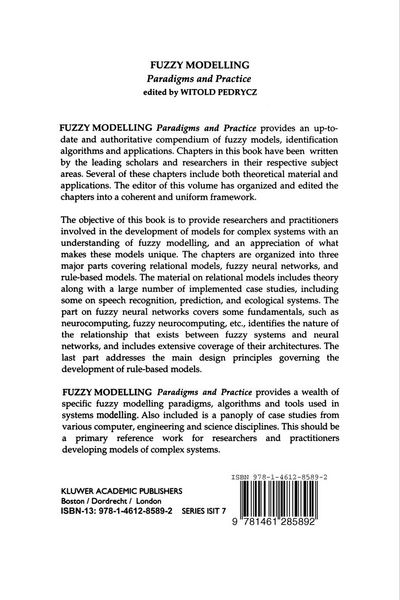
provides an up-to-date and authoritative compendium of fuzzy models, identification algorithms and applications. Chapters in this book have been written by the leading scholars and researchers in their respective subject areas. Several of these chapters include both theoretical material and applications. The editor of this volume has organized and edited the chapters into a coherent and uniform framework.
The objective of this book is to provide researchers and practitioners involved in the development of models for complex systems with an understanding of fuzzy modelling, and an appreciation of what makes these models unique. The chapters are organized into three major parts covering relational models, fuzzy neural networks and rule-based models. The material on relational models includes theory along with a large number of implemented case studies, including some on speech recognition, prediction, and ecological systems. The part on fuzzy neural networks covers some fundamentals, such as neurocomputing, fuzzy neurocomputing, etc., identifies the nature of the relationship that exists between fuzzy systems and neural networks, and includes extensive coverage of their architectures. The last part addresses the main design principles governing the development of rule-based models.
Fuzzy Modelling: Paradigms and Practice
provides a wealth of specific fuzzy modelling paradigms, algorithms and tools used in systems modelling. Also included is a panoply of case studies from various computer, engineering and science disciplines. This should be a primary reference work for researchers and practitioners developing models of complex systems.

Produktdetails

Einband

Taschenbuch

Erscheinungsdatum

26.09.2011

Abbildungen

XX, 394 p.

Herausgeber Witold Pedrycz

Produktdetails

Einband

Taschenbuch

Erscheinungsdatum

26.09.2011

Abbildungen

XX, 394 p.

Herausgeber Witold Pedrycz
Verlag Springer Us
Seitenzahl

394

Maße (L/B/H)

23,5/15,5/2,3 cm

Gewicht

633 g

Sprache

Englisch

ISBN

978-1-4612-8589-2

Herstelleradresse

Springer-Verlag GmbH
Tiergartenstr. 17
69121 Heidelberg
DE

Email: ProductSafety@springernature.com

Noch keine Bewertungen vorhanden

Verfassen Sie die erste Bewertung zu diesem Artikel

Helfen Sie anderen Kundinnen und Kunden durch Ihre Meinung.

Kundinnen und Kunden meinen

Bewertungen (0)

  • Produktbild: Fuzzy Modelling
  • Produktbild: Fuzzy Modelling
  • 1: Modelling with Fuzzy Sets.- 1.1. Fuzzy Models: Methodology, Design, Applications, and Challenges.- 2: Relational Models.- 2.1. Fundamentals of Fuzzy Relational Calculus.- 2.2. Max-Min Relational Networks.- 2.3. Relational Calculus in Designing Fuzzy Petri Networks.- 2.4. Prediction in Relational Models.- 2.5 Implementing A Fuzzy Relational Network For Phonetic Automatic Speech Recognition.- 2.6 Fuzzy Ecological Models.- 3: Fuzzy Neural Networks.- 3.1. Fuzzy Neural Networks: Capabilities.- 3.2. Development of Fuzzy Neural Networks.- 3.3. Designing Fuzzy Neural Networks Through Backpropagation.- 4: Rule-Based Modelling.- 4.1. Foundations of Rule-Based Computations in Fuzzy Models.- 4.2. Evolutionary Learning of Rules Competition and Cooperation.- 4.3 Logical Optimization of Rule-Based Models.- 4.4 Interpretation and Completion of Fuzzy Rules.- 4.5 Hyperellipsoidal Clustering.- 4.6. Fuzzy Rule-Based Models in Computer Vision.- 4.7. Forecasting in Rule-Based Systems.